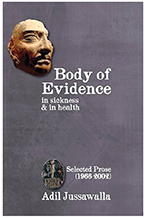
Body of Evidence in sickness & in health: Selected Prose (1966-2002) by Adil Jussawalla. Published in 2024 by Red River Story, an imprint of Red River, 157/1, Patparganj, New Delhi 110091. Pp: 135. Price: Rs 299.
We always associate Adil Jussawalla with poetry. After all, he has been honored with the Sahitya Akademi Award for his collection of poems Trying to Say Goodbye as well as being named the Poet Laureate at the Tata Literary Festival in 2021. But we tend to forget that he was the editor of several magazines, the book review editor for the Sunday edition of The Indian Express and The Times of India and contributed a fortnightly syndicated column for Yogi Aggarwal’s Associated News Features from 1991 to 2002.
Body of Evidence in sickness & in health is a thought provoking collection of articles, reviews and essays written over a period of 36 years. As the title suggests, the book covers his articles on the body and the mind and these sparkle with his inimitable wit and thoughtfulness on the subject, always perceptive, humorous and compassionate, occasionally scathing, written in perfectly balanced and colorful prose in his clear, limpid and concise style.
Adil Jussawalla: perfectly balanced prose
The articles have been grouped into three main sections — Physical, Intensive Cares, Occupying Our Minds and a single essay under the heading of Victory. The first article is "Hungry Children,” where Jussawalla reveals that in a recent photo-journalistic book published by Oxfam, the blurb contrasts the worlds of the privileged and the underprivileged children. The writer feels that the inner life of children suffering from deprivation does not exist and, if at all it does, it must be as desolate as the reality around them. But no attempt is made to present the inner life of these children. The photographs of English children whizzing through the playground or licking lollies are flat, repetitive and monotonous. Jussawalla seems to question whether we really conclude from these that privileged children have a better "inner life”?
In his essay entitled "Running Scared,” though he briefly speaks about the disadvantages of running, he does admit that when you are feeling low, running is one of the best solutions. There is a limit to reading, writing, writing about writing — all this is an excuse for inaction. "Words can and do corrupt when they eat out the heart of action.” A similar theme is repeated in "If I had a Hammer,” where he writes that it is not meditation and yoga that help us in difficult times. He is willing to admit the possibility of prayer as an antidote but recommends that the best way out of problems which depress us is to be occupied with "the force of physical work.”
Do faces reveal character? No, Jussawalla expounds in his essay "In Your Face.” He used two quotes from English playwright William Shakespeare’s Macbeth to justify his view: there is no possibility of finding the "‘mind’s construction in the face’” and Lady Macbeth’s advice to Macbeth to "‘look like the innocent flower but be the serpent under it.” It is impossible to judge a character from a person’s face. Some people feel that the French musician, Boulez, looks like a football player. Jussawalla feels that he looks like a ruffian. If he saw a photo of Zubin Mehta he would never say he was one of the world’s most prestigious conductors; he would have thought him to be "the manager of a five-star hotel. If man is "constellation” — a group of stars forming a definite pattern — his face is "lodestar” — a star used to guide ships, like the North Star. But most often it misguides. Maybe the solution lies with the Belgian painter René Magritte who painted portraits without faces or the cover of Kazuo Ishiguro’s novel The Unconsoled which depicts a man without a face.
In the second section entitled Intensive Cares Jussawalla writes about our innate compulsion to read books on health and medicine. What he says is quite true. In an essay entitled "Illness as Compulsive Reading” he perceptually points out that it is a human tendency to know more about our illnesses despite the doctor’s diagnosis and feel that "our health is in our hands.” We all want to know about the state of our health especially when it is slipping away. These ‘"get-well, keep-well’” books, as he calls them, have a wide market. Such books as well as health magazines play on our anxiety about the future and the desire to lead a healthy lifestyle to enable us to live "to a ripe old age.” Though he passes snide comments about such books, his impartiality is evident when he praises some books on health, particularly a booklet entitled War on Disease. The booklet deals with basic human health issues like sanitation and the necessity of community toilets; another section tackles the problem of leprosy. He praises this type of anecdotal writing as it conveys to the reader "in clear, simple language, how certain diseases are caused, how and why they spread and how they can be prevented.”
In "Sex in a Compass Box” Jussawalla comes down heavily on poverty and child prostitution. He starts with the story of a 13-year-old girl who stabs the girl sitting next to her with a compass and is expelled from school. Her behavior could be the result of a chemical imbalance, a brain tumor or some trauma suffered during her childhood, probably sexual abuse. Jussawalla feels that in six months she will enter child prostitution. He finds it deplorable that even 50 years after Independence (the piece was written in 1996), "we’ve failed to provide a decent education for society’s most vulnerable sections — children.” Instead of debating on underage sex, infantile sexuality or the age of consent, Jussawalla rightly points out that "any sexual act which is violent, brutal, sadistic and which seeks to destroy another person’s identity should be regarded as a crime.”
"The Information Trap” is the first article in the section Occupying Our Minds. We live in the age of information thanks to the personal computer and satellite hook-ups where individuals in different parts of the world can take part in a panel discussion. But Jussawalla asks the pertinent question: how does one know we are being told the truth and where would one go to verify the facts? Most of us would take the information provided on the media on trust as "for an age of information to be effective it’s imperative that we take all information on trust.” But just as computers have viruses, human beings are born with a very important one, termed "doubt.” Jussawalla feels as the sources of information grow, so do our doubts about them. The problem, as he sees it, is how to assess the correct facts to see the true picture.
In "I Think Therefore I am Not” Jussawalla regrets that "to think, in Bombay’s present climate of culture, is to be marginalized, made invisible.” Where have all the discussions on politics, literature and philosophy disappeared? he asks. He wryly remarks that perhaps air conditioners have prevented "ideas being brought out in the open.” He expresses sorrow that philosophy has disappeared from our lives and the attitude all over the world seems to be anti-intellectual and anti-thought. He concludes with the bitter remark that this is perhaps one of the reasons for the mess we are in today.
His last section, Victory, is enigmatic. There is one sole essay, "What Made (tennis star) Enqvist Sick?” which relates to Jussawalla’s visit to interview a fictional character, Dr C. V. Ramakrishnan, "our best known non-resident Indian computer scientist.” The family seems totally dysfunctional. Ramakrishnan seems to be addicted to the bottle even though it is breakfast time; his wife is called Croccodilly, the daughter Forcefed and the son, Feelgood. The newspaper headline for the day reads Thomas Enqvist has to abandon his tennis match as he "bows to nausea.” The chaos in the household is exacerbated by Forcefed thinking that nausea is the name of a tennis player. The section carries an epigraph (inscription) from cosmologist Martin Rees "…and ultimately, we ourselves are stardust.” This seems to be a rather grim ending to a brilliant and effervescent collection of essays. Is Jussawalla playing a joke on us? It’s hard to tell.
FIRDAUS GANDAVIA
Gandavia holds a doctorate in English literature and is a retired chartered accountant. He is a compulsive reader of fiction.