Novy Kapadia has made a mark in his twin
careers as a sports journalist and an academic
Feroza C. Jassawala
"Sports in general and football in particular have been a passionate and integral focus in my life,” states 67-year-old Novy Kapadia, football guru, sports commentator, analyst, author and Asia’s leading football expert. He was slated to receive the Pushpen Sarkar Memorial Trophy of the East Bengal Football Club at the hands of Mamata Banerjee, chief minister of West Bengal, at
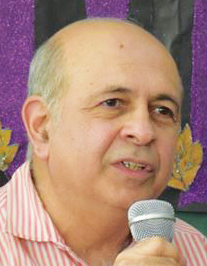
Netaji Indoor Stadium in Calcutta on August 1, 2019 to mark the commencement of its centenary year celebrations. The Club will also honor several well-known players like former internationals Tulsidas Balaram, Bhaskar Ganguly, Manoranjan Bhattacharya and Baichung Bhutia and their Nigerian superstar striker of the 1980s Chima Okorie.
Kapadia’s award recognized his outstanding contribution in journalism, commentary on TV and radio, expert comments, articles and his book Barefoot to Boots — The Many Lives of Indian Football, the only work dealing with the legacy of Indian football from 1888-2017. Eight months ago, on December 17, 2018, the Delhi Minorities Commission honored him as a person of substance for his contributions as a sports journalist and author.
"Working 12 to 14 hours a day — as an academic during the mornings and early afternoon till about 3 p.m. and journalist and commentator later in the day left me no time for socializing,” smiles the soft-spoken Kapadia. "Maybe this is the reason I remained unmarried as I devoted my life and time in my youth to enjoying my sport — playing, commentating and writing on it,” he admits.
Kapadia has commentated at and covered several reputed international sports events including the World Cup in 1982 in Spain, Italy (1990), USA (1994), France (1998), Korea-Japan (2002), Germany (2006), South Africa (2010), Brazil (2014) and Russia (2018), all the European Championships from 1992 onward, Asian Games from 1982-2018, Olympic Games of 2000, 2008 and 2012, Commonwealth Games from 1998-2018, World Cup Hockey Tournaments, SAF Games and the Champions Trophy Hockey tournaments. He is also a studio expert on the popular Kick-off and Football Extraa shows on the Sony Ten network in India.
At present, Kapadia is a football and sports columnist with The Asian Age, The Week, Deccan Chronicle, The Sportstar and consultant to the Limca Book of Records. He was a member of the monitoring committee of the Union Ministry for Sports and Youth Affairs in 2014 and 2018 which selects candidates for the Dronacharya and Dhyan Chand awards for National Sports Coaches.
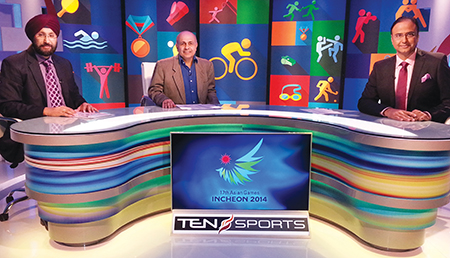
Novy Kapadia (top) and above (center) with hockey player Jasbir Singh (l) and
anchor Charu Sharma during Asian Games 2014
Kapadia has written three books on football. Barefoot to Boots — The Many Lives of Indian Football, published by Penguin, was released by the president of Fédération Internationale de Football Association (FIFA), Gianni Infantino in Calcutta during the U-17 World Cup in October 2017. His other book, The Football Fanatic’s Essential Guide, A History of the World Cup 1930-2014 was reprinted with additional chapters as The Football Fanatic’s Essential Guide to the 2018 World Cup. His contributions to Enduring Legacy — Parsis of the 20th century —Volume 4 —Sports and Cricket (2006); Sporting Legacies in India: Mohun Bagan’s 1911 Football Victory vs Olympic Hockey Medals (2015) are considered classics in the field of sports literature. Some of his scholarly articles on football have been published abroad, the most renowned being "Triumphs and Disasters: The Story of Indian Football, 1889-2000” published in Soccer In South Asia Empire, Nation, Diaspora, edited by Dr Paul Dimeo and Dr James Mills, Frank Cass, London, September 2001.
"Writing books on literature was a demand of my teaching profession,” explains Kapadia. Besides publishing scholarly articles he wrote and edited books on Parsi literature. "Parsi poets like Keki Daruwalla, novelists like Bapsi Sidhwa, Dina Mehta, Nergis Dalal, Firdaus Kanga and Rohinton Mistry have greatly influenced me to specialize in Parsi literature,” he said.
Kapadia’s significant works in this category are Novels of Bapsi Sidhwa (1996), The Parsis Madyan to Sanjan — An Appraisal of Ethnic Anxieties reflected in Literature (1997), Bapsi Sidhwa’s Ice-Candy-Man: A Workbook (2000), Parsi Fiction Volumes 1 and 2 (2001) and a Foreword in Parsi Community and the Challenges of Modernity, a Reading of Rohinton Mistry’s Fiction by Vibhuti Wadhawan (2014). His article "Love and Politics” on Dina Mehta’s And Some Take a Lover was published in a Sahitya Kala Akademi publication Parsi Contribution to Indian Literature edited by Dr Coomi Vevaina of Bombay University and released in February 2019.
He has also written over 36 research papers on eminent Parsi novelists like Sidhwa, Mistry, Mehta, Dalal and Boman Desai and on renowned Indian authors like Salman Rushdie, Amitav Ghosh and Anita Desai, which have been published in various journals.
Interest in Parsi literature led to philosophic questions about the Zoroastrian religion. Kapadia is very concerned about declining numbers within the community. He feels that low birth rate and interfaith marriages are preventing growth amongst the Parsis. He feels it is necessary to shun orthodoxy and adopt a liberal attitude to interfaith marriages. "A conciliatory approach has now become a historical necessity. Acceptance of children of mixed marriage couples and openness on the adoption issue are changes which the community must embrace soon or there is a danger of extinction,” he emphasizes.
He also commends the Delhi Parsi Anjuman (DPA) for being liberal and progressive in allowing non-Parsi spouses of mixed marriages to become co-members of the Anjuman and permitting non-Parsis to live in the Parsi dharamshala there.
The erudite scholar favors a liberal attitude towards religious beliefs as we live in a multicultural society. "There is no need to be rigid. Young children are mostly influenced by their mothers and so they will adopt her religion by choice,” he says. He feels the community is declining because of rigid beliefs, especially when the children of a Parsi girl who marries outside the community are not accepted as Parsis.
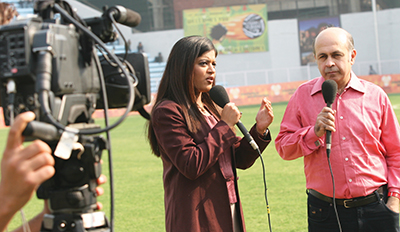
Kapadia (r) being interviewed by NDTV during the 2006 Durand Cup
Kapadia finds the Zoroastrian religion fascinating, especially the idea of choice between good and evil. "According to Zoroastrianism the whole universe is dominated by two primal forces, good and evil and the task of human beings is to choose between them. Good is represented by Ahura Mazda, the lord of light; evil is represented by Angra Mainyu, the hostile spirit. The conflict will continue till evil is routed.” Hence the idea of charity, positive thinking and ethical philanthropy for which Parsis are famous stems from this choice.
Born in Delhi on April 2, 1952 to the late Soona and Minoo Kapadia, Novy’s early life was spent in the comfortable environs of a joint family in Chabigunj near Kashmere Gate, Old Delhi. The area had vast open fields where the young student first began playing football with the local boys. Novy schooled at the prestigious St Colomba’s School and completed his Bachelor of Arts with English Honors in 1973, masters in English in 1975 and MPhil in literature thereafter from St Stephen’s College, Delhi.
His passion for football started more by accident than design, a result of spending his growing years in Old Delhi. In these days when cricket reigns supreme it is difficult to imagine the grip that football had on people in the Walled City, which was a hub of the sport in the 1950s and 60s. Each mohalla (locality)supported a football club in the local league; footballers were encouraged, admired and nurtured. "There was an abundance of open space in Old Delhi near Rajghat, the ramparts of Red Fort, the Indian Express building where people played football and this is how I became interested in the game, playing with friends and watching players. It turned into a lifelong passion,” explains the affable Novy of his early career.
Bengalis were the biggest patrons of football in India and many Bengali families lived in the Mori Gate and Kashmere Gate areas. They had a club house in Kashmere Gate called the Bengal Association [which was the local "adda (hangout”)] and above all they had a football team, the Young Bengal Association (YBA), which played in the annual Delhi Football Association League. As a child going for walks with his mother, Novy was fascinated seeing these boys practice at the erstwhile St Stephen’s College grounds. When in college he fulfilled his ambition, playing for YBA in the local league. He even became their captain for the 1974-75 season.
A promising footballer with speed and skill, Novy’s career began with Union Football Club when, as a precocious 14-year-old he scored his first league goal in 1967 and again at the age of 15. He later played for President’s Estate and YBA. He was also captain of the St Stephen’s College Football team and played for Delhi XI and the Delhi University teams.
In 1971 Novy launched his own club, Ashoka Football Club and began coaching young players for the Delhi League. The Club was based in New Rajinder Nagar where the family had shifted in 1969. "It was initially a colony based club but gradually young players from all over West Delhi joined, earning it a reputation as a nursery for developing young talent,” states Novy. He also coached the Delhi Sub Junior Football Team in 1984-85.
On August 28, 1977, Novy joined the Sri Guru Tegh Bahadur (SGTB) Khalsa College as lecturer in English, where he taught for 40 years. He retired in April 2017 after a distinguished career as associate professor and convener of the department of English. While doing research for his MPhil degree he became interested in Parsi literature and during his academic career wrote and edited several books on this subject.
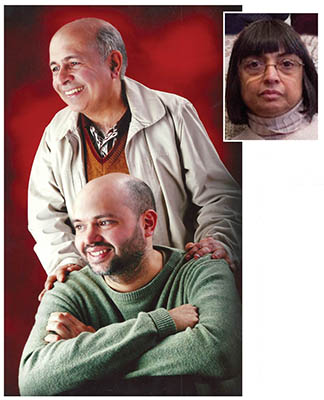
Kapadia (standing) with nephew Jonathan Page; inset: sister Bunny Page
Novy’s outstanding rapport with students was noticed by the authorities and he was assigned several university and
college administrative duties: deputy proctor, University of Delhi from 2003-2010; member of the apex committee of Delhi University for prevention of sexual harassment from 2006-2009; councilor for admissions to Delhi University 2003-2016 and member of the University’s Central Placement Cell 2008-2017. He was also member of the Sports Board of Delhi University from 2010 and of the sports committee of his College for nearly 40 years.
From 1980 he began to dabble in journalism, his understanding of football and fluency in English making him a much sought after freelance journalist. His long relationship with the Calcutta based Anandabazar Patrika (ABP) Group started accidentally. In 1980 he was in Calcutta as a commentator for the Federation Cup football tournament. After the semifinal match between East Bengal and Punjab Police, Novy went to the ground to speak to Manjit Singh, former captain of India, whom he knew personally and had played against in University matches. Ajay Kumar, deputy editor of Sportsworld magazine of the ABP Group, noticed this interaction. He traced Novy to the hotel where he was staying and invited him to the ABP office at Prafulla Sarkar Street. Kumar was also from St Stephen’s College and aware of Novy’s passion for football. He urged Novy to write a profile on Singh, focusing on the conversation they had had at the Eden Gardens Stadium. Thus was Novy’s successful career as a sports journalist launched. Later, when the ABP group launched The Telegraph, Kumar and the editor M. J. Akbar asked Novy to work as a stringer from Delhi in July 1982.
For the next 23 years Novy regularly wrote articles for The Telegraph, Business Standard and Sportsworld (edited by the late Nawab of Pataudi). He was the only Parsi journalist in Delhi at the time and the DPA honored him in 1986 when he won the Wills Award for Excellence in Sports Journalism for his article "The Other Side of the Medal,” which focused on the role of cutting edge technology in preparing Olympic champions. This article appeared in both Business Standard and The Telegraph.
From 1982 onward Novy worked as both, a lecturer at SGTB Khalsa College, University of Delhi and in the evenings as a sports journalist. In 1983 he became editor of the Durrand Annual, India’s only statistical football journal.
His flair for commentary was evident during the 1982 Asian Games in Delhi. Novy was a regular football and hockey commentator on All India Radio (AIR). In the summer of 1982 he trained at the National Institute of Sports, Patiala on the background and rules of several Olympic sports. Trial commentaries were also held there and this workshop added to his repertoire and reputation.
With the advent of satellite television in India in the 1990s, Novy became a regular TV commentator with Star Sports and ESPN, mainly on football. He also continued to work for Doordarshan and AIR. He soon became a sought after bi-lingual (Hindi and English) studio expert on sports shows of NDTV, CNN-IBN (now CNN-News 18), Headlines Today (now India Today TV), Zee News, Zee Sports, Lok Sabha TV and several other channels.
As an avid reader of autobiographies, history, sports and fiction, the author reveals another hobby. "From my young days, I have read 10 to 12 newspapers daily. Earlier I used to travel to the British Council at least once a week, to read the British newspapers but now I read them on my computer,” he adds.
The energetic footballer shows no signs of slowing down. "My future plans are to do commentary in English and Hindi on TV channels, football shows on TV, help chronicle the history of Parsis in North India for a book being brought out by the DPA and give lectures and attend seminars on sports, literature and journalism.” He has always lived life to the fullest, with self-discipline and value for time. His journalistic experiences have taught him how to adhere to deadlines.