Poet Adil Jussawalla’s vision of Bombay, though both
sinister and ominous, carries hope for a brighter future
Firdaus Gandavia
"Living in a port city, one is always aware of the sea, the boats and the ships and childhood impressions do survive a long time. I sometimes feel that I am done with poems of the sea and I have written them out of my system,” says Adil Jussawalla (pictured) on the publication of Shorelines, a new collection of poems. But that said, has he done with the sea poems forever? Rather unlikely. Some of the poems in this collection were published in 2015. They have an organic link with those he composed for his first collection Land’s End (1962), many of which he wrote as a teenager. Now, nearing 80, he returns to the sea. "Certain subjects do come back. I don’t know why.”
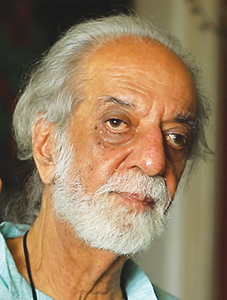 Jussawalla is troubled by the fact that human beings face continual displacement, coupled with a sense of impermanence. "Hardly has one settled down than one is unsettled again.” He adds, "We’re all castaways here;” there is no permanent or long-lasting resting place — all seems to suggest evanescence and a sense of the temporary.
His concern for Bombay and its future is a frequent theme in his poems, not just the Bombay of today as seen in Castaway City, which once could boast of being a "great hub,” and has ceased to exist. The images which assault our senses are grim and fearful: "dud robots, pouches of spoiled powder… coil wire, crewless wrecks on our shorelines.” Jussawalla says, "The two poems, Shorelines and Castaway City describe different scenarios of Bombay separated by time. The first one, with its shanties is more here and now. The second is the site of a civil war where the "last troops left for the hills” and "nothing lifts off our launchpads.” Says Jussawalla, "We hope this is decades away, though even today I believe the country has several derelict airports which are non-functional and nothing lifts off the launch pads.”
Jussawalla affirms, "I am not merely referring to Bombay but to other port cities as well. So many ports have disappeared. Ports which were once active are no longer active. They are also temporary, evanescent.” In A Message from the Harbour Master, the captain of the ship is peremptorily told to "Get lost, turn around,” and informed that he should have been told that the port no longer exists. The possible one-time port is now merely a chimera or an illusion.
The poet’s vision of Bombay is sinister and ominous. In Patches of Blue Tarpaulin, after the monsoon, the tarpaulin tends to "parch” and expose "the bones of the roofs.” But what protection, Jussawalla seems to be asking, can they provide the ordinary man as "black clouds” — not necessarily restricted to the monsoons — break:
"on a broken city and there’s nowhere we see to hide,
Nowhere we see, but to keep running for shelter.”
In An Expat’s Letter Home, Bombay was once a glorious city "of glass and gold… its monuments illumined” but, even then, it had the seeds of its destruction as the pier was rotting, and trusted and reliable friends were criminals, whose victims were "kicked aside,/crippled, shunned, forgotten.”
The concern for the city is once again present in an earlier poem. In 2017, Jussawalla published a single five-page poem, Gulestan. "After the attack on Bombay in 2008, things never seemed the same to me and to many of its citizens… It was my way of hitting back, an attempt to survive,” he says in a "Note” to the poem.
Gulestan is the Persian word for rose garden. Saadi Shirazi’s Gulistan, written in 1258, is a collection of poems and stories and is widely quoted as a fount of wisdom. Bombay, like the three ancient cities Jussawalla mentions in the poem are doomed for destruction: Shiraz, is no longer the leading center for the arts, literature, poets (like Hafiz and Saadi), gardens and wine; Tabriz, a city which was invaded and destroyed many times; and Babylon — a center and symbol of great civilization, of multiple languages and religions, a symbol of glory, but more importantly of vanity – which was annihilated in 689 BC.
The rose garden is destroyed and ceases to exist. Everywhere one sees destruction by terrorists and violence. Bombay, like the garden, is littered with "a severed hand,/a bleeding foot,/a small jaw” the last suggesting that children have not escaped the violence which has been perpetrated by assassins "entering paradise.” There is so much violence, hatred and rage that one wonders if the garden can ever be "leached of its poison.”
The poem ends with a fervent prayer as "Belief, the one word I lack.” It is possibly belief in God which will make "a garrisoned city breathe.” The poem ends with the hope of a way out of the "baffling darkness.” The protagonist recites the 101 names of Ahura Mazda: "Yazad, Harvesp-tavan, Harvesp-agah, Harvesp-khuda…” looking forward to a brighter future both for the individual as well as the city.