At the turn of this century, the canopied forest at Doongerwadi was bereft of vultures. The species Gyps Bengalensis or the white-rumped vulture became extinct in Western India. Diclofenac, a popular anti-inflammatory drug used by doctors and vets for renal disorders and rheumatoid arthritis amongst other illnesses, was the chief culprit. Vultures feeding on cattle carcasses laden with diclofenac dropped like confetti to the ground. The Parsee Voice, the newsletter of the ultra-orthodox, urged Parsis to spurn the lifesaving diclofenac as it was fatal for vultures.
In the early 1970s, when the vultures were not yet all gone, an Ahmedabad Parsi called Dara Cama had circulated a photo album of identifiable bodies in varying states of decay months after they had been consigned to the dakhmas. As a teenager, this columnist recollects hastily browsing through this album on the desk of his journalist father. A few years later, two Bombay Parsi Punchayet (BPP) trustees, Shiavax Vakil, a noted solicitor, and Dr Aspi Golwalla, an eminent cardiologist, entered the dakhma to examine firsthand the state of affairs. Only nassessalars can enter, said the enraged orthodox. "Aay kai bawa no bagicho chhè su (Is this your father’s garden)?” asked a high priest at one of those public meetings at Dhobi Talao where all resolutions are always passed unanimously. Receiving anonymous threats to throw acid on his face, he resigned midterm to avoid further unpleasantness, on condition that the industrialist Jamshed Guzder be elected in his place.
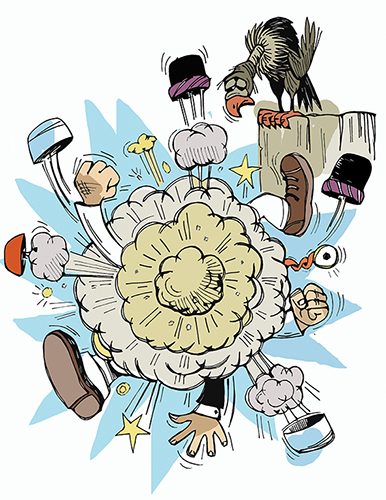
Illustration by Farzana Cooper
When the new millennium dawned, the situation became more grim. The stench from the dakhmas was noticeable and disposal took unacceptably long. However, the environs of the 55 acres of verdant virgin forest land in the midst of a suffocating metropolis were soothing to those who had lost their loved ones. Perhaps there was no better place from where to exit to the far beyond. Even the liberals conceded that the solution of installing an electric crematorium at the Towers of Silence itself was too radical; its time had not yet come. Instead a bungli could be earmarked for funerary prayers of those who wished to be cremated at a municipal crematorium.
An influential, elite group of doctors, lawyers, businessmen and professionals constituted themselves into an association rather cumbersomely called DDD-AG or Disposal of the Dead with Dignity-Action Group. The orthodox alleged that DDD stood for din dushmano dhaglabandh (plenty of enemies of the faith). Many thought that the association stood for supporting euthanasia.
DDD started pressurizing the BPP trustees to act. And lo and behold! for once, they actually did. On November 6, 2001, the BPP trustees by a majority of six to one a historic resolution stating that the use of the Doongerwadi including the bunglis be permitted to every member of the Parsi community professing the Zoroastrian religion and the performing of the four days religious rites and ceremonies at the Doongerwadi complex whether or not the dakhmenashini system for the disposal of the dead was availed of or not.
In a separate bungli earmarked for those opting to be cremated, the funeral prayers would be recited by the priests and thereafter the body would be transported to a crematorium. Sacrilege! Irreligious! Heresy! Violation of the fundamental tenets of the religion! Prayers cannot be recited for those whose bodies are not consigned to the dakhmas, said the orthodox.
The first decade of this century began on a favorable note for the liberals. Dinshaw Tamboly, enfant terrible for the orthodox, as BPP trustee, spearheaded the resolution. Chairman Minoo Shroff, who the orthodox alleged did not wear a sudreh-kusti underneath his immaculately suited and booted self, was undoubtedly a liberal. Maneck Engineer, though not a liberal, toed the line. The three CER (Committee for Electoral Rights) trustees and close friends — Silloo Kavarana, Dadi Engineer and Dinshaw Mehta — were certainly not orthodox; nor was the mercurial municipal corporator, Rustom Tirandaz. Hence, somewhat miraculously, Tamboly pulled out a rabbit, and the resolution was passed.
This writer, then a columnist in the Mumbai Samachar (Parsi Taari Aarsi) rather flippantly christened the new bungli as "Cremate ni bungli.” A college friend and now an eminent senior counsel would always ask mockingly: "Which is your favorite bungli — Albless or Hodiwalla?” For the reformists, it was cremate ni bungli.
DDD-AG members were in ninth heaven at having scored a major victory. The optimal had been achieved. Not so fast, said the high priests. This is a conspiracy of the rich and powerful, they claimed, aided by the Mumbai Samachar and Parsiana, as also by the traditional Jam-E-Jamshed which, then edited by Rusi Dhondy (a tale by itself), in a volte face supported the cremate ni bungli. The dice was loaded this time against the orthodox.
Undaunted, the traditionalists organized a public meeting at Dhobi Talao in a hall packed to capacity where the high priests relentlessly attacked the BPP resolution as irreligious. They had smelled blood. Seated in the front row were four BPP trustees — Kavarana, Mehta, Engineer and Tirandaz. Tirandaz told the BPP board that he had had a dream in which he saw a distinguished bearded horseman on a white stallion who castigated him for passing the resolution. "Ai cremate ni bungli aapi né tamé bo khottu karonch (by permitting this cremate ni bungli you are committing a great wrong)!” said the horseman. Kavarana, Engineer and Mehta fell in line with Tirandaz’s premonition. The BPP trustees, by a majority of five to one, Tamboly dissenting, rescinded the resolution.
Later, former BPP trustee Jamsheed Kanga, community activist Homi Khusrokhan and Golwalla filed a suit in the Bombay High Court challenging the rescinding of the resolution, in what came to be known as the Cremate ni Bungli case. Subsequently, this case was inexplicably withdrawn as part of a package deal settlement with the trustees in the matter concerning the renegade priests.
The furious liberals retaliated by raising the stakes. Either build a crematorium or close down Doongerwadi as it was becoming a health hazard. The Bombay Municipal Corporation (BMC) sent senior officials to visit the Towers. Mehta was now in charge. The BMC reported that not only was there no stench or health hazard; these pristine forest lands were home to rare exotic species of birds, insects and butterflies and ancient trees not even to be found in the Western Ghats. The environs of the Doongerwadi are picture perfect. During the health inspection, a gorgeous peacock danced and a peahen proudly strutted. Even Mehta could not have orchestrated this.
And then came a scholar, Dr Homi Dhalla, who suggested the installation of solar panels adjacent to the dakhmas. At 110 º, the heat of the sun was directed, through giant mirrors, upon the corpses, which dehydrated within a week (though Golwalla opined that the internal organs did not decompose or dehydrate). At 110 º, wisps of smoke emanate from a body. At 140 º, the body ignites. During the monsoon, however, the solar panels were ineffective and Dhalla proposed to construct a glass dome over one of the unused dakhmas with protective clothing being provided for those who entered it. This proposal never saw the light of day.
"Backdoor crematorium!” said Dastur (Dr) Firoze Kotwal, the scholarly high priest. Indeed, said the somewhat placated DDD-AG. Tamboly had had enough with the BPP, his colleague trustees and their nocturnal horseman. A few years later he, along with Kanga and Khusrokhan, built the Worli Prayer Hall for those who wished to be cremated. The Cremate ni Bungli became a reality at last.
Berjis Desai, lawyer and author of Oh! Those Parsis, and recently Towers of Silence, is a chronicler of the community.