Individuals who have made an impact on society enthused
the gathering to make informed choices
Parinaz M. Gandhi
"The big concern for India is not economic but social cohesion,” remarked Dr Naushad Forbes, co-chairman of Forbes Marshall, India’s leading steam engineering and control instrumentation firm, in his keynote address on the third day of the global conclave of the World Zarathushti Chamber of Commerce (WZCC) in Poona from January 4 to 7, 2024. While confident that "India will rank among the 10 best performing economies in the next 30 years,” he was uncertain about the rate of growth: "Will it be six to seven percent that is feasible, or eight to 10% that it is capable of?”
As an individual who takes great comfort in the diversity in the country, Forbes who is also chairman of Ananta Aspen Centre and the Centre for Technology, Innovation and Economic Research wondered, "Would the impulse towards radical majority cohesion lead to minority isolation? Can we fulfill our potential if we have 200 million disaffected citizens? Parsis are too insignificant to matter but if Muslims (estimated to number over 200 million) are disaffected it is of much greater concern.”
The progress of a country depends on its people and what they do. "Belief in individual rights is much more important than collective rights where some strong leader decides ‘this is our common destiny,’” remarked Forbes. He fully supported English philosopher John Stuart Mill’s "simple principle” that the State should only intervene when the acts of an individual could harm someone else.
He enumerated the many advantages of liberal democracies that have made the world peaceful and less violent. In such an environment businesses flourish for they can attract talent, trade with any one, enjoy the benefits of a level playing field, be governed by international rules. "Equal treatment for all is a very good principle.”
The nation’s multilateral policies should extend to like-minded countries like Japan, Germany, South Korea, Indonesia, Australia, New Zealand, he believed. While sanguine that India will not choose to partner with China, he was not certain whether it would want to be allies with the US. "What should we look for in individual countries?” he asked before offering a solution: "Those with a varied geography, where movement of people is possible; committed to a rules-based international order; observing the principles of liberal democracy where there are free and fair elections and civil liberties are assured.”
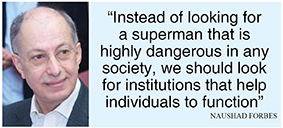
In 2024, an estimated four billion people will vote in political elections globally of whom one-third will be from India, mentioned Forbes. For optimum results, he recommended voters should look for "the best package deal on offer. We are not looking for perfection but a government that offers the best balance; where the rule of law applies equally; there is no suppression of individual rights; power is diffused/decentralized for individuals to thrive… Instead of looking for a superman that is highly dangerous in any society, we should look for institutions that help individuals to function. Our first Prime Minister was a great believer in institutions — of education, science, law.” Forbes was disappointed that in India "we have been terribly served by a fragmented opposition that has failed to provide a viable alternative.”
When asked for his recommendations on an ideal business venture, Forbes stated that it should be one that does not depend on the government for its success, ruling out those in the infrastructure or power sectors. He also believed that B to B businesses (where there is exchange of products, services or information between two business houses) are more stable than B to C businesses (between a business and a consumer). Rather than get carried away with technology and artificial intelligence, he recommended, "Think of it as a tool to improve efficiency; not as a big thing that will transform the world.” The people who work for you are "your greatest asset. To attract the best people, try to be much more inclusive and diverse when hiring; at least half should be women,” he advised.
Integrity and trust being the key principles of a Zoroastrian business, Forbes considered it "a huge strength. A high trust society is much more efficient economically than a low trust society that needs contracts and lawyers.”
"The voice of change”
"Green is the new gold,” summed up Dr Rashneh Pardiwala, founder and director of the Centre for Environmental Research and Education (CERE) when speaking on the second day of the WZCC conclave. Working to promote environmental sustainability through corporate partnerships, government collaborations and formal education, she added, "It makes business sense going green.” When Environmental Social Governance (ESG) is implemented, businesses can access new customers, markets, investors besides improving operational efficiency and brand value. "If there is no ESG in place, banks are very diffident to finance companies,” she warned.
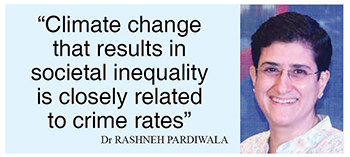
"Business leaders need to start talking of the triple bottom line” — profits, people and the planet. "This planet is ill. It requires our help. We can’t wish it away,” she said, referring to distress signals throughout the world: drought in Europe, wildfires in Australia, hurricanes in Florida, all contributing to massive death tolls. "We have climate refugees. This is a humanitarian crisis.” Certain communities who don’t have access to basics try to move across borders leading to a lot of pressure on the local system. Further, climate change that results in societal inequality is closely related to crime rates.”
Rainwater harvesting and urban afforestation would result in protecting biodiversity and water resources, she is convinced. Nonavailability of fresh water will be a major crisis in every country, she cautioned. In the last two decades, CERE has planted 2,84,500 trees in 26 cities in India, including over 5,000 trees last year at the Doongerwadi in Udvada. "I wish all our community lands were green. For sequestering (reducing) carbon footprint, we need to create an ecosystem by planting trees. Our religion is steeped in the environment. If we create models, other communities will emulate us. We have to walk the talk. The ground water levels have dropped by over 120 ft in India. Are our agiary open lands/wells being optimally utilized?” she enquired.
Looking forward to the day when every Zoroastrian business follows environmental norms, she spoke of the advantages of making a transition to a circular economy (a model of production and consumption which involves sharing, leasing, reusing, repairing, refurbishing and recycling existing materials). Investing in renewable energy, promoting energy conservation and efficiency are some of the ways to map and cap carbon footprints, she suggested. "Our survival depends on our natural resources. Even stock markets follow climatic events. We have rise in prices because of climate change,” she reminded.
"In this country we are blessed with renewable solar energy,” she said citing examples of the Tata Memorial Centre that has installed solar panels on its roof with CSR (corporate social responsibility) funds and all the company owned HDFC buildings that run on solar energy. When using solar energy you can "quantify how much carbon you save… You can’t manage what you can’t measure,” she has learnt. "All our patterns are cradle to grave; we need cradle to cradle where solar panels should be manufactured in solar factories run by solar panels,” she urged. Electric vehicles she considered a stop gap solution and not a long-term one.
Absence of supporting regulations and policies, lack of expertise and awareness, budgetary constraints, inconsistent, poor quality data, lack of transparency, and greenwashing (making an activity appear more environmentally friendly than it actually is) results in erroneous decisions. She mentioned how setting up thermal plant in Dahanu, an ecologically fragile zone, to supply power to the Mumbai Suburban Electric Supply has resulted in the town "facing fly ash and pollution and hours without electricity because Bombay needs to be lit like a Christmas tree!” She made a final plea to the gathering: "As a privileged person, please be the voice of change.”
The future for females
Instrumental in improving the financial independence of over 5,000 marginalized women from 10 villages on the outskirts of Poona, Armene Modi spoke on "Transforming lives in rural India” on the second day of the WZCC conclave and the initiatives of Ashta No Kai (ANK) that she founded 25 years ago. When working as a teacher in Japan, she learnt that the women’s literacy rate in India was 38%. "The statistics called out to me, ‘Do something about it. Return to India and make a dent, even if a small one,’” she told the delegates.
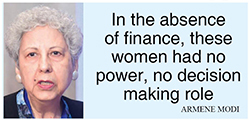
Working amidst a population of approximately 15,000 in the drought-prone Shirur area with rudimentary infrastructure facilities like water, electricity, roads, schools or education, she initiated a literacy program: each one teach one. But at the end of two years, only 10% became "somewhat literate” making her realize that their greater need was financial independence through self-help groups. In the absence of finance, these women had no power, no decision making role.
ANK thus introduced livelihood intervention programs in the form of dairy farming, poultry/goat rearing whereby the predominantly agricultural population could supplement their income. To empower women with financial independence and dignity, self-help micro credit groups were constituted. Freed from the shackles of moneylenders, these women become change agents and confidently participated in village assemblies demanding their rights and rallying for better facilities.
Unfazed by the periodic rumors that she was a Christian missionary and harbored political ambitions, Modi continued with her work. To support education for girls, she arranged for bicycle banks, life skills education, scholarships, karate classes, as attested Sarita who briefly took the mike to acknowledge that it is thanks to ANK that she can proudly announce that she is the first lawyer from her village. Yet another beneficiary, Sitabai, narrated how their women’s group came up with a slogan "Amcha vikas amhi karu (we are in charge of our own progress).” She gave credit to ANK for enabling her to participate in village sabhas and to get knowledge of different government schemes. She proudly announced that 17 girls from their village had become policewomen.
Based on biomarkers
"The future of global healthcare is predictive, preventive, precise and based on population genetics,” reminded Dr Villoo Morawala-Patell in her brief presentation on Agenome LLC, incorporated in the USA. A precision medicine company (with presence in the UK and India), it will commercialize the outcomes of The 10000 Avestagenome Project that is registered as a private limited company in India.
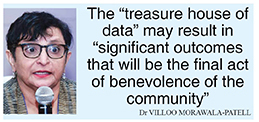
Having collected blood samples of nearly 5,000 Zoroastrians in India and abroad, she was hopeful the "treasure house of data” will result in "significant outcomes that will be the final act of benevolence of the community towards the entire world.” From the initial analysis there clearly emerged "biomarkers for longevity and diseases associated with longevity.” She considered this "critical data on the Parsi population that is endogamous (prescribes marriage within one’s community).”
Since such an effort requires substantial funding, she added, "To deliver three outcomes at the level of therapy” Agenome would need USD100 million (Rs 829.67 crore).” As the founder of the parent company Avesthagen that will complete 25 years in 2025 Morawala-Patell invited financial support from corporates, foundations, academia, industry, hospitals, high net worth individuals towards the unique project. Commitments for funding could be towards separate or combined phases of analysis of aging, longevity, stroke, cancer, rheumatoid arthritis, diabetes, Alzheimer’s, Parkinsons and rare diseases.
Photos: J. Y. B. Photo & Video
The fourth instalment of the global conclave report will be carried in a forthcoming issue of Parsiana.