Jer Sarkari, 97, happily shared details of her school days
and even sang a song in praise of her alma mater
Farrokh Jijina
When Jer Sarkari (née Ghista) was enrolled in the Bai B. S. Bengallee Girls’ High School, the monthly fee was one-and-a-half rupees. But since there were two other siblings, Dina and Dhun, the principal, Jerbanoo Dalal, gave them a bulk discount. "Amé tann béhno ni fee saara taan rupiya hati (The fee for us three sisters was three-and-a-half rupees).” Over a cup of tea and biscuits at her Cusrow Baug residence, Sarkari agreed to go for a walk down memory lane with Parsiana on January 20, 2022, a few months short of her 98th birthday. The meeting was arranged by Kersi Commissariat, her son-in-law and president of the board of trustees of the School. "She has many, many memories,” he told us.
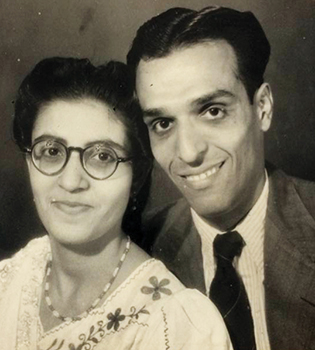
Jer Sarkari (seated on platform) with parents
Hiramai and Jamshedji, siblings Dina (ext l) and Dhun (r)
The School was then located at the junction of Sir Pherozeshah Mehta (P. M.) Road and Parsi Bazaar Street. (It was relocated to its current site at New Marine Lines in the 1950s.) Sarkari said her siblings and she walked to and from School from their Mody Street residence in the Fort area. "Khaali rasto cross karri dévano…étlo traffic nai hato téh vakhaté [You only had to cross the (P. M.) Road…there was not much traffic then],” she reminisced. The all-girls School, which admitted only Parsis, had not at that time started preparing students for the matriculation examination. The girls were imparted stree kélavni (women’s training). Lessons were in the Gujarati medium till class four. From class five to 11, the girls were taught history, geography, mathematics, science and other subjects in English. "We even had a ‘foreign’ teacher, a Ms Tholly who taught English songs… Bachchaa kém aavé té bhi sikhavta hata motta class ma (In the higher classes we were even taught how babies are born).”
The top floor of the two-storey building was partitioned into classrooms. At School functions, the partitions were opened up and it became a hall. April 3 of each year was an important day to commemorate the founding of the School. The girls would sing praises to the founder. "Tammuné gayi samjaaoun? (Shall I sing this for you)?” Sarkari asked, eyes a-twinkle! "Sir Sorabjee Shapoorjee Bengallee é bandhavyu aa béhést nu makan /Bhikhaiji Mataji na naam thi chhokrio bhané aa dhaam/…Téhni krupa thi Parsi stri o bhala bhantar bhané… (Sir Sorabjee Shapoorjee Bengallee built this heavenly building/ Girls study here in the name of his mother Bhikhaiji / Thanks to his largesse Parsi women learn good lessons here…),” she lilted. The name of the School commemorates the founder’s mother.
Girls started schooling at age seven and Sarkari did so in 1931. The uniform was a cream pinafore over a white blouse. "Bé-tan chhokri o sari péhrti hati (Two or three girls would wear saris).” A topi was compulsory. But when a new principal, Dina Dastur, took charge she had the topi rule removed. "We only had to take it to School but leave it in our desks” after assembly, which included the singing of religious songs. All teachers but three were Parsi women, and sari clad, she said, rattling off names. Living close to the School was an advantage. The Ghista sisters could go home for lunch, choosing not to partake of the free lunch provided by their alma mater.
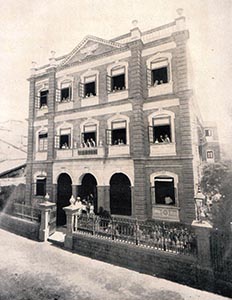
Bai B. S. Bengallee Girls’ High School
Photo: Sorabjee Shapoorjee Bengallee nu Jeevan Charitra
Typhoid struck Sarkari at age 13. A stint at convalescent homes in Bandra and Matheran, arranged for by the School, followed. To recuperate, the teachers put her on the "milk list,” an offer which was politely refused in favor of other more needy cases. "Aapré sukhi hata (We were content).” Since Bengallee did not offer matriculation until the mid-1940s, by the time Sarkari reached class 11 in 1942, only a handful of her classmates remained. Parents wanting their wards to sit for the school leaving examination would transfer them to other schools like Alexandra or J. B. Petit. "Non-Parsi friends…no, no, I did not have any,” she says, with a slight twitch of her nose.
Sarkari and her family worshipped at the Maneckji Sett Agiary. It was de rigeur to wear a sari to the fire temple in her growing up years. "Pacchi frock par aavi javaanu (After the visit it was back to frocks).”
The quirkiness of the English language came in for comment: "Why is it that in Gujarati I do not use the hard g to write my maiden surname, but in English I write it as Ghista (with the hard ‘g’)?” Parsiana had no answer for her.
Learning did not end in 1942 for Sarkari. "Paachha bésaari dé (They made us stay back).” The girls continued to be groomed privately in laundry and Parsi and "English cooking,” their teacher being Jai Masani, the daughter of Jalbhai Bharda who founded the eponymous school. "Shakespeare na plays bhi vaachta hata (We even read Shakespeare’s plays).” Sarkari, in fact, went back to the School for a diploma in sewing after her second daughter, Shernaz (Antia), was born in 1950.
Holding hands
1st row, from l: Shernaz Antia, Farida Cooper, Jer and Nariman Sarkari and
Zarine Commissariat at the parents’ golden wedding anniversary;
Dina Boomla; Dhun Dhalla; 2nd row: ceremony at the opening of Bengallee
School, 1885 Photo: Sorabjee Shapoorjee Bengallee nu Jeevan Charitra
But we are getting ahead of ourselves. In the mid-1940s, into Jer’s life walked Nariman Ghista, Godrej employee and husband-to-be. "Neighbor hatto…aapré ék bija né gamta hata (He was a neighbor… we liked each other).” Parents Jamshedji, who worked in the municipal office, and Hiramai, were indulgent. The young couple was allowed to go out alone, but had to be home by seven. "Rasta ma haath nai pakartata (We did not hold hands on the road).” Outings included walks along the then open seafront along Ballard Road (today’s Shoorji Vallabhdas Marg) and Apollo Bunder, and to the Capitol and Empire cinemas. Daughter Zarine Commissariat was born in 1947, Antia in 1950 and Farida Cooper arrived in ’54, she recounted.
The glint in Jer’s eye got brighter when recollecting the tram rides she had taken. She said she had a way of making the tram fare stretch. "Pann ékdum yaad nathi (I do not remember exactly how).”
She narrated how she explained the concept of soul and death to her 13-year-old great-grandson Vivaan. "Just like when the battery in your cell phone gets over, and the phone dies, one day the soul stops functioning.” Quizzed on interfaith marriages, the nonagenarian said it was an imperative of the times. When Farida entered into an interfaith marriage, her husband-to-be asked Jer if he could be coverted to Zoroastrianism, she laughed at the memory.
"Sixty-one years in the Fort, 20 in Godrej Baug and the remaining in Cusrow Baug.” That is how Jer sums up her 97 years. "Vakhat badlaay tém aapuné bhi badalvanu (We have to change with the times),” she told us, as we stepped out of her home. It was time for her television serial.