Since Zoroastrianism holds any form of life — animal or plant — in high esteem, the massacre of thousands of trees for the construction of a Metro car shed at Aarey Colony in Bombay has given rise to the question: What is a forest? The common man’s conception of a forest is a group of trees standing fairly close to each other and covering a fairly large area. A plantation would involve only a species or two, whereas a natural forest would have a good diversity of indigenous species.
Flora means the list of species occurring in a given area, while the term vegetation describes the manner in which the species of the flora are grouped together in different proportions to constitute the landscape or the physiognomy, like forest, thicket or grassland. Unlike the species which are strictly defined by their morphological characters, terms regarding vegetation tend to be rather vague. For example, a low forest according to one may be described as a tall thicket by another. The commonly used term jungle may mean anything — from a clump of shrubs to a densely wooded land. Bush in common parlance means a low thicket, but in Australia woodlands of tall eucalyptus trees go under the name bush. Some forests, like those of the Nilgiri and Palni hilltops, have received a special name, shola.
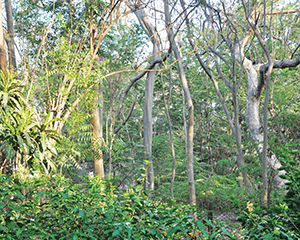 While dealing with the topic of vegetation, it may not be out of context to comment on the trend of naming the forest after climatic, geographic or soil features. A classic example is the rain forest, where rain is an atmospheric parameter. The well-known publication, Forest Types of India makes liberal use of environmental epithets. For instance, in the case of southern, tropical dry deciduous forest, southern is a latitudinal reference, tropical is geographic and dry is climatic. In laterite scrub, laterite refers to the soil and not vegetation. Foresters have classified certain forests as reserved, but a reserved forest may have a less dense cover than an un-reserved one.
Given the lack of clarity, some foresters, ecologists and botanists met in Yangambi in Africa in 1961 to bring order in the definition of forest. As per this group, a forest would be a collection of trees of a certain height and girth, fairly dense. The distance separating the trees would decide the degrees of open forest. If, under the trees, the ground is covered with a carpet of tall grasses, promoting the population of herbivores and carnivores, the formation would be called savanna — woodland. Some of our sanctuaries are in this physiognomic form. If the undergrowth is formed of thorny and spiny shrubs beneath the trees, it would be scrub woodland. These are among some of the decisions taken by the group of specialists.
To conclude, in any controversy like that of the Aarey Colony, the first step should be to prepare an inventory of the flora and fauna and the number of indigenous species. Introduced exotics like the subabul, even if their fodder is reported to be somewhat toxic, play a very important role in protecting the environment and need conservation measures like all other tree species.
The Metro authority emphasizes the aspect of reduction of pollution but misses out on problems like floods, loss of habitat and attendant man-animal conflicts and hardships faced by the tribals due to deforestation. Destroying a forest in an eco-sensitive location and instead planting trees elsewhere is like searching for a needle not where it was lost but at a spot where the light is good. Popular demand is for an alternative site for the car shed, the cost of which pales in comparison to the damage to the environment. And who knows how many more trees will be massacred in view of the relocation of the Zoo at Aarey?
Dr V. M. MEHER-HOMJI
Former Research Director,
French Institute of Puducherry and
Dean, School of Ecology, Pondicherry University