Considered to be one of the most architecturally significant buildings in the city, the Karachi Metropolitan Corporation Building on M. A. Jinnah Road has been renamed the Jamshed Nusserwanjee Mehta Building to honor the memory of the legend who has earned the epithet, "Maker of Modern Karachi.”
The "shaan o shaukat (grandeur)” of the Building can be witnessed even after 90 years, commented the current mayor of Karachi, Murtaza Wahab, when addressing the gathering as the chief guest at the 138th birth anniversary function in honor of Mehta, organized by the Karachi Theosophical Society (TS) and the Theosophical Order of Service in Pakistan. In his bilingual speech in English and Urdu Wahab mentioned that one of the first tasks he undertook on becoming mayor was to rename the grand edifice that houses the mayor’s and deputy mayor’s office as well as the City Council. An Urdu inscription on a prominent plaque at the entrance recognizes Mehta as the first mayor of the city and his contribution to the city.
Additionally at the mayor’s office in the Building, Wahab has kept a bust of Mehta close to where he sits. Sometimes he keeps it covered with a cloth for if Mehta were to witness the condition of Karachi today he would not be happy, Wahab wryly commented. "Sometimes I talk to him, saying that Karachi in your time was good — when you could work independently, devotedly and with compassion.” Given credit for creating the cleanest city in the subcontinent with wide, tree lined avenues, good infrastructure and amenities, Mehta not only had the welfare of the people in mind but also the animals for whom veterinary hospitals and water troughs were thoughtfully laid out. Trying to revive in the citizens the same commitment to their city as shown by Mehta, Wahab urged those seated in the Jamshed Memorial Hall on January 21, 2024 "to take ownership” of not only what lies within their homes and office but also beyond.
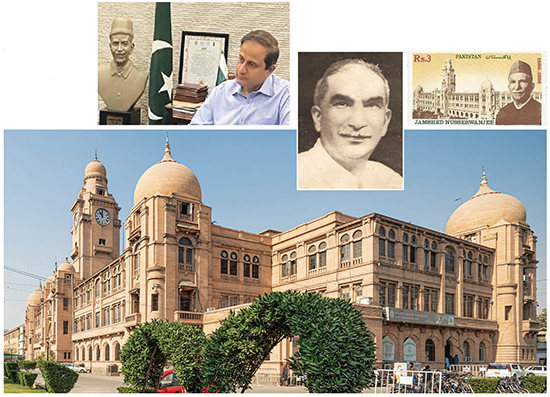
Clockwise from top: Murtaza Wahab with bust of Jamshed Nusserwanjee Mehta at the mayor’s office;
Jamshed, honored with a postal stamp; Jamshed Nusserwanjee Mehta Building in Karachi Photo: Wikipedia
Clockwise from top: Wahab (7th from l) with invitees at the 138th birth anniversary function;
Homi Khambata, Dinshaw Avari; Mushtaq Jindani and Hamid Mayet with plaque
Having studied at the Bai Virbaiji Soparivala High School where no discrimination was made on the basis of religion or financial status of the child, Wahab acknowledged his "special bond with the Parsi community which I tried to recreate when I joined public service.” He remembered the love with which children were taught by benevolent principals and teachers because of which they continue to harbor fond memories of their school days. Looking at Dinshaw Avari, president of the Karachi Parsi Anjuman Trust Fund (KPATF), seated in the audience, Wahab stated, "I was a great fan of Byram Uncle.” (Dinshaw’s father Byram was president of the Anjuman and chairman of the Avari Group of hotels until his demise last year.)
Designed by James S. C. Wynnes, a Scottish architect, with Jehangir Setna as the civil engineer, from the time of the construction of the Municipal Building in 1927 until its inauguration in 1932, Mehta continued to take a keen interest in its progress for he was then the long-standing president of the Karachi Municipality. Built at a cost of Rs 17,75,000 (USD 21,385), at the time of its inauguration it was known as the Karachi Municipal Building, according to Wikipedia. When the municipality became a corporation the following year and Mehta was elected its first mayor, the building came to be known as the Karachi Metropolitan Corporation Building. The structure, a blend of Anglo-Mughal style, also incorporates Egyptian and Spanish motifs, adds Wikipedia. Even the three-rupee (USD 0.01) postal stamp in Pakistan bearing Mehta’s visage has this Building in the background.
Yet another speaker, Homi Khambata, honorary secretary of the KPATF, mentioned that like in many Parsi homes he had a photo frame of Mehta hung at his residence. When summoned by Muhammad Ali Jinnah to aid the displaced refugees after partition, Mehta opened up the doors of hospitals, schools and open grounds with which he was connected to give them shelter. Even the Sukkur dam and barrage on the River Indus owes its existence to Mehta who convinced the British government of its need. "This dam saved all of us when the city was flooded. It should be renamed as the Jamshed Nusserwanjee Barrage,” recommended Khambata.
Deeply influenced by the ideals of Theosophy and its then international president Dr Annie Besant, Mehta was active in the Home Rule Movement. In later years he dissociated himself from politics, but continued to dedicate his life to the causes he supported. Regarded as the father of scouting in Sindh, Pakistan’s sea scout landing craft is named after him. The Jamshed Memorial School named in his memory by Gool Minwalla is a testimony to his support for Montessori education. The Government College for Women has its roots in the Vasant Pathashala started by Besant as a small school for girls in the vicinity of the Karachi Theosophical Society on Jinnah Road and nurtured into a high school and college by Mehta.
Even seven decades after his demise in 1952, philanthropic and welfare work continues to be perpetuated in his memory by members of the TS in Karachi, attested Mushtaq Jindani and Hamid Mayet who showed their appreciation to the speakers and audience who attended the function. Among the other speakers on the occasion were Cardinal Joseph Coutts, Dr Masuma Hasan, chairperson, Pakistan Institute of International Affairs, educationist Dr Riaz Ahmed Shaikh, journalist Ghazi Salahuddin and lawyer Farsheed Rohani.