Memories of a challenging childhood recalled with insight and wit
Edited excerpts reproduced from a letter the late jurist Fali Nariman wrote to his fellow "twenty-niner” (both born in 1929) Rusi Sorabji of California. Sorabji shared the missive with Parsiana.
My parents and I came to India as refugees in March 1942 overland since the Governor of Burma Col Sir Reginald Hugh Dorman-Smith had confidently told my father (Sam Nariman) at one of his war council meetings: "We will get rid of the Japanese in a month.” With this exaggerated assurance my father, mother and I left Rangoon for Mandalay in the north (Rangoon was being bombed almost every day), expecting to return shortly. But the Japanese Army advanced swiftly and relentlessly and the road/rail link between Rangoon and Mandalay got interrupted, preventing us from reaching Rangoon to take the weekly passenger ship to Calcutta.
So we had perforce to take the long, 21-day land route to India. After seven days in small boats, seven days in a bullock cart and seven days on palanquins called doolies we at last arrived in the border town of Tammu from where we took the train to Imphal in Manipur arriving at a refugee camp run by a European lady. It was here that we first learnt that Rangoon had been captured by Japanese troops in February 1942.
I was then in the seventh standard of the Diocesan Boys School in Rangoon. Since my schooling was interrupted, after making inquiries my parents decided to place me as a boarder in Bishop Cotton School (BCS) in Simla (there was no ‘h’ in Simla then).
I was admitted to Form V which was the junior Cambridge class — from where I wrote my junior Cambridge examination in pencil (for the first time). In those days our exam papers were sent on to London for evaluation (with one copy preserved in case the ship carrying the examination papers was attacked and sunk by a German U-Boat!). I was in BCS for two years and was pretty miserable since I was the only child of my parents, and "spoilt!”
But Simla in those days was a beautiful place and my parents knew the Framjis (Dosibai and Dinshaji). They were extremely hospitable to all Parsi students and invited them (myself included) to their home on the Mall every Sunday for a treat of dhansak! In those days, and in that climate, there was no problem walking miles from the School which was located down below Chhota Simla, three or four miles from the Mall.
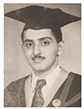
Top: Fali Nariman; above: Bishop Cotton School, Simla
To encourage competition in learning and in sports BCS had divided the students into four houses — Ibbetson, Lefroy, Curzon and Rivaz — named after prominent Britishers in British India. Rivaz was the Bishop in Calcutta. My house was Ibbetson and my house master was a man called Fisher. He was a good house master but to the delight of the schoolboys his wife created a scandal by running away with another master — which got talked about for months!
Our principal was an English padre, Rev Canon Sinker. When I joined he was only Reverend but the following year he became a Canon (one step below a bishop). To the delight of our School hospital matron (an old lady who was tone deaf) he shouted to her: "Don’t worry. I am not the Canon that goes off!”
I was housed in the headmaster’s dormitory (at an extra charge), which was located above the principal’s residence. The only added advantage was that we were invited every Sunday to dinner by the principal’s wife (an extremely religious person). In those days I frequently gave expression to expletives like "Oh God!” and "Thank God!” She pulled me up with a stern: "Narriman” (I was always called Narriman with a double ‘r’) "Narriman — in this house I will not have the Lord God’s name taken in vain!”
BCS was an otherwise friendly school with little to complain about except perhaps the food — but my parents were kind enough to instruct (the confectionary store) Davicos (with Framroze Deboo as the genial manager) to send me a cake every week, which endeared me to many "friends!” We had a Jewish boy in our dormitory, a chap called Julian Elias from Calcutta, who was similarly blessed with a parental cake delivered from Davicos once a week. He would not share it with others. He quietly brought it up from the matron during the day and locked it in his locker next to his bed in the headmaster’s dormitory. Only after "lights-out” at 8 p.m. every night, when no one was supposed to move from their beds, Elias would bring out his cake and (crunch! crunch!) eat it without sharing it with the other boys (10 of them). "Stingy,” they called him. Boys in school can be very nasty. There was a boy called Stubbs whose father was a general in the British Army in North Africa. The poor fellow was epileptic. During his fits the boys would throw their gym shoes at him instead of helping him. His rather imperious mother would come and complain, but to no effect!
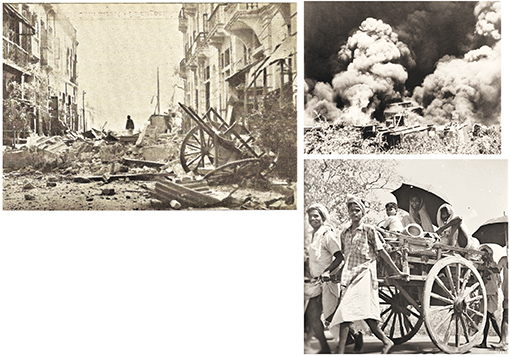
Clockwise, from above: Rangoon ravaged by Japanese invasion; destroyed oilfield in Burma
Photos: Wikipedia; refugees retreating from Rangoon Photo: iwm.org.uk; below: Rusi Sorabji
In the same headmaster’s dormitory we also had three boys, each by the name of "Singh.” They were all sons of the erstwhile Maharaja of Patiala (but each son by a different wife)! For easy reference they were called Singh I, Singh II and Singh III. There was a story about the Maharaja that I recall. He had a place in Simla known as Oakover, a large palatial bungalow located somewhere between our School and the Mall. The story went that in the days of the British Raj (some time in the 1930s) an English female rider found that her horse had lost a shoe. She went into Oakover for help — and never came out. She was pretty and extremely well connected, being the daughter of the commander-in-chief of all British forces in India. The Maharaja treated the young girl tenderly but would not let her go — which created a viceregal incident. A complaint about her incarceration was made to the Viceroy of India who issued an edict that the Maharaja was not to visit Simla ever again. But the Maharaja being a man of means built a palace lower down in the Simla Hills (it is now a hotel) at a place called Chail from where he could see his beloved Simla.

The Maharaja of Patiala was a generous host and a lover of cricket. He invited and hosted cricket teams at Chail but on one condition — no matter who was batting then, the Maharaja would go in to bat at four in the afternoon, his bat being carried to the pitch by his orderly, and no one dare give him OUT! His son — after abolition of the privy purses — was still called the Maharaja and after independence was appointed India’s first Ambassador to the Netherlands. His palatial house at The Hague — which I have visited and had dinner at, on my trips to that city — is still the Indian Ambassador’s residence: the largest and best ambassadorial residence of any Indian Ambassador anywhere in the world!
It was in Simla that the Cripps Mission (British Mission headed by Sir Stafford Cripps) met to talk with Indian leaders about granting independence to India. I was fortunate to see (but not meet) a whole set of important people: not only Cripps, but also Mahatma Gandhi, the frail Mohammed Ali Jinnah in his three piece suit being driven in a rickshaw (pulled and pushed by four flunkeys) on the Mall, Sir Pethick-Lawrence and A. V. Alexander — and the great Panditji (Jawaharlal Nehru) himself.
Nehru I saw by chance. I was walking somewhere in Chhota Simla when I heard the sound of a galloping horse. As the rider and his horse moved swiftly past me, the man on the horse addressed me loudly with just two words "Jai Hind (long live India)!” That’s all I saw of (and heard from) Panditji — a great inspiration to me later in college where I (and many colleagues) read Discovery of India written by him during his ninth term of detention in prison!
Another memory of Simla was of the British Viceroy Lord Linlithgow (Lord Louis Mountbatten was the last one, but was known as Governor-General). A batch of students from BCS had been chosen to bid Linlithgow farewell, and I was one of them. We had to walk five miles from our School to the Viceregal Lodge on the other side of Simla. Since it was a rainy day we wore raincoats… and we all expected to get at least a cup of hot cocoa and some buns. Instead all we got was an order to line up on the long drive from the gate of Viceregal Lodge to wave to His Excellency as his Rolls Royce came down the drive — and the noble Lord extended a weak hand waving back to us! We cursed him since we had to walk another five miles back to School late in the evening, famished and hungry!
Although I did well in my junior Cambridge exam as well as in my senior Cambridge exam, I did not enjoy my stint in BCS — perhaps since I was (I must confess) a bit of a namby-pamby!
In 1942 and 1943 when I was at BCS, Simla was all spit-and-polish — so much so that if someone was dressed in a bush shirt, or in shirt sleeves and not in coat and trousers, the policeman on duty would stop him from walking on the Mall and direct him to take the lower bazaar road! Those were truly days of pomp and circumstance.
I passed out of School with a first class at the early age of 14 and joined St Xavier’s College in Bombay some six months later — a Catholic institution with (mainly) Fathers of the Society of Jesus as our teachers. Fr Fell was our teacher in French. In college a second language was compulsory (whereas in school I was exempt, being a refugee from Burma). I chose French — to my regret. My friends from College still remember that at one class in French (which I had to pick up within six months after I left school) Fell asked me, addressing me by my number (we were all given numbers), "Number 308, parse the word ‘Apprendre (to learn).’”
I stood up and uttered some nonsense, which prompted Fell to ask me: "Where you did go to school, man?”
I puffed up my small chest and proudly said: "Bishop Cotton School, Simla.”
Fell’s response was remembered by one and all of the 300 students in the First Year Arts class: "Simla! But man, why did you have to go so far away to learn so little!”