The scriptures specify the correlating roj for deaths that occur during Gatha days
Firoze Kotwal
If a Zoroastrian dies on any of the five Gatha days when should the subsequent prayers be performed? Scholar and high priest Dastur (Dr) Firoze Kotwal offers the answers in his paper "Religious Injunction to be Observed when a Zoroastrian Expires During the Gatha Days” which appeared in the Dabir journal No 5 of 2018 published by the Samuel Jordan Center for Persian Studies and Culture, University of California, Irvine. Parsiana publishes an extract from the academic article.
The current practice of the observation of the monthly remembrance of someone who has died during the Gatha days is not as per the the Zoroastrian scriptures. In the past, many learned scholars have publicly drawn the attention of the community to this erroneous practice.
The Gatha days are connected only to the Frawardigaan days and have no connection with any month of the calendar. Hence they are not included in any of the 30 days of the month. Due to the close association of the Gatha days with the Frawardigaan days, the scholar-priests of Iran religiously decreed that the roj applicable to the person who dies on any one of the Gatha days would be Frawardin roj. These scholar-priests have stated in the Pahlavi books that the chahaarom (fourth day after death ceremony) of a person who dies during the Gathas would be performed on the fourth day, the dasmu (10th) on the tenth day, the sirojaa (30th day) and the maasiso (month) on the 31st day including the day of demise. Thereafter the other monthly ceremonies for the departed soul should be performed on Frawardin roj and the death anniversary should be observed on the particular Gatha day the person died. The well-known scholar-priest Dastur Erachji Meherjirana agreed with the Iranian scholar-priests on this issue, and he stated in his book Pursesh-Paasokh that: "If any person dies during the five days of the Gathas, his chahaarom should be performed on the fourth day, the dasmu should be performed on the 10th day, his sirojaa should be performed on the 30th day, and monthly ceremonies should be performed on Frawardin roj of each month and the chhamsi (six month) should be performed in such a way that the sirojaa is performed on Rashne roj and the chhamsi on Frawardin roj, and the annual ceremonies should be performed exactly on the day of demise, i.e. the Gatha day on which he has died and the sirojaa should be done prior to the day on which he has died.”
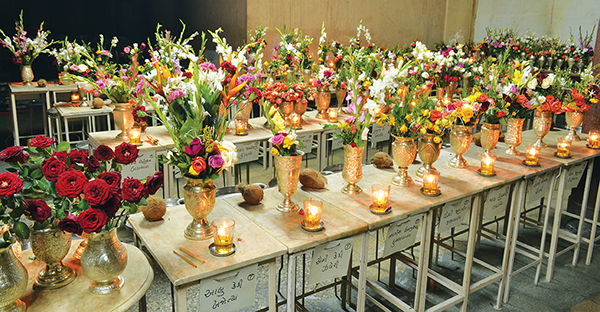
Muktad tables at an agiary Photo: Mahafrin H. Mistry
Moreover, the scholar-priests of Iran have stated in the Pahlavi books that if the roj and the mah on which a Zoroastrian dies is not known, then Adar mah Frawardin roj, which according to the present arrangement of the calendar due to intercalary changes falls on Frawardin mah and Frawardin roj should be determined as the day of his demise. If one knows the mah of the person’s death but for some reason the roj is not known, then the Frawardin roj of that mah should be considered as the day of his demise. On the other hand, if the roj of his demise is known but not the mah, then Frawardin mah of the current calendar should be linked to the particular roj (which is known), and this day should be observed as the day of the person’s demise. The above facts are clearly stated in the commentary to Fragard (Chapter) VIII, Para 22 of the Pahlavi Vendidad, in the first chapter of the Pahlavi Rivayat Accompanying the Dadestan-I Denig, in chapter 123 of the Pahlavi Rivayat of Adur-Farnbad and Farnbag-Srosh as well as in the Pahlavi text of Waziriha I Den I Wen I Mazdesnan (The Decisions of the Good Religion of the Mazda Worshippers). In addition, in the Persian Rivayat of Kamdin Shahpur dating back to 928 AY (1559 CE) under the signatures of the Dasturs of the Iranian villages and provinces of Turkabad, Sharifabad, Khorasan, Sistan and Kerman, it is clearly stated that the monthly rojgaar of a person who dies during the Gatha days must be observed on Frawardin roj.