Stage offerings reflected the social trends prevailing in the late 19th century
Farrokh Jijina
When Dr Rashna Nicholson was studying for her master’s degree at the University of Copenhagen she came across Kathryn Hansen and Somnath Gupt’s The Parsi Theatre: Its Origins and Development. The book revealed how the 19th century phenomenon spread far afield to places like Burma, Indonesia and East Africa and became the precursor to the Hindi film industry.

"But there was a paucity of historical detail about the period… I knew I had to come back to India and study this further,” she said at the virtual launch of her book The Colonial Public and the Parsi Stage: The Making of the Theatre of Empire 1853-1893 organized by The K. R. Cama Oriental Institute (KRCOI) on August 26, 2021. The event was anchored by critic and theorist in visual culture and architecture Dr Kaiwan Mehta.
"I went to UNESCO Parzor in Delhi where they have about 100 scripts from the Calcutta Parsi Amateur Dramatic Club… I met descendants of actors… The foundation of this book rests on the resources I found in India, in private and semiprivate sources” and newspaper reports. The author had to learn to read 19th century Gujarati which was "challenging.”
Assistant professor of theater studies at the University of Hong Kong and Barbro Klein Fellow, Swedish Collegium for Advanced Study (2021), Nicholson narrated that just when she thought she had adequate material to complete her doctoral thesis on Parsi theater, a German professor at Munich’s Ludwig-Maximilian University insisted she examine newspapers of the period. The tome Parsi Natak Takht ni Tavarikh (History of the Parsi Stage) by Dadabhai Patel is the only visual resource, she recalled. The author said she studied the newspapers, particularly the Rast Goftar, Mumbai Samachar (MS) and the Jam-e-Jamshed at the reading room of the J. N. Petit Library.
Nicholson linked the social milieu prevailing then with the trends and subjects presented on stage. The "theoretical fulcrum” of the book is that the Parsis were compradors or go-betweens and gatekeepers with the colonial masters. As with trade, in the theater too, they served as forerunners of proscenium-based theater and took it all over Asia, she noted. (Wikipedia defines proscenium as the "metaphorical vertical plane in a theater, usually surrounded on the top and sides by a physical arch and on the bottom by the stage floor itself.”)
The backdrop in which the first nataks Roostum Zabooli and Sohrab and Dhanji Garak were presented in 1853 was the presence of Christian missionaries who said "awful things” about Zoroastrianism and the debates in the Press, particularly the MS, about the need to reform Zoroastrianism, and rid it of child marriage and arcane rituals. "Reformist articles were debating the opium trade, the Parsi identity, appropriate head gear, mehtajis (school masters) who could not teach…everything was under scrutiny,” she stated.
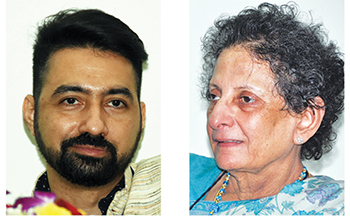
Top: Dr Rashna Nicholson; above, from l: Dr Kaiwan Mehta, Dr Nawaz Mody
The four "pillars” that Parsi theater was based on were a display of colonial loyalty; a mode of emancipation of women; a marker of prestige and self-aspiration; and a focus for physical fitness. So along came Gujarati adaptations of Shakespeare’s works and in April 1857 a special staging of The Taming of the Shrew for women which "sanctioned the entry of women into public life.” The theaters were spurred on by the cotton boom in the 1860s that brought wealth into the city.
The influx of Iranians to Bombay led to the emergence of the Iranian Theatrical Company that performed only in Farsi and which relied on spectacular sets and magical effects. One performance even included live horses on stage. "A trans-Zoroastrian identity was being created…the shows went to many places where the language was not understood.” By the 1880s, shows were being staged in Burma and Singapore, she noted.
A form of proto-nationalism too emerged within the theater she stated, giving the example of Sona na mul ni Khurshid
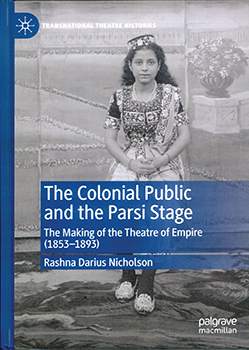
(Khurshid worth her weight in gold) where the protagonist is a woman who maintains her chastity despite being pursued by many, Khurshid being an allegory for an indigenous essence, possibly nationhood. With the emergence of Hindu mythologicals like Nal Damayanti and Harishchandra, the trend of having a woman as the central figure continued.
Mehta commented in his closing remarks that Nicholson’s book was "closely tied” to the larger social background of the city. "It will force one to reflect on the formation of Bombay and how theater shaped it.”
In her opening remarks, honorary secretary of KRCOI Dr Nawaz Mody requested a minute’s silence in memory of past president Muncherji Cama who passed away in July this year. "The book has some photos from a book in our library,” she mentioned.
As Nicholson summed up, "After the 1880s you cannot speak of a single (form of) Parsi theater… There are various iterations, depending on where the stagings were held,” in India or overseas.