"I wanted to write the story of Cyrus with momentum, not as dry facts and research,” stressed author and scholar Reza Zarghamee in his nearly two-hour presentation followed by a chat at Washington’s Kamran Dar-e Meher on October 29, 2022. An assembly of over 60 participants plus another 100 joined on Zoom to hear the speaker at the Cyrus the Great Day celebration held jointly by the Zoroastrian Association of Metropolitan Washington Incorporated (ZAMWI) and Arash the Archer (ATA), a non-profit organization focused on advancing research and scholarship on ancient Iran and the culture and history of Zoroastrianism.
"Knowledge of the past — like the common heritage and impact of Cyrus the Great — would lead to an informed future,” stated ZAMWI president Zarir Khademian who is also the president of ATA. Many facets of Cyrus’s life with relevant visuals held the audience’s attention as Zarghamee proceeded to sift facts from fiction associated with the life of Cyrus the Great. Author of Discovering Cyrus: The Persian Conqueror Astride the Ancient World, Zarghamee mentioned that absence of Achemenid studies convinced him to create his own research pathways.
Drawn to Middle Eastern history, at the age of 13, Zarghamee, who is of Persian descent, studied old Persian cuneiform under Prof Richard Frye. He mentioned how Old Persian has only three vowels a, i, u and "we cannot be sure how to pronounce them.”
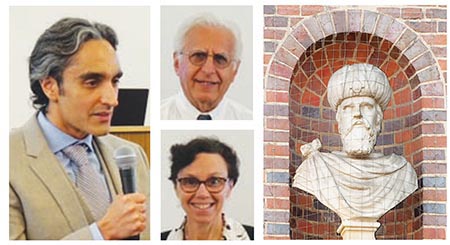
Above: Reza Zarghamee (l); Zarir and Anne Khademian (center);
17th century bust of Cyrus the Great in Hamburg Photo: Wikipedia
Cyrus cylinder proclaiming human rights
In a candid discussion with ZAMWI past president and ATA director Anne Khademian at the end of his presentation, Zarghamee related how his legal training (he is a partner in the legal firm of Pillsbury Winthrop Shaw Pittman LLP) to evaluate, be transparent, explain the applicability of law and viable solutions was transposed to his research and writing on Cyrus where he collected data and linked facts together. Aware of all the data, details and disputes, with a critical eye he then sat back and studied the commonalities. Disparity of sources contributes to secondary literature being forgotten, said Zarghamee.
He referred to the Cyrus sagas that relate stories, probably mythological, about his early childhood when his grandfather feared that he would be killed by the grandson and ordered him to be banished from the kingdom. Suckled by a dog and brought up as a commoner, when he started showing signs of his royal lineage, he was reunited with his family.
His name Kourash (possibly of Elamite origin) meant "he who bestows care.” By 539 BC he became a local ruler following tribal conquests. He moved to different frontiers — Macedonia, Bactria, Armenia. "By winning the favor of the local elites you can go a long way in establishing political power” was an early lesson learnt by Cyrus in the sixth century BC as he proceeded to establish the mighty Achemenid empire. Within 14 years he unified the lands he had conquered, consolidating his empire and governing a mosaic of different peoples.
"Cyrus remains obscure in many ways,” summed up the author, explaining how Cyrus would probably say he is a Zoroastrian. "I cannot prove; I can only marshall evidence together” by sourcing Herodotus, Cuneiform tablets and other material.
Young Persians were taught three things: to ride a horse, shoot from the bow and speak the truth. Although there may be many grey areas, "Cyrus acted with magnanimity and chivalry. Vestiges of his deeds have survived,” reminded Zarghamee.