He was exceptionally short; she was rather sweet. By the standards of stunted Navsari she was quite tall and towered over him. They nicknamed the couple Gilli-Dando (dando: a long rounded stick with which one hit the gilli, a much smaller wooden object full in the middle and tapering at both ends). Gilli was one of the biggest landlords of Navsari and the largest individual shareholder of a joint stock company called Ahmedabad Electricity. A ruthless rent collector, he showed not the slightest mercy to his tenants. Dando was a poor mobed’s daughter whose brothers would attain great fame as religious scholars. She was 22 years younger than her portly, rotund and dreadfully boring husband. They resided in the largest house in Seervai Vad with two mirror image wings.
Dando spawned a boy and a girl, in quick succession. We shall call them Pheroze and Gool, though their real names were quite exotic. Behind their sprawling house, there used to be a mini forest containing huts of the tribals who mostly worked as domestic help in Seervai Vad and its environs. Six of them worked in the Gilli household in various positions — the cook who was called misteree; two ladies who swept and dusted and mopped (Gilli adored them and surreptitiously bestowed them with gold chains); a man who helped Gilli to wear his duglo, pugree, and polish his shoes; another who served food during the day and after dusk was entrusted with killing the many tadpoles who croaked and created a nightlong rumpus along with the chirping of a million crickets in the thicket behind the house.
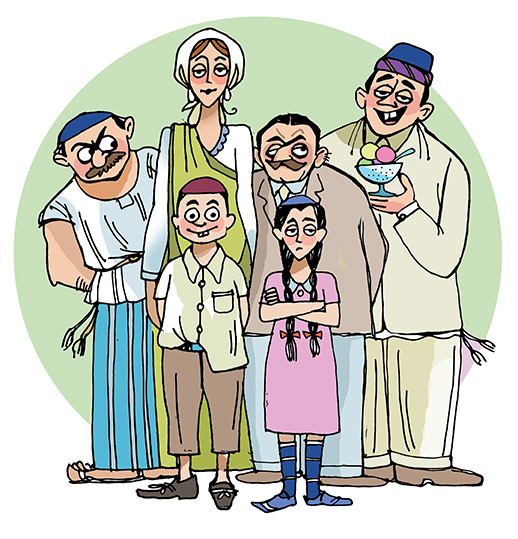
Illustration by Farzana Cooper
Gilli rose early, duck-walked to the Atash Behram, prayed mechanically, cracked a banal joke or two with his not-too-bright children, gorged on a huge breakfast of boi (mullet), kaleji and bookka (liver and kidneys) or runny scrambled eggs, flirted with the cleaning ladies, browsed through the previous day’s Jame, taunted Dando about her father giving no dowry, and sat in a horse-drawn carriage to do his rounds of rent collection.
Pheroze and Gool went to their respective same sex schools. The boy had an overdeveloped sense of humor and little interest in the geometry class; he aimed a divider at the feet of a dhoti clad teacher standing on a wooden dais, solving theorems on the blackboard, in order to startle him. The teacher was startled enough to make Pheroze place his fingers on the edge of a drawer which was then forcefully shut. The boy’s posterior was ruthlessly caned almost every day by irate teachers. Gool, a dullard suffering from chronic dysentery, to control which she ate a mixture of elchi (cardamom) and saakar (rock sugar), envied her brother’s inhuman energy levels in harassing teachers, servants, neighbors and her girlfriends. Dando was exasperated with the litany of complaints against her son and Gool’s daily visits to the doctor who was irritated because he had to treat her free as she happened to be a resident of Seervai Vad.
One summer afternoon a man called Fali promised Pheroze four scoops of Kolah nu ice cream from a new shop in Tarota Bazaar opposite the Atash Behram. Fali bore a concerted animus against his immediate neighbor Keki (whose claim to fame was being constipated for as long as a fortnight with obvious unpleasant results). Pheroze’s assignment was to walk up to Keki while the latter was having tea on his so-called portico and ask loudly enough for half of Seervai Vad to hear: "Keki, tu ghelsappo ké ghelchodio (are you stupid or a moron)?” Fali was confident that even Pheroze would not dare undertake such a caper. His confidence was misplaced as, to his horror, he heard Pheroze shout out the impertinent question in a booming voice. Keki was momentarily stunned and fairly confused by the question, and then ran after Pheroze who darted into his own house and shivering in fright, hid behind Dando, who was unaware of the reason for the commotion.
To address this grave misdemeanor, a meeting of the Seervai Vad elders was held on a Sunday morning to find out who had prompted the child to abuse Keki. Prior to the meeting, Fali had successfully negotiated with Pheroze 12 scoops of Kolah’s ice cream to buy his silence. Acutely embarrassed, Gilli and Dando sternly instructed their errant son to name the real offender. Pheroze thereafter ambled across to Keki who encouraged him to name Fali. The number of scoops promised rose to 15.
At the public meeting, a source of great entertainment for the terribly bored Seervai Vad residents, Pheroze was directed to speak the truth. He promptly named Fali, much to the latter’s consternation and Keki’s great delight, that was short-lived. "Uncle Keki told me to name Fali Uncle and promised me 15 Kolah scoops.” Technically, it was the truth. In the commotion that followed, Pheroze made a quiet escape.
Fali later told Gilli and Dando that their son was a genius. Gilli dismissed the praise but Dando came to believe that her son was a much misunderstood superstar.
Gilli’s bad, cholesterol choked arteries soon made Dando a merry widow. From a meek, naïve, repressed woman, she flowered in her role as the matriarch, almost like Sansa, the Queen in the North, in the Game of Thrones. She celebrated her miserly husband’s sudden demise by splurging on luxuries for her son who lost his hyper-energy and became a rather quiet lad. Those were the late 1950s. The first scooter with a silly side car, in all the Parsi Vads of Navsari, belonged to Pheroze. Also, the first tape recorder with its huge spools of tapes; the first transistor (Dando simply could not fathom how a radio worked without any wires); and the first 35 mm movie camera (a large contraption) with which Pheroze captured a mentally disabled woman derisively called "Alli Gaandi” in the streets of Navsari, capturing her nose on camera in a grotesque close-up. Dando was highly amused with this shot and made Pheroze repeatedly play the film on a large white wall. Alli Gaandi provided much mirth to mother and son while Gool groaned in discomfort battling her chronic dysentery amidst mouthfuls of elchi-saakar.
Berjis Desai, author of Oh! Those Parsis and The Bawaji, occasionally practices law.