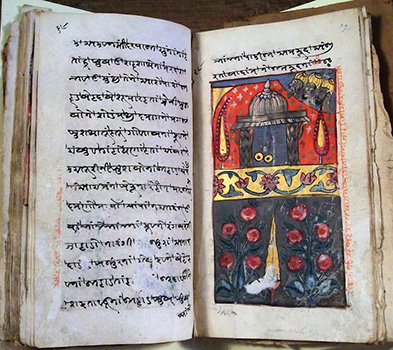
An 18th century illustrated manuscript of the
Ardai Viraf Nameh is on display at a museum
at Baroda’s Maharaja Sayajirao University
Shruti Gautam
The themes of good and evil, virtue and sin, rewards and punishments, heaven and hell have caught the fancy of humankind since the dawn of time and are present in the literature of the world’s major religions. They have also found place in fictional writing and the visual arts in the form of illustrated manuscripts or on canvas. Ardai Viraf Nameh or Arda Viraf Nameh, a Zoroastrian text, was written in Sassanian Persia in probably the fifth to seventh century as part of state propaganda to ensure Zoroastrianism as the state religion. The text is in Pahlavi, which is considered the Middle Persian language from which modern Persian has evolved, and deals with Zoroastrian notions of heaven and hell, virtue and sin and subsequent rewards or punishments.
Ardai Viraf Nameh revolves around the journey to heaven and hell undertaken by a pious Zoroastrian priest named Viraf during Sassanian rule in Persia. Viraf is assisted by angels from heaven during this journey. He witnesses pious souls in their afterlife enjoying the glory of heaven as well as the tortures of hell unleashed on wicked souls. Viraf returns to the mortal world with the message that Zoroastrianism is the true way to lead a noble life.
This article focuses on an illustrated manuscript of Ardai Viraf Nameh dated 1785 CE which is currently on display at the Museum of the Department of Museology, Faculty of Fine Arts, The Maharaja Sayajirao University of Baroda. It is written in old Gujarati and has yet to be translated. Studying this particular manuscript is both challenging and exciting as it’s a curious interplay of text and image.
Depicting the glory of heaven
Ahura Mazda seated on a throne
Sisters of Viraf pleading to the Mazdayasnians
Religious manuscripts played an important role in society in pre-modern times. They were a source of dissemination of knowledge, religious or secular. The manuscripts were either commissioned by religious institutions or individuals for their personal edification. They were read aloud by priests at gatherings or by individuals and their family members at home. Traders took religious manuscripts along with them when they travelled as they were an important part of their religious beliefs and culture.
As far as this particular manuscript of Ardai Viraf Nameh is concerned, we do not know who commissioned it as it has not been completely translated. However, there are inscriptions scribbled in modern Gujarati and English on the manuscript which show that at one point of time the book belonged to a Zoroastrian priest and had been purchased for Rs 32. From the above, it can be construed that this manuscript has passed through many stakeholders before it came to be housed in the Museum. It is the accumulation of these different layers of information about a museum object which constitutes its actual identity.
For Zoroastrians, the object is a reflection of their beliefs and traditions; for non-Zoroastrians it is a medium to learn about a set of beliefs other than their own, making it an important part of the tangible heritage of the Zoroastrian community.
I researched the manuscript as a student of art history focusing on the style of the miniature paintings in it. As a part of my research undertaken in 2013, I met a priest of a Zoroastrian fire temple in Fatehgunj, Baroda who informed me that people now read Ardai Viraf Nameh only occasionally as it is not a part of the scriptures and prayers which should be chanted daily by believers. The manuscript was originally written in Ancient Iran not only to assert the supremacy of Zoroastrianism as the state religion; it was also meant to serve as a book of ethics where detailed accounts are given of righteous deeds and rewards in heaven as well as wrong deeds and subsequent punishments in hell.The decrease in the user value of the manuscript is an indisputable fact in modern times and highlights the significance of the manuscript as a museum object.
Today the Zoroastrian community is grappling with the issue of population decline which affects the chances of loss of its tangible and intangible heritage. The Museum, by displaying the manuscript, rescues it from anonymity. Aesthetically, the illustrations in the manuscript are a fusion of Persian as well as the indigenous folk idiom of Gujarat which have the power to attract visitor attention. Here, the perception that universally museums are seen as places where one can appreciate rare objects which have an artistic merit, comes into play. The manuscript’s value is heightened by its inherent function as a signifier of the core beliefs of Zoroastrian theology.

Shruti Gautam is a trained museologist from India and the Netherlands. Her interests include museums, heritage, art history, visual culture and religion.