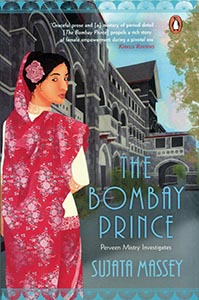
The Bombay Prince by Sujata Massey. Published in 2021 by Soho Press, an imprint of Penguin Random House India Private Limited, 4th Floor, Capital Tower 1, MG Road, Gurugram, 122002. Pp: 350. Price: Rs 499.
Meeting Perveen Mistry for a third time in Sujata Massey’s (pictured) The Bombay Prince is like encountering an old and familiar friend. She is Massey’s Miss Marple (the fictional detective in Agatha Christie’s crime novels), intelligent, persistent, endearingly

human, Oxford educated and first woman solicitor in Bombay. Massey takes us back in time to November 1921, when Edward VII, then Prince of Wales, was about to start his four-month tour of India. She captures the atmosphere of Bombay which is in the grip of riots and looting where several Indians have lost their lives and the Parsis were especially targeted as they were considered to be supporters of the British Raj,
Massey loses no time in establishing Mistry’s efficiency as a lawyer. On the very first page we learn she has successfully negotiated a rental agreement between two very difficult parties each making their own unreasonable and trivial demands. No sooner is the envelope containing the contracts sealed than she receives a visit from 18-year-old Freny Cuttingmaster. Mistry has been recommended to Freny by Alice Hobson-Jones, the lawyer’s best friend who teaches mathematics at Woodburn College where Freny is a student. Though the College had cancelled lectures on the day of the Prince’s arrival, the students were expected to come to the College and cheer him, a situation which is heinous to Freny. Hence, she wants to know what action could be taken by the College if she absents herself. She does not want any adverse implications as her father, a head tailor at the Hawthorn Shop, is extremely proud to tell his customers that his daughter is studying at a reputed college. Massey counterbalances the characters of Mistry and Freny: the former is a practical lawyer and tells Freny that the easiest way out is to report sick; the latter, on the other hand, a principled and staunch Zoroastrian, does not want to tell a lie. "To be a good Parsi was to tell the truth.”
Massey portrays Mistry as an ardent supporter of home rule as she refuses to attend the Prince’s welcome. However, Massey also suggests that Mistry is curious to know what Freny has finally decided to do and, as a result, joins her teacher friend Hobson-Jones at the Woodburn College to watch the procession. Massey presents an exciting moment when Dinesh Apte, the most outspoken member of the Students’ Union, runs behind the Prince’s carriage, "hands outstretched as if to grab it,” shouting, "Empire must die! Empire must die!” He is arrested and placed in custody at the Gamdevi Police Station. In the meanwhile, Freny’s dead body is found lying in the garden of Woodburn. Massey presents us with several possibilities as to the cause of her death, all of which may not be plausible Has Freny fallen off one of the upper porches of the college, which seems unlikely as the stone walls bordering them seem too high? Has she jumped and committed suicide, which seems equally unlikely? Or has she been murdered — Massey stresses that Mistry finds that there was something odd about the position of the corpse.
Mistry and her father assist the bereaved parents to get the body released from the morgue at the J. J. Hospital as well as attend the inquest where it is established that Freny has indeed been murdered. Mistry decides to investigate the murder and her suspicion falls on several characters whom she decides to track.
Massey builds up suspense by presenting various possible suspects, any of whom could be guilty. She raises our doubts by mentioning that both Mr Gupta, the dean of the College and Mr Grady did not attend the viewing of the procession and, hence, could have possibly committed the murder. Khushru Kapadia, who was Freny’s childhood friend and intended husband, behaves in a very suspicious manner. There is Khushru’s friend, Naval Hotelwala, whose family owns Hotel Spenta near Kirkee station, not far from the place where five fishplates on the railway track on which the Royal train is expected to pass have been removed and where Freny’s bag has been mysteriously found. Even Freny’s father is not above suspicion; he’s an ardent royalist and may have come to learn that his daughter was a supporter of Gandhi. There is also a theft from the College safe. Is this in any way connected with the murder? And, finally, the police have accused Apte of the murder which Mistry finds most unlikely.
It is not all cloak and dagger. Massey introduces a brief love angle in the novel which lightens the mood. Mistry re-encounters Col Sandringham, an Indian Civil Servant with the British government. He is a political agent in employ of the Kolhapur Agency and she has met him in one of Massey’s earlier novels, The Satapur Moonstone. Sandringham has come to Bombay in connection with the Prince’s visit as both he and "Eddie” (the Prince) were acquaintances when they were students at Oxford. Massey shows that in addition to presenting a murder, she can also skilfully and sensitively handle a romantic situation. Both Sandringham and Mistry are attracted to each other and as we watch the sparks fly we wonder if anything will come of this attachment.
The novel has an energy of its own which makes the action fast paced. Like all good mystery stories it is tightly plotted to keep the reader guessing till the very end as to who the murderer is and why the murder had been committed. One waits with bated breath for the fourth in the Perveen Mistry series. F. G.