The functioning of The Federation of the
Parsi Zoroastrian Anjumans of India runs
counter to democratic norms
Banners in bold typeface attached to the tables displayed the place seating for the various zonal members of The Federation of the Parsi Zoroastrian Anjumans of India (FPZAI) at the July 20 and 21, 2019 executive council and annual general meeting (AGM) in Ahmedabad’s heritage, air conditioned Sir Navroji Vakil Hall, Parsi Sanatorium Compound. But one zone remained unlisted: the East. There were no representatives from the cities of Calcutta or Jamshedpur.
From the South comprising Belgaum, Calicut, Hubli, Madras and Vizag, only the South Zone vice president from Belgaum was present. From the North Zone comprising 14 anjumans only three anjumans were present, one from Delhi who attended only the first day’s proceedings, two representatives from Jabalpur and the vice president of the Zone from Ratlam. From West Zone A which pertains to Maharashtra and Goa and includes Bombay, only five of the 16 members were present. West Zone B which comprises Gujarat and has 31 members had the best attendance. Twenty-six members were present, a third of whom absented themselves on the second day, July 21. They had shown up on day one mainly to support the re-election candidature of their present zonal vice president, Sam Chothia, managing trustee of the Valsad Parsi Anjuman (VPA). By a vote of 16 to nine (one ballot was blank) he comfortably defeated his formidable opponent, Brig Jahangir Anklesaria (retd), president of the Ahmedabad Parsi Panchayat which had hosted the meet. Chothia is a confidant of the FPZAI president and Bombay Parsi Punchayet (BPP) chairman Yazdi Desai.
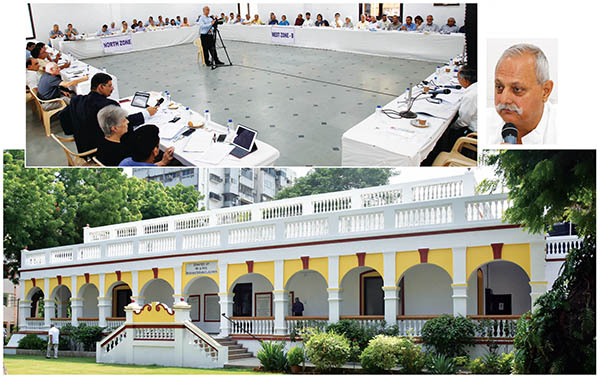
Clockwise from above l: view of participants at the executive council meeting of The Federation of the Parsi Zoroastrian
Anjumans of India; Brig Jahangir Anklesaria (retd), president, Ahmedabad Parsi Panchayat which hosted the meet;
Sir Navroji Vakil Hall All photos: Sarosh Daruwalla, Mazda Studios
From l: Mancher Mubarakai, Cmde Medioma Bhada (retd), Farrokh Rustomji, Dastur Khurshed Dastoor,
Yazdi Desai, Sam Chothia, Jahangir Anklesaria, Tehmton Anklesaria
Desai’s candidate for the West Zone A vice presidency, Mancher Mubarakai of Dahanu who stood for re-election, lost however, to his opponent Pervez Irani of the Iranian Zoroastrian Anjuman (IZA) by one vote. Prior to the vote, Irani told the gathering that the IZA had been "waiting a long time” to occupy the position. "We are now adamant. That’s why my insistence.” At the last election Mubarakai had requested he be nominated on the understanding the IZA would be given the opportunity the next time. The FPZAI had therefore refrained from holding an election, recalled former FPZAI president and former BPP chairman Dinshaw Mehta who now represents Bardoli. According to Mehta, "Mubarakai said ‘Let me come this time. Next time will be your turn.’” Mubarakai, however, denied giving such an assurance: "No, I never said so.” "Let others get a chance,” urged Mehta.
The anjumans of Thana and the IZA favored Irani while Borivli and Dahanu supported Mubarakai; the casting vote was Bombay’s. Desai said the BPP "will abstain” from voting as they had not decided which candidate to support. This brought a howl of protest and disbelief from the other three BPP trustees present: Armaity Tirandaz, Viraf Mehta and Xerxes Dastur. Dastur was the most vocal noting that at the board’s weekly Tuesday meeting the trustees sat till 2.10 a.m. meeting nearly 45 people and going over 62 items on the agenda. "We would gladly have discussed one more item had it been raised,” he added. The trio stated they were not aware there was to be a vote, nor had Desai mentioned one at the meeting. Dastur noted, "We have made an attempt to come here. I don’t want the BPP vote going to waste. We want our vote.”
Desai retorted they should have read the FPZAI agenda which mentioned the election. Viraf noted four trustees were present at the FPZAI meet. (Desai’s main, vociferous opponents, BPP trustees Noshir Dadrawala and Kersi Randeria were unable to attend. Dadrawala’s wife had fractured her fibula and Randeria was caught up in some urgent work. Zarir Bhathena too was absent.) "We have a quorum. Why are you scared?” asked Viraf. "Nonsense,” replied Desai, adding, "this is a BPP issue.” Dastur countered, "Don’t make it a BPP issue...We can decide” now. Desai insisted, "We can’t take a decision outside of the boardroom.” The vote had to be by "a show of hands; not emails or phones.” "For urgent issues we have done that in the past,” interjected Viraf. "Three of you can’t vote” and decide, retorted Desai. "Let’s get Kersi and Noshir online and discuss,” said Dastur. "And Zarir,” added Desai. Dinshaw asserted, "The chairman is only the first among equals. The majority vote counts.” Reluctantly Desai agreed as six of the seven BPP trustees favored Irani. The casting vote therefore went to Irani.
Desai had called for secret ballots for the two contested seats of West Zone A and B, ensuring the other trustees and the local population of the anjumans would have no way of knowing if their representatives voted according to their mandate or not. Voting in elected bodies such as the legislative assemblies all over the free world is always an open one. The ballot is not secret. Representatives are answerable to their constituencies.
For the North and South Zone posts only one nomination was received, that of sitting North Zone vice president Tehmton Anklesaria who said he reluctantly filed his nomination only four days prior. He said he did not favor candidates holding on to office for long durations and wished someone else would stand: "A vice president should step down after two terms.” Each term is of two years. "There should be a time limit, a rotation of leadership. Ghana varas cheetki nahi réhvanu (Shouldn’t remain stuck to the post for many years). There are wiser people than me,” stated Tehmton. He offered to withdraw his nomination but was persuaded to continue for some time. "Take Cyrus Engineer [trustee of the Delhi Parsi Anjuman (DPA)] under your tutelage,” suggested Desai.

From l: Armaity Tirandaz, Viraf Mehta, Xerxes Dastur, Dinshaw Mehta, Pervez Irani,
Khurshed Pastakia, Cawas Panthaki
West Zone B voting in progress
Engineer is a traditionalist and therefore acceptable to Desai. The nomination for vice presidency has to come from the concerned anjuman and zone but this formality is observed in the breach as most of the zones outside of West Zone B do not attend the FPZAI meets nor send any nominations. Cmde Medioma Bhada had not filed a nomination but Calicut and Belgaum nominated him, and was therefore asked to continue as South Zone vice president. Rusi Jeejeebhoy of Calcutta who had filed his nomination for East Zone vice presidency was reappointed. No other nominations were filed from that Zone. Calcutta has refrained from attending the meets after the FPZAI violated its cardinal rule and principle of not interfering in the internal affairs of a member anjuman. (Rule 5A: "Members... shall be free to manage their own affairs...The Federation may from time to time formulate...recommendations and suggestions...and the member anjumans may implement such recommendations and suggestions as they deem fit.”) The all-India body at an extraordinary general meeting on July 30, 2017 decided, despite objections from the anjuman, to implead itself in the Originating Summons filed by two Calcutta ladies over who is entitled to enter the local agiary.
There was another tussle over who should be the joint honorary secretary of the FPZAI. Desai wanted his loyalist Farrokh Rustomji to continue but Dastur pointed out that he and his colleagues on the board had "issues” with Rustomji. Rustomji had signed the agenda notice for the May 5 EGM which sought to remove five of the BPP trustees from the FPZAI and change the body’s address and rules, amongst other things, in order to give Desai complete control. A proposal was put forth by Dastur Khurshed Dastoor, president of the Udvada Athornan Anjuman and the Zoroastrian representative on the National Commission for Minorities suggesting that Jahangir be made a honorary secretary, but Desai refused, stating, "West Zone B wants Rustomji to continue.” Baroda anjuman president Baman Cama added, "The Federation will suffer if Rustomji steps down.” Jahangir had earlier stepped down as joint treasurer of the FPZAI stating he was never consulted in the financial matters of the body. Khurshed Pastakia, a chartered accountant and a traditionalist representing the Borivli and Suburban Zoroastrian Association was nominated in his place. Dinshaw made a suggestion that the Brigadier be appointed chair of the Defunct Anjumans Committee (DAC) which Chothia occupies. Desai retorted, "You can’t decide.” "It was only a suggestion,” Dinshaw replied.
His command over the 16 or so small Gujarat anjumans gives Desai leverage in the 69-member Federation as most other zones are barely represented. At one time the membership of the all-India body had touched 80 but some anjumans such as Bangalore withdrew and Secunderabad-Hyderabad suspended membership. Desai had erroneously stated that Bangalore was never a member of the FPZAI when in fact they were among the founding members of the body. Bangalore left around the time the BPP withdrew its membership in 1978 because the then DPA president Shiavax Nargolwala criticized the archaic BPP election scheme. Bombay rejoined five years later but not Bangalore, largely because of the opposition of the traditionalist head priest Dastur Nadirshah Unvalla.
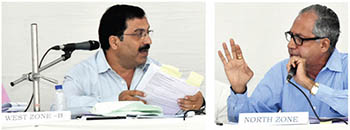
Sam Chothia (far l) and Tehmton Anklesaria: heated exchange
Even at the Global Working Group (GWG) meeting in Bombay on December 21, 2018, the other BPP trustees had expressed surprise when they were presented with a fait accompli of the proposed Global Council of Zoroastrian Trust (GCZT) deed and some proposed trustees. Desai does not appear to keep his colleagues on the board abreast of developments in the GWG and the FPZAI. He is at loggerheads with his six co-trustees and wants to cut them off from the other two bodies.
At the FPZAI EGM in Bombay on May 5, 2019 (see "Give peace a chance,” Parsiana, May 21-June 6, 2019) Desai had attempted to oust five of his co-trustees from the executive council and change the correspondence address of the FPZAI to his residence and the registered office to the same building that houses the World Alliance of Parsi Irani Zarthoshtis (WAPIZ) of which he is the chairman. He had called for the May 5 meeting knowing that Dastur would be attending the GWG meeting in Orlando, Florida and others may be away. When Dastur inquired, "Why the Federation (EGM) was held on the same day” as the GWG meet, Rustomji replied that they wanted the global body to be aware of the FPZAI decision on forming the GCZT so as "not to lose any time.” The FPZAI wanted the GCZT beneficiaries in India to be Parsi Zoroastrians while the others wanted the benefits for all Zoroastrians. Dastur alleged the communication was received from the FPZAI during the GWG meet. "You were aware I was there. Why didn’t you send me a draft?”
Dastur wanted to know why the BPP was not a signatory to the new trust. "The actual draft had the BPP. The BPP was lost somewhere along the way,” he remarked. Desai argued, "The BPP is not a federation.” To which Dastur countered "neither is WZO (World Zoroastrian Organisation) Trust Fund.” Desai replied it was a "world body.” Dastur countered, "The BPP is a 300-year-old body... elected by the largest franchise...nothing was discussed” in the BPP boardroom. With stiff opposition from Dastur, Desai agreed to put off signing of the trust deed.
Irani too complained that the IZA trustees did not have an opportunity to study the GCZT draft as they met once a month and if the draft came after the meeting was held it could only be discussed at the next meeting. He said the Anjuman "will not be part of it.”
Dastur also criticized the detailed minuting of conflicts at the FPZAI meetings. The recordings of the EGM on May 5 referred to "a barrage of accusations, rebuttals and counter accusations between the BPP trustees and members of the DAC. One of the vice presidents (Bhada) pointed out that it was exactly this kind of behavior which was hurtful and degrading for them, and which had prompted them to move the office of the FPZAI away from the BPP.” "Why are we putting it in writing?...Where will it end? We are Parsis,” remarked Dastur. Dinshaw countered the minutes "cannot be an eyewash. Facts have to be mentioned...in better language.”
Dastoor chipped in, "I agree with Xerxes. This should not be recorded...At the end of the day we are all together.” His sentiment was echoed by Cama. Desai conceded, "This will be knocked off.”
While Desai’s attempt to oust his co-trustees in the May 5 meeting had failed, at the July meet he managed to deprive three of them of their cheque signing authority for the FPZAI. BPP historically is the main funder of the FPZAI and provides the administrative and secretarial support, not to mention a registered office. Hence traditionally BPP trustees were given cheque signing powers. Now only the FPZAI office bearers and zonal vice presidents will have that right, he stated. Earlier the BPP trustees had questioned or opposed some payments that Desai had approved. He apparently retaliated by withdrawing their cheque signing authority. Ironically, Dadrawala, who refused to sign one cheque, still has cheque signing powers as he is honorary secretary of the FPZAI. Even Bhathena as the FPZAI honorary treasurer can sign.
Meet "once a year”
Perhaps aware that opposition from his co-trustees to his dictatorial functioning was causing him considerable embarrassment in front of his Gujarat loyalists, Desai wanted to hold the next FPZAI meet after a year instead of the six months mandated in the earlier FPZAI rules and regulations (in the copies of FPZAI rules with Parsiana this requirement appears to have been dropped. In its place is an amended clause which states, "An ordinary general meeting will be held once in every _ year at such time and place and on such date as the executive council shall determine”). The rules and regulations have been amended so whether the mandated bi-annual meetings requirement has been changed is unknown. Since copies of the current rules are not available at the FPZAI’s registered office, no one barring Desai and a few loyalists are aware of which rules are applicable and to what.
Desai also stated the meeting would be held only for a day instead of the traditional two days. He also put a halt to the reports presented by each anjuman on their current status, difficulties and successes. Instead the report would have to be submitted in writing and would appear in an electronic newsletter that has still to be started. Any queries or problems raised by the anjumans in their report would be answered "in a year’s time(!)” assured Desai. This means that several anjuman representatives will have no occasion to speak at the meet and their incentive to attend will be further reduced. It is a handful of vocal members who dominate the proceedings. At one stage when Dastur asked the gathering if they were okay with a proposal to hold the meeting once in year instead of twice, and for one day instead of two, few dissented. They did not publicly want to cross swords with Desai. It was finally decided to hold the next only for a day on February 16, 2020 in Bombay.
Attendance and participation at the FPZAI meets is dismal, save the West Zone B who come at Chothia’s bidding and lend their crucial vote to ensure Desai’s diktats and whims are acted on. Their numerical strength must be below 2,000 though the all-India Parsi population is around 50,000. But the handful determine how the FPZAI votes. The major anjumans in the zone such as Ahmedabad, Navsari and Surat are not with them. The vice presidents did not object to the scrapping of the anjuman reports where everyone has an opportunity to know what is happening elsewhere. The vice presidents, whose responsibilities include energizing their zones, ensuring participation, holding zonal meets, attending to the needs of the anjumans in the zone, have largely failed in fulfilling their obligations. Perhaps rightly, Dastur called for scrapping of the zonal system and adoption of the Federation of Zoroastrian Associations of North America (FEZANA) model.
The Parsi Junction fortnightly of July 21 carries correspondence between Pervez Mehta, trustee and honorary secretary of the Bardoli Jarthosti Anjuman and a former joint secretary of the FPZAI, Desai, Dadrawala and Dinshaw over which set of rules should apply to FPZAI. Dinshaw alleged that the amended rules could not come in force until the Charity Commissioner (CC) gave his consent, while Desai countered in the May 5 meet he had a legal opinion from a former CC that said the new rules could be followed, and as chairman so ruled.
But in a letter to Dadrawala, Pervez Mehta noted there was "confusion” among the anjumans on which set of rules were being followed. "In terms of rule 6...an anjuman member is required to authorize an individual to act as a representative of the anjuman...whereas...as per the amendment of April 4, 2017...only a trustee or a managing committee member or an authorized member of the anjuman (will) be permitted to attend.” Desai replied, "We have decided to follow the old FPZAI rules and regulations till the change report is accepted by the CC.” Dinshaw alleged the old rules were being followed so that the Desai camp could get their loyalists to represent any anjuman, even assuming they had no connection with the place. Dinshaw’s request that the delegates state their position in the anjuman when introducing themselves at the start of the two-day meet was vetoed by Desai, probably because several of the representatives may have had no connection with the anjuman they purported to represent.
Tithal missing
Chothia presented a DAC report on the assets of 16 defunct anjumans and the progress or lack of it on each property. The report was purportedly an update of the account he had presented in 2017. Of the 16 properties listed, Chothia has in the past two years visited seven: Neemuch, Allahabad, Dharwar, Rajkot, Harda, Hubli and Deesa. Eight anjumans, Igatpuri, Bhopal, Bijapur, Bina, Khambat, Nadiad, Nanded, and Suvali-Damka were visited in 2016 or before. No visit is shown against Raipur.
The report makes no mention of probably the most valuable land mass, the 13 or so acres of the forsaken Tithal Sanatorium which fronts the sea. A rough calculation after surveying on the Internet the land and apartment prices in the vicinity would put the valuation at around 200 crore rupees (around USD 29 million) for the plot. When Dastur inquired about the omission, Chothia lamely replied the matter was "sub judice.” But that did not prevent Chothia from including the property in his 2017 DAC report. The matter, incidentally, has been sub judice ever since the last 30 or more years when Mehrwan Irani of the IZA approached the courts to stop the sale of the valuable land parcel. Mehrwan fought the case till the Supreme Court and provided regular updates at the FPZAI meets. At some stage, tired of the lone and valiant legal battle he had initiated, he handed the matter over to the VPA. Tithal is in Valsad district and borders the city. Chothia has always been cagey about the legal status of the case.
A heated exchange took place between Chothia and Tehmton when the North Zone vice president complained he was not kept in the loop of defunct anjuman property developments and visits in his zone. Chothia showed a sheaf of emails sent stating the details and alleged Tehmton was not reading them. Tehmton responded by saying Chothia should phone and inform him when a site visit was planned. On other issues, delegates stated no one read emails and the most efficient means of communication was WhatsApp, social media and phone calls.
While confirming the reappointment of auditors, H. D. Jain and Company, Jahangir wanted to know if there had to be a rotation of auditors. Dastur, a chartered accountant, explained this requirement was not applicable to trusts. Jahangir suggested every trust should annually add 15% of the interest received from corpus investments to the corpus. Dastur added the amount could be invested in specific mutual funds. "It is incumbent on us to grow the corpus,” he added.
To be continued