Whether in government service, the railways, in business, boarding
schools or on summer holidays, many Parsis frequented the hill station
Rusi R. Sorabji
Opposite the Blessington Hotel in Simla was a narrow 150-yard long road tunnel passing under the Mall and the Ridge, skirting the haunted Band Stand. It connected the Hotel and rink side of the town to what was then called Lower Bazar, a street lined with shops: clothiers, dressmakers, photographers, military outfitters, jewelers (a name I remember was Hamilton and Company), Gaiety Theatre and another cinema. Going west along this road took one to the telegraph office and railway station. Going east and south took one to Chhota Simla, Bishop Cotton School (BCS), two breweries and the new cemetery.
Though built by an English engineer named Elysium in 1905 and later christened Khachhar Surang, in Parsi circles the road tunnel was referred to as Behramji nee (Behramji’s) tunnel. How or why it was so called, I had been unable to ascertain for 80 years, but while talking with eminent lawyer Fali Nariman earlier this year, he refreshed my memory that Byramji was the owner of the Blessington Hotel where his parents stayed when visiting him during his schooling at BCS. And this is one story they related. "Proprietor Byramji was a wily old fellow. One night an Englishman who worked at a tailoring shop on the Mall had drunk one too many and angrily strode into the dining room saying: ‘Where is that bugger Byramji? He feeds us only potatoes and tomatoes.’ Byramji was in his office but did not stir out. My father pacified the Englishman, took him to our room and offered him another drink, which calmed him! Next morning the wily old Byramji took out a whole lot of broken crockery from his godown, summoned the Englishman to his office and informed him that he had broken it the previous night and billed him for a fanciful Rs 100! Byramji was fat and short: the Britishers who stayed at his hotel — and drank a lot — would occasionally pick him up and throw him on the billiard table, just for fun. He suffered these indignities but had his devious methods of extracting money from the hotel guests.” Thanks to Nariman, the riddle of how the tunnel in front of Blessington Hotel got its name now stands resolved.
There was another Behramji, whose surname was Malabari, a remarkable person who lived out his final days in Simla. Malabari passed away on July 10, 1912 and was buried in the Parsi cemetery there. He was born on May 18, 1853 in Baroda where his father Dhanjibhai Mehta was in the service of the Gaekwad ruler. Later, his mother remarried a relative, one Meherwanji Malabari, and young Behramji adopted his stepfather’s surname.
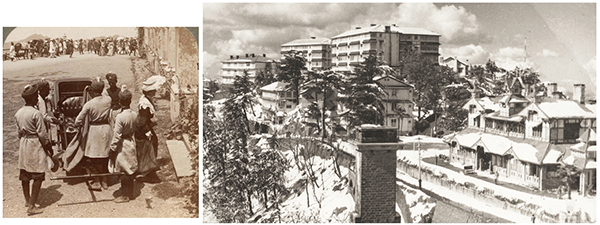
Above left: Rickshaw in Simla; right: Grand Hotel and General Post Office
Top row from l: Cavas and Aban Desai; Shermin, Rusi, Villy and Daraius Sorabji;
2nd row: Villy, Dinshaw, Maneck and Gool Karbhary; Kumi Sorabji and friend at Waverley Convent; Kumi
Grave of Behramji Malabari (below)
Behramji Malabari had come to Simla to establish a public tuberculosis (TB) sanatorium in the clean air and beneficial climate of nearby Dharampor. A close friend of Sir Cowasji Jehangir, Dr Dadabhai Naoroji, Max Mueller and Florence Nightingale, he was best known for his ardent advocacy for protecting the rights of women in India and his opposition to child marriages. At 34 years of age, he was made a Fellow of the Bombay University and a justice of the peace.
Malabari’s writings created strong public awareness and influenced the British government to bring about social reforms that
redressed the exploitation of women and young girls. He was strongly supported in his mission by his friend, the reputed Justice Diwan Dayaram Gidumal. Malabari wrote three books: The Indian Eye on English Life (Rambles of a pilgrim reformer), Gujarat and the Gujaratis (A personal account of the Gujarati culture, politics) and The Indian Problem.
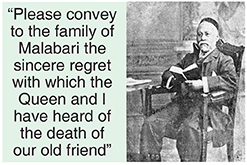
On Malabari’s death, when the hearse passed the commander-in-chief’s bungalow the Gurkha regiment reversed arms to pay their last respects. He had been friendly with almost all the viceroys and governors and His Majesty King George V wired the Viceroy as follows: "Please convey to the family of Malabari the sincere regret with which the Queen and I have heard of the death of our old friend. His death will be a loss to the country.”
The Seva Sadan Society, of which Malabari was the co-founder, resolved: "Womanhood in India, especially destitute and widows, has suffered an irreparable loss in his passing away.” A similar resolution was passed by the TB sanatorium at Dharampor.
Christ Church School was attached to the 1844 landmark place of worship with the high steeple on the Jakhoo Hill side of the Mall. This is where Villy Karbhary, who was to become my wife in 1963, received her early education. Her parents, Gool and Dinshaw, were originally from Nargol, near Sanjan. Dinshaw was the manager of the Government of India’s Grand Hotel, located at the other end of the Mall past the general post office and Davicos, from 1944 to 1952.
During Karbhary’s tenure, the Grand Hotel was the summer home for many Parsis escaping the hot and humid weather of the plains or for those on their honeymoon. One regular resident was the brother of Feroze Gandhi, a brilliant and highly accomplished person. But as Gool once told her daughters and me, when it snowed something made him act in a crazy manner. He would take off to the Mall in his birthday suit with the hotel staff in hot pursuit carrying a blanket and some clothes in the hope of catching him before the English policeman did. Recently a friend, originally from Allahabad, mentioned that when this gentleman came to visit their family, the young ladies were asked to leave the room.
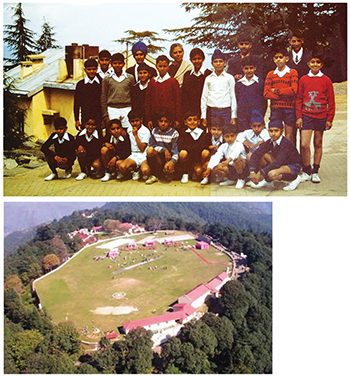
Top: Daraius Sorabji (standing, far right) at Chail Military School;
above: cricket field at Chail
Loreto Convent School, old and new; School emblem Photos: School’s Facebook page
In 1952 my father-in-law’s services were transferred to New Delhi as Superintendent, Government of India Hostels. My wife’s younger brother Maneck, born in Simla in 1946, later rose to be a wing commander in the Indian Air Force and was a classmate of Air Chief Marshal Fali Major. Maneck was with the VIP squadron which transports Indian presidents and prime ministers. In 1987-88 he joined Air India International as captain on the Boeing 747s.
The baby of the Karbhary family, Daisy, was born in New Delhi at the Hardinge Hospital and delivered by my dear friend and classmate, the soft-spoken Dr Pervez Heera. After her marriage to Adil Bapuna of Nagpur, Daisy, like the pioneering Parsis of the 18th and 19th centuries, settled down in the remote town in Central India. Their family business is daru (liquor), distilling, brewing, bottling and distributing the finest in the land. Parsiana had published an extensive article on them some years ago (see "The family spirit,” Parsiana, June 2003).
Even though the Karbharys left Simla for New Delhi, the family maintained a connection, making frequent visits to the hill station over the next three decades, whether on honeymoon, to escape the heat of the Delhi summer or for the schooling of my son Daraius.
Nariman, who had arrived in Simla in March 1942 as a 12-year-old refugee from Burma after the Japanese overran that country, told me, "My parents decided to place me as a boarder in BCS. I was admitted to Std V. I did my Junior Cambridge examination (from there) in pencil. Our papers were sent to London for evaluation (with one carbon copy preserved in case the ship which carried our examination papers was attacked and sunk by a German U-Boat!).
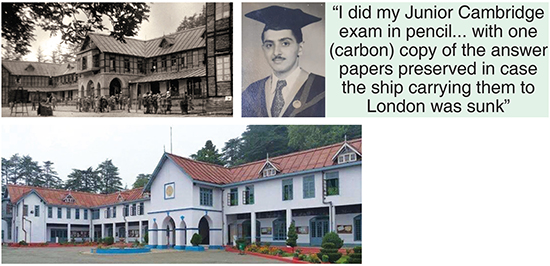
Bishop Cotton School then and now Photos: School’s Facebook page; Fali Nariman (above r)
"I was in the school’s cricket team but fared quite badly. Once the school was visited by the then fastest bowler in the world — the Australian (Harold) Larwood — and we were thrilled when he umpired a couple of our cricket matches.”
Nariman remained at BCS for two years where he was rather miserable since, as the only child of his parents, he was "spoilt!... But Simla in those days was a beautiful place and my parents knew the Framjis (Dosibai and Dinshaji), who were extremely hospitable to all Parsi students, inviting them to their home on the Mall every Sunday for dhansak. In that climate, there was no problem walking miles from the school which was located down below Chhota Simla, three or four miles from the Mall.”
Like all boarding school kids, Nariman’s one complaint was "school food.” His father had made arrangements with Davicos and Mr Daeboo would deliver a cake to him every Sunday. "Every week we boys would be paid (at our parents’ expense) the maximum of two rupees, and at our tuck shop in the School a fried egg on toast (still delicious to contemplate) cost us as much as eight annas (i.e. half a rupee),” Nariman recollected. "In those days the food at restaurants was truly inexpensive. Sometimes on Sundays I would indulge in what was known as a half-lunch at Davicos (main dish — chicken curry and rice) paying only one rupee and fifty paise. A full lunch with soup and dessert cost a rupee more, which I could not afford since my weekly allowance was only two rupees.”
Similar accounts of spending the pocket money on food were related to us by Daraius who was a student at the Chail Military School in 1975. He used to go down the very steep road to the few shops that made up the nearest bazaar and eat jalebis or aloo parathas. Daraius was supplied with bhakhras, which his maternal grandmother Gool mailed him, since we then lived abroad. The bhakhras were so good that the boys in the dormitory would break open Daraius’ steel cabin trunk with three locks in the middle of the night to get to them!
Simla at 8,000 ft and Mussoorie at 6,500 ft were two hill stations famous for their boarding schools: St Bede’s College and Loreto Convent for girls, the BCS for boys in Simla and The Waverley Convent and the Woodstock School in Mussoorie. I can still recall some Delhi Parsis whose children schooled in Simla and Mussoorie in the 1920-50s. The Bankwalla girls, Dolly, Nelly (Nargish) and Fanny (Freny) were at the St Bede’s in the early 1940s. My friend and classmate from over 78 years ago, Roshan Vania, qualified for her teachers’ training course from the same institution in 1951-52. One of her classmates was Meher Madan, while my mother Kumi, my aunt Tehmi Jal Irani and the Kothawalla ladies were at The Waverley Convent during the early 1920s. The last was the oldest boarding school for girls in India dating back to 1845.
The Bankwalla boys, Noshir, Jungoo and Rusi and the Ghandi boys, Homi, Rusi and Tester received their early education at Woodstock School. Noshir was brutally murdered in the School’s dormitory while he was fast asleep. Homi Ghandi was implicated in the crime, but Sir Tej Bahadur Sapru, one of India’s top lawyers at the time, proved him innocent.
At the BCS, the earliest Parsi student was said to be Rusi Boga who passed out in 1920. His nephew Jal Boga arrived at the School in 1945, the year Nariman left on completing his Senior Cambridge examination. Jal was a brilliant student and a good sportsman. His name still appears on the honors board in the Irwin Hall. In his memorial letter, "The Best Years of my Life,” Jal recalls four other Parsis at the School. They were Behram Irani, Keki Nanavati, Feroze Vakharia and one Ratan Tata. I was able to contact Irani in Switzerland who clarified that his friend Ratan was fondly called "Lamboo” as the boy was six-and-a-half feet tall! Irani also mentioned that Nanavati was the best wicket keeper and his mother, the bursar of the School, was a kind and generous lady who invited all the Parsi boys for a treat on the two Navroz festival days. About Vakharia he recalls that he had settled down in New York or New Jersey.
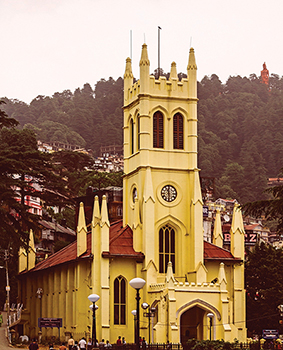
Christ Church Photo: Hersh Acharya
The Chail Military School further south of the BCS was situated in the beautiful summer capital of the princely state of Patiala overlooking the valley of the river Sutlej. The romantic history of Chail deserves to be told. Sometime in 1905-08 the young Maharaja of Patiala eloped with the daughter of Lord Kitchener, commander-in-chief of the British Indian Army, and secreted her in his summer palace at Chail. Kitchener banished the Maharaja from Simla, so the latter built for himself a summer capital better than Simla. The majestic snowcapped Shivalik peaks, beautiful orchards, sylvan pine and deodar valleys cast a spell on everyone. Chail also boasted the only school in the region with its own cricket field. At over 8,000 ft it is the highest cricket field in the world built to international specifications, created by flattening an entire hilltop. I was once able to take the cricket team of Engineers India Limited to play against the Chail Military School XI.
In June 1963 my wife of two days and I went on our honeymoon to the Grand Hotel, Simla; she after a lapse of 11 years. It was funny hearing some of the old staff calling my wife "baby,” with pride and respect. We were allotted a suite on the top floor with a panoramic view of the snow-capped peaks. The monkeys came visiting throughout the day. To escape these mischievous long tailed Simla langurs, we went for a stroll along the Mall where we bumped into several Parsis from Delhi and elsewhere. Like the langurs of Simla, it was difficult to avoid them. The Mall, the Band Stand, sari shops and even remote places like Summer Hill, Wild Flower Hall or Jakhoo, you name it, they were there. Two-thirds of the Parsi families of Delhi’s Tansen Marg (Bengali Market) were there as well, accosting this newly married couple wherever they ventured.
My wife and I had to forget our honeymoon and found ourselves entertaining some of these Parsis. The Sidhwa sisters, Hilla and Katty, stayed two nights with us at the Grand Hotel… in the same room! Then came Meher, Daulat and Mehru Nanavatty, Khurshed Kapadia, his wife Villy and daughter Gool. When she invited us to lunch, old Bapai Sidhwa would not allow us to cross the threshold of her place in Summer Hill until she performed the aachhu michhu, swirling an egg in circular orbits around our two bowed heads seven times before smashing two good wholesome ones on either side of the steps.
In 1963 "Aapro (our) Sam,” accompanied by his wife Silloo, daughters, Sherry and Maja, arrived in Simla as the officer commanding, Western Command. He was then Lt Gen Sam Manekshaw.
Our next holidays in Simla were in the summers of 1972 and 1974 at the invitation of Villy’s cousin, Maj Zarir Patel and family, originally from Nargol. In 1972 Indira Gandhi, who was also there, would wave out to our kids as she drove by in a black Mercedes. In May 1974 Dr Homi Sethna of the Indian Atomic Commission conducted India’s first underground nuclear test, which resulted in unseasonable heavy rains and hail in Simla. We were caught outside in heavy hail storms a number of times. Once at the Wild Flower Hall hill, it was thunder, lightning and hail from low clouds just a few hundred feet overhead. The flash and the bang being instantaneous, it was very scary for our two kids, Daraius and Shermin, and Villy’s young sister Daisy, with only a three-foot extension of the roof jutting out to partially protect us from the lethal blast of hail, deafening bolts of thunder and blinding flashes of lightning.
Chail, with its highest cricket field in the world and the scary or scandalous stories that Jal Master would relate when travelling by train to and from outstation cricket matches, has remained etched in my memory. During the 1973 summer vacation, when we paid Daraius a visit at Chail, the entire Maharaja’s Guest House along with the staff [cook, bearer, chowkidar (watchman)], was available to us.
One moonlit evening we were seated around a fire on the lawns of the Guest House enjoying evening drinks and Himachali pakoras, when along came the khansama, the waiters and their families to share the warmth of the fire. While chatting with these humble people the topic turned to wildlife. But before the chowkidar’s account had ended, one by one the family disappeared indoors to safety behind the thick English oak doors on hearing his revelation: "Pichlay haftê shér humaré kutte ko lé gaya (Last week a tiger carried off our dog).” A leopard is a really fast and dangerous cat. In the safety of the Guest House’s richly furnished Victorian interiors all hands banged on what must have once been a very expensive upright piano, hoping the noise would keep any leopards, panthers or tigers at bay! Post dinner and more piano playing, this time more melodious, it was bedtime.
In the quiet of the night we could hear slow footsteps on the stairs outside the bedroom. Master’s stories were now playing in real time. The weight of whatever was haunting the staircase made the English mahogany or oak steps squeak and groan. Accompanied by the banshee wail of the wind outside, it was scary for our children. My wife and I, armed with a hiking umbrella with a four-inch lethal spike at its end went to investigate. We found no person or apparition anywhere, and all the doors and windows were bolted from the inside. Who had bolted them and how did the bearer or the waiter, the last person exit the premises? My wife made another horrifying discovery: the door of our room could not be bolted from inside. So we used a seven-foot settee and a large sofa to barricade the door, with two table lamps aimed at the door to blind anyone trying to enter. We tried to sleep, but soon I could hear a faint sobbing from my companions.
Terrified by the occasional ghostly squeaks from the staircase outside, I don’t recall when I fell asleep, but on waking up to a loud knock on the door with the bearer announcing that morning tea was served in the dining room, I found I was still gripping the umbrella. At breakfast the waiter informed us that the doors and windows had been bolted by him from the inside. That eventful night these adult Parsis of Delhi almost believed that ghosts do exist. Was it the ghost of the beautiful young daughter of the commander-in-chief of India who, as the story goes, was kidnapped at Scandal Point on the Ridge by the powerful young Maharaja of Patiala and locked up in the basement so that her father’s troops could not find her?
However, as non-believers in ghosts we often visited Chail and stayed at the same place several times between 1974-78 along with friends and relations. We made several discoveries: it
always rains at midday on June 15 as the bells toll at the temple atop Chail hill; the millions of tiny bright stars that one sees at night below the silvery snow ranges to the north are not heavenly bodies but the lights of Simla; at Tattapani in the river Sutlej one has a choice of hot or cold running water and even an open-air steam bath in the sulphur springs, as well as river rafting; on a hot day using the Thandi Sarak is cooling despite any distance one may walk; one should ignore the monkeys, but beware of running into a bhaloo (bear); always walk on the hill side of a mountain path, avoiding the khud (valley) side.
We also had a Parsi governor of Himachal Pradesh, retired Vice-Admiral Rustom Khushro Shapurjee Ghandhi who, along with his wife Khorshed, resided at Raj Bhavan, Simla from 1986 to 1990. Ghandhi, who received the Vir Chakra for gallantry in action during the 1971 war with Pakistan was also awarded the Param Vishisht Seva Medal for meritorious service of the highest order. The Ghandhis made many improvements to Raj Bhavan, including completely restoring the billiards room and Durbar Hall, as well as constructing a gazebo on the premises. Ghandhi later served as a Member of the National Commission for Minorities from 1993 to 1996.
There were other Parsis in Simla prior to 1950, some in the railways and government service whose names elude me. One such railway family lived on the corner where the road up from the railway station meets the Mall.
Vania’s sister-in-law Bulbul’s father, who was with the newspaper Tribune came to Simla in the late 1940s, when Bulbul was just seven. The family was friendly with one Miss Banker who was attached to the Young Women’s Christian Association and Bulbul recalls playing badminton with her during the mid-1950s while she was schooling there. Bulbul and Minoo’s son Bingo and his family were stationed in Simla for six years from February 2005 to June 2011.
There was another family, the Dotiwallas, who had a daughter named Vira. The father was with the Singer Sewing Machine Company with a shop in Lower Bazar.
While looking for Parsis in Simla I was surprised to find that the "middling-sized village” of 1817 had by 1870 onwards become virtually the capital of one of the greatest empires in the world, with maharajas, princes, European lords and nobles, travelers, merchants, poets and writers from various countries to be seen on the Mall and in the bazaars. Beautiful villas and splendid Victorian houses dotted the hills. The Mall, The Ridge and the roads were on summer evenings the venue for a show of fashion and beauty.
Exactly 40 years after completing his education at Chail, Daraius entered the 2018 US general election as a counselor from the City of Campbell. Being the first Parsi or Indian to do so from Silicon Valley, California, some Bombay periodicals printed this news. One Farokh Nowrosji of Bombay read about him, obtained my address from the editor of the publication and advised me to write about the Parsis of Simla. He very kindly briefed me about one Sorabji Billimoria who was the first to open a Chinese shop on the Mall in Simla nearly a century ago. The gentleman was his grandmother’s brother.
When I informed Nowrosji exactly where the shop was located in 1940, where the Billimorias lived and that he was amongst the first two people to open a shop in New Delhi’s newly constructed Connaught Place, he confirmed, "Spot on!” I added that as Sorabji was the father of Navel who married my mother’s youngest sister in 1949 and "Navel being your mother’s cousin, we are sagaas (relatives).” My late father always said, "Our community is so small, all Zoroastrians are like family to us.”