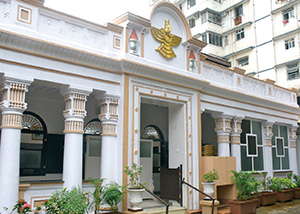
The Sorabji Cowasji Thoothi Agiary at Walkeshwar, Bombay was founded by Bai Cooverbai, the widow of Seth Sorabji and daughter of Navroji Fardoonji Vachha. Both Sorabji and Cooverbai belonged to the Bhagaria mobed sect of Navsari. Thoothi came to Bombay at an early age and served as a priest to a wealthy Parsi named Readymoney. His employer was influential and a municipal councillor.
 Young Thoothi worked for some time and gained the confidence of his employer. He then requested a building contract, which the kind gentleman obtained for him to build Grant’s building at Colaba and another to build a pond at Dhobi Talao. These contracts proved profitable. Through the good offices of his employer Thoothi also obtained the contract for laying railway lines of the Great Indian Peninsular Railway Company. Being short of money, and the work being considerable, Thoothi formed a partnership with Bamanji Jamsetji Moolan, Pestonji Rustomji Kanga, Sorabji Manekji Katrak and Dosabhoy Hormusji Bajan. They were successful and Thoothi, as senior partner, assisted by his wife who moved up and down in a palanquin to supervise the line, made a fortune. But when his health failed, the partnership was dissolved.
On September 12, 1857, Thoothi set up a new firm called Jamshedji Dorabji Naegamwalla and Company with only Jamshedji Dorabji Naegamwalla, in which he remained more or less a sleeping partner. On October 12, 1844 he invested part of his earnings to buy a hill called Angola Doonger on Malabar Point, where the present Raj Bhavan is situated. There he built two bungalows and planned to build an agiary as several Parsis had come to dwell nearby. He died on May 29, 1858, but his wife had the agiary built in his memory. It was opened on the first anniversary of Thoothi’s death, Amardad roz, Adar mah 1228 YZ, May 29, 1859.
In or about 1861 the government wished to build a bungalow for the use of the governors on a small plot at the extreme end of Malabar Point, the only approach to which was by sea. The government approached Cooverbai for land to create a road leading to their plot. In lieu of this, the government offered her land at Byculla where the Victoria and Albert (now Bhau Daji Lad) Museum and Victoria Gardens (now Jijamata Udyan) stand. Cooverbai gifted the land to the government. In appreciation of this, the then Governor of Bombay presented her with a silver tea set which was later auctioned in England.
For the maintenance of the fire temple she donated government loans worth Rs 12,000 and two bungalows adjoining the agiary. Legend has it that when the agiary was being built a well was dug, but there was no water. Cooverbai was lowered into the well on a chair and there she prayed the Avan Yasht. As a miracle of faith, sweet water was found in the well though it faces the Arabian Sea.
Cooverbai, who was born in 1810, died on October 1, 1889.
MARZBAN GIARA
marazbang@gmail.com