Navsari, even in the 20th century, did not always accord respect to its ordinary priests. An overripe melon was said to taste like a dasturji. He was often denigrated and looked down upon. Quite contrary to the Brahminical supremacy among the Hindus, Parsi priestly families were poor and only the brightest received formal education. Young boys were ordained as priests even before puberty and soon started working full time in fire temples. The girls were not too welcome in better off behdin families [andhyaru ni chhokri andharoo laavé (daughter of a priest is the harbinger of bad luck)], thereby adding to the penury. This did not however prevent diamonds from sparkling and lotuses from blooming.
What Dastur (Dr) Firoze Kotwal is to scholarly learning, Ervad Eruchsha Karkaria was to piety. If Zoroastrians recognized saints, he would have been canonized by now. And we are neither exaggerating nor being lyrical. A ninth generation priest, he had two daughters and knew that his line would end with him. And he was aware of this even before his marriage, as he was an exceptionally gifted astrologer. With his highly myopic vision, without charging any fee he would peer through thick glasses at horoscopes till late at night, and few knew that he was near clairvoyant and clairaudient. He led a spartan and pure life, dedicated to serving the holy fire. In his long life, he must have recited several lakh (yes, several lakh) Atash Nyaishes (hymn to the fire) before the king of kings or Padsha Saheb, as he addressed the sacred element. As an accomplished Khshnoomist (mystic), he recited the second and eighth paras of the Moti Haptun Yasht after finishing the Atash Nyaish; a most potent formula for spiritually cleansing every cell and purifying the aura. His smiling, slightly cockeyed gaze made his countenance more radiant. Other senior priests sought his counsel in confidence and he soothed many a lay person’s heart with sage advice. He died a poor man who never asked for help. Society did not mourn him and few knew his true spiritual status. But then condolence meetings are not required for those whom the angels are eager to receive.
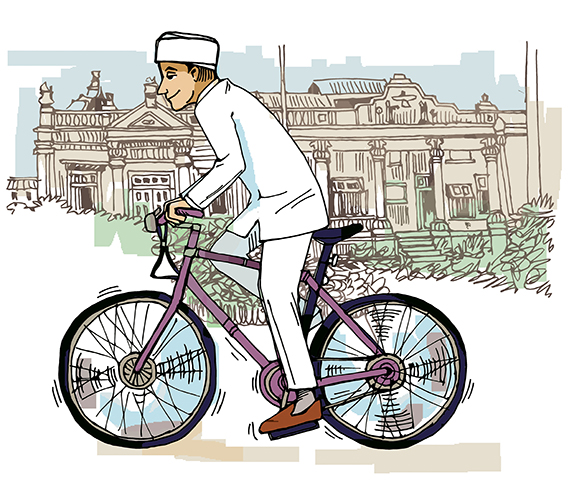
Illustration by Farzana Cooper
Karkaria narrated the story of a very short and rotund old priest of great dedication called Desai who was a stickler for ritual observances to the extent that he once performed a three-hour-long ceremony in a fire temple and then realized that his kusti had become accidentally untied at the back. So he repeated the entire ritual. Desai was a regular boiwala in the Navsari Atash Behram and late one night, after tending to the fire in the Ushain gah, at around 2.30 a. m., he saw a very tall, handsome, bearded figure with a glowing aura step out of the sanctum sanctorum. Desai fell to the ground in a daze and remained unconscious until dawn. Many other mobeds recalled similar experiences to what Desai had witnessed. Each fire temple of antiquity has a guardian angel, believed Navsari. Karkaria thought these could also be highly advanced Zoroastrian sages performing certain rites for replenishing the strength of the holy fire diminished due to constant absorption of negative energies emanating from devotees.
Of course, Navsari also had priests who omitted large portions of the prayers (gaapchu maaryu) and pocketed money from the unsuspecting members of the laity or those who recited profane limericks during the seclusion period of cleansing prior to participating in a ceremony for their clients or those whose vocabulary of abuse would make Dadar Parsis blush. Then there were others who clowned around, becoming objects of ridicule and mirth. They were openly addressed by their nicknames. We recall a very short-tempered priest who reportedly bathed only twice a week and was called for some inexplicable reason as choi.
We were quite fascinated by the old priest with a smiling face who acted like a town crier of the Middle Ages. We recall seeing him in the early ’60s, standing in the mohalla, cupping his hands to his mouth and loudly announcing in a nasal voice that Pallonji Khurshedji Bhathena, khavind (husband) of Goolbai, and bawaji of Rustom, Sorab and Dolly, had left for his heavenly abode, and giving details of his paidust and uthamna. The priest was not only a harbinger of bad news; he also doubled as the reader of the lagan ni chitthi, extending an invitation to the entire mohalla to attend the wedding. Woe betide him, if he read out the invite in a mohalla not on the host’s list ["Dasturji! Tumné Baria Vad ma chitthi vaanchva koné kahéloon? (who told you to read out the invite at Baria Vad?)”]. His voice robustly making announcements in the early morning was true Parsipanu. Those were the days, my friend; we thought they would never end.
During our navar initiation, and also later, we were very impressed by a young handsome priest in his early 20s, very unassuming and friendly, but with a no-nonsense approach, riding a bicycle, who was blessed with a sonorous voice and poured his heart out while praying. His name was Keki Ravji. Today they call him the 18th Dasturji Meherji Rana, the High Priest of all Navsari.
Berjis Desai, author of Oh! Those Parsis and The Bawaji, occasionally practices law.