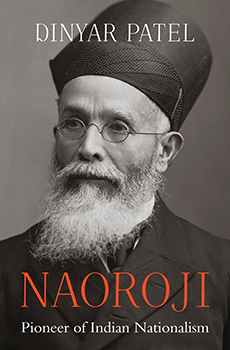
NAOROJI: Pioneer of Indian Nationalism by Dinyar Patel. Published in 2020 by Harvard University Press, 79 Garden Street, Cambridge, MA 02138, USA. Pp: ix + 352. Price: Rs 699.
With NAOROJI: Pioneer of Indian Nationalism Dinyar Patel (pictured) has indeed accomplished a monumental task. The book is a comprehensive biography of the "Grand Old Man of India.” By piecing together multifarious sources, cloistered in libraries and archives of London, Delhi, Bombay, Ahmedabad, Baroda and Navsari, this beautiful narrative on Dadabhai Naoroji is offered to us readers through painstaking efforts by the young historian. The journey of Parsis and their contribution to Indian nationalism has led to this magnum opus which was preceded by an equally great contribution in 2016, in the form of an edited volume with S. R. 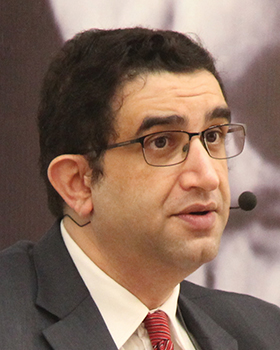 Mehrotra titled Dadabhai Naoroji: Selected Private Papers published by Oxford University Press. The present book has deservedly received the prestigious Kamaladevi Chattopadhyay New India Foundation Book Prize 2021 that celebrates non-fiction literature of quality. It is the result of eight years of constant endeavor at Harvard University where Patel completed his PhD dissertation.
Patel’s work is not the first biography on Naoroji. R. P. Masani and Omar Ralph’s works on Naoroji are two previous noteworthy contributions on this young Bombay boy who grew to be the "Grand Old Man of India.” Patel’s work however is not just the story of Naoroji as revealed by his published writings but a history unfolded by leafing through his massive private correspondence amounting to almost 15,000 documents. During his research, Patel also unearthed new material in English and Gujarati. Through this book Patel has tried to highlight Naoroji as the leader who enunciated the concept of Swaraj (self-rule) — a simple and powerful word acquiring great resonance among the Indian masses. Patel’s work also answers charges leveled by Naoroji’s critics labeling his policies as being "collaborative,” "a kind of mendicancy” and his political career as a "sad failure.”
Patel has rightly concluded that the life and thoughts of the first Asian Member of Britain’s Parliament showed a constant evolution. Naoroji in his young days was in the vortex of the developing Indian national movement. From a believer in the just and fair character of the British, Naoroji soon became an unflinching critic of the drain of India’s wealth under foreign rule. While he appeared moderate in his views to many radicals like Bipin Chandra Pal who had ridiculed his notion of "Self Government under British Paramountcy,” his transition to the concept of Swaraj showed his disillusionment with the British rule. He became more radical with age and was ready to embrace new ideas even at the ripe old age of 81 in 1906 when he was made the president to avoid a split between the moderate and radical factions in the Indian National Congress. This trait of Naoroji was recognized by Gandhi who looked on him as a source of inspiration. Naoroji’s determination to enter into the British Parliament and his victory from Central Finsbury on a Liberal Party ticket may not have yielded the desired results but it established the trend of Indian leaders engaging with British politics. His courage and conviction were admired by leaders like Jawaharlal Nehru and Sarojini Naidu who regarded him as a trail blazer.
 Much is also revealed about Naoroji and his family in this biography. Naoroji’s family had to endure long periods of separation from him when he was in London. His influence on his grandchildren led Perin Naoroji and her sisters Gosi, Nurges and Khurshed to plunge into the national movement.
Patel’s biography is not just the story of Naoroji but the story of Bombay and the trans-national connections which Naoroji developed during his lifetime. It is also an interesting narrative of the early years of the Indian Anti-Imperialist struggle and a detailed but engaging documentation of Naoroji’s parliamentary campaigns. He remains an inspiration even today to the British Asian community. Naoroji’s influence was not limited to India alone and his confrontation with the British regarding economic drain helped further colonial struggles in Indonesia, Ghana, etc. What also emerges through the biography is the love and respect the people of India, particularly Bombay, showed for their pitamah (grandfather). The doyen of social reform among the Parsis who took up the cudgels for girls’ education, the voice of rationality and truth, has received a befitting tribute and renewed recognition through this compelling biography.
Dr MEHER MISTRY
Mistry is assistant professor and heads the history department at Ramniranjan Jhunjhunwala College, Bombay. She earned her doctorate from the Asiatic Society, University of Mumbai.