The Parsi DNA comprises many ethnic strands
Yezdyar S. Kaoosji
In March 2016 I was present at Parzor’s Everlasting Flame exhibition at the National Museum in New Delhi. I was walking to the gate after attending a conference session where the discussion panel chairman had waxed eloquent about preserving "Parsi racial and ethnic purity” when a security guard appeared bewildered and exclaimed that I resembled Vijay Mallya, the fugitive beer baron who was then on the run from the Indian authorities! Other guards joined in and jokingly cautioned me to be careful, warning that the New Delhi police may pick me up! Apparently, my appearance in a business suit, sunglasses, and my grey French beard bore a resemblance to the infamous lookalike! I had a good laugh with them before I drove away, wondering how a so-called "racially pure Parsi” could resemble a Saraswat Madhwa Brahmin from Bantwal, Karnataka!
Like many Parsis, I had unhesitatingly accepted my ethnicity as being of "pure Persian ancestry.” There were no known so-called parjats (outcasts) among my ancestors. Besides, I have a documented list of forefathers going back seven generations to an ancestor born in 1679! I shrugged my shoulders, tucked this trivia away and have often joked about my newly found allegedly crooked cousin!
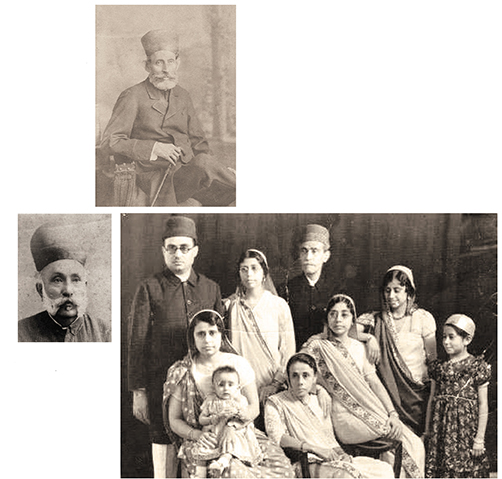
Top: Yezdyar Kaoosji’s great-great-grandfather Khursheed Hormusji and (above left) grandfather
Dadabhai Bastawalla; (above right) his maternal grandparents Eduljee and Aalamai Taraporewalla
with five daughters, son-in-law and granddaughter, his mother Parvis Kaoosji (3rd from r)
Group photo taken on parents Sheheryar and Parvis Kaoosji’s wedding
But, the comments at the conference session continued to haunt me so I responded to an advertisement for a DNA kit that provides a detailed report on one’s genetic make-up. To my utter surprise, the results of my ethnicity estimate contained several other ethnicities besides my Persian roots. I share these findings of a "racially pure Parsi” who may physically resemble many Parsi readers of this article!
West Asian (Mizrahi Jewish, Iranian, Iraqi, Turkish) 48.4%; South Asian (Indian subcontinent) 35.9%; Scottish, Welsh, Irish 5.4%; North African (Egypt, Libya, Tunisia, Algeria, Morocco) 4.7%; Middle Eastern (Israel, Saudi Arabia) 4.7%; Nigerian 0.9%!
I have enjoyed watching the PBS-TV series Finding Your Roots by Prof Henry Louis Gates. In each segment, he explores the ancestry of three US celebrities and reveals the results to his surprised subjects. So I attempted to examine my DNA analysis similarly, but Prof Gates uses a combination of DNA comparisons across the world, with census and other public records. Alas, we do not maintain records in India as is done in the USA and Europe. So I can only construe from my DNA information that in the distant past, some of my ancestors had traveled, interacted and intermingled with people of other ethnicities, and added an interesting rich diversity to my gene pool.
My first and lasting reaction has been: "Great…I am a very well-rounded human being!”
In the Parsi community women and men are ostracized for marrying non-Parsi spouses. Their children, with certain exceptions discussed later, are not considered Parsis though they may be initiated into the Zoroastrian faith. I hope this article will encourage all Parsis to examine the fallacy of the so-called "racial purity” argument upon which this practice is based! I believe many others in the community will find themselves in similar circumstances.
I could also infer that like my ancestors other Persian Zoroastrian migrants to India were nomadic traders, soldiers of fortune or even mendicants who had drifted beyond their tribes. To Scotland for instance…yes, I confirm there’s an active gene in me that enjoys sipping a good scotch! Or, to the rich and diverse Middle East and its surviving archives that draw me to spend my meager retirement resources on vacations to see the lands trodden by my ancestors!
Then, thoughts wander to other Parsi families I knew in Hyderabad and Secunderabad. What do they know or not know about their ancestry? Their family names reveal ties to countries far away from Persia. The Cheenais or Chenoys have their obvious connection to China. The Parsi connection to the British opium trade with China is a documented fact. Another family of Hyderabad was the Italias, with obvious ties to Italy. So, there are many more possibilities that refugee Parsis mingled with other races. DNA testing put the issue in context for me and could do the same for others who may wish to check out their ancestry. This science is now available inexpensively.
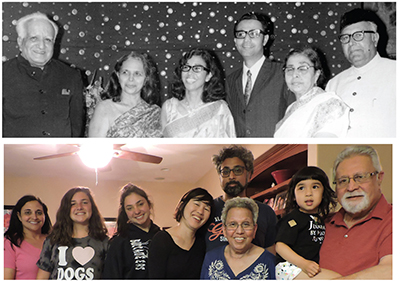
Top: Yezdyar and Irene (née Israel) with parents at their wedding;
above, l-r: Afreen Rebecca, Alyssa, Alyson, Sheheryar, Irene, Aiko and Yezdyar
The legend of Parsi immigration into India itself is speculative. We dispute even the date of immigration. Some claim 716 CE and others prefer 936 CE. Weigh that uncertainty to a historical fact that the last Sassanid Zoroastrian king, Yazdegerd III, was executed in 651 CE. Therefore, possibly most of our ancestors who landed on Indian shores had not yet been born when the Sassanid Empire fell to the Arab conquest. It is not my purpose to discuss the historiography of Qissa-e-Sanjan here, but to cite these dates and speculate that emigration from Persia occurred over an extended period and that much more dispersion had probably occurred among the refugees following the exodus and before landing on the western shores of India.
Continuing my thought process, I recall reading Dr Dadabhai Naoroji’s speech, "The Parsi Religion” delivered at the South Place Institute, London. The Institute published his speech in 1901 in an anthology titled Religious Systems of the World; A contribution to the Study of Comparative Religion. I have a copy from my father Sheyeryar’s library. My father was a student of religions and I had the privilege of sitting with him often to discuss issues including some articles in this excellent anthology. Naoroji, who was an athornan, an ordained Zoroastrian priest, had no hesitation in observing and recording the fact of Parsi ethnic assimilation, and that the immigrants had merged with their new neighbors in more significant ways than the legendary sugar-in-the-milk analogy.
Naoroji said, "Gradually, by intermarriage and otherwise, they (Parsis) mixed with the Hindus to such an extent that they became almost assimilated with them — ‘almost as Hindu as the Hindus themselves’ — making offerings at Hindu temples.
"When I was prime minister of Baroda, a Parsi lady appeared before me on some appeal. I should have never considered her a Parsi, had not my attention been expressly called to the fact, because she was so completely Hindu in appearance, in her accent, in her ideas, and dress.
"Then came the Mahommadan on the scene, when the Parsis, ever pliable, adopted some Mahommadan customs, and even carried offerings to the shrines of some famous Mahommadan saints. They now knew little of their own religion; but two of its teachings they never forgot — that there is only one God and that man should marry but one wife. It is true they continued to repeat prayers in the old Zend language, but they did not understand one word of them. With the exception of a few priests, no one knew anything of that language, or of the doctrines inculcated in the scriptures.”
In his lecture, Naoroji continues to explore Parsi interactions with the English overlords. His observations of more than a century ago remain valid today. Few Parsis can deny the Hindu, Muslim and Christian traditions they observe, and the icons they place alongside Zarathushtra’s image and the Avesta in their prayer nooks at home.
Given this background, I beg the question, when will Parsis stop nursing this fantasy that we need to guard and maintain "our pure race?” It is abhorrent to pride one’s self about racial purity, holding the universal religion of Zarathushtra hostage to a racial purity test. It contradicts the fundamental tenets of Zarathushtra’s credo: good thoughts, good words and good deeds!
Worse, it is not merely chauvinistic pride. This belief is at the root of the decimation and isolation of the Parsi community in India. Zoroastrianism is a universal religion, not a secret cult. By frowning on interfaith marriage and conversion the Parsi community has displaced the Zoroastrian religion’s universality, closed itself out of society, and is rapidly heading towards a self-inflicted extinction. The Government of India sponsored Jiyo Parsi program is too little and too late to have any significant impact on the numbers in the community. For every child born because of the financial incentives of the program, several more adults and their children are being driven out of the community. For a community that prides itself as enlightened and educated, this strategy is suicidal.
Monthly demographic statistics published in Parsiana reveal that in Bombay from January 1 to July 22, 2019, 110 marriages took place. Of these 52 (47%) were interfaith marriages, with 28 men and 24 women marrying non-Parsis. Statistics from the other Indian cities and from the western diaspora will probably show a greater increase in interfaith marriages. Too many families are unfairly driven away from the community following an interfaith marriage. Such permanent exclusion of the family is contributing seriously to shrinking the population, besides depriving the community of promising future generation members.
If a man marries a non-Parsi his offspring are accepted as Parsis. However, if a woman marries a non-Parsi the offspring and the woman are not accepted as Parsis. I see a much more sinister reason for this different treatment of genders, besides the obvious misogyny it reflects. If the children of Parsi men married to non-Parsi women were not accepted as Parsis, the community would have lost its claim to icons like J. R. D. Tata, the son of a Parsi father and a French Catholic mother, as well as to the families of many other wealthy and influential Parsi men in India and the diaspora.
I share one more example from my personal experience. As a Parsi man my Bene Israel Jew wife Irene and I are permitted to bring up our children as Parsi Zoroastrians. However my wife as the mother of the children is prohibited from participating in any rituals or entering the agiary. Our dilemma: The children would be initiated into a faith that teaches them to consider their loving mother an outcast! It is ironic that our children can be Parsis despite inheriting half their DNA from a parjat! The absolute absurdity of this argument convinced us that such an initiation ritual would ruin the family unit and harm the development of our innocent children. Instead of this charade, we were confident that the strong moral and spiritual traditions of my wife’s Judaic upbringing merged with my own Zoroastrian values would be a better guide to nurture our children to grow up to be good human beings. We are both proud of our decision, and today, nearly half a century later, we enjoy watching how our daughter Afreen, an accomplished lawyer, and son Sheheryar, a prominent labor unionist, are nurturing our three granddaughters Rebecca, Alyssa and Aiko, and inculcating in them similar values. In all humility, the downside for the Parsi community is that the numbers and the accomplishments of our current and future descendants will not be part of the annals of the Parsi community of India!
The spiritual and lay leaders of the Parsi Zoroastrian community in India have unquestioningly adopted baseless rules and dictats to govern our lives. These actions have added to other factors accelerating the reduction of our population. On March 1, 2001, India became the second nation in the world to cross the one billion population mark placing the Parsi community in India at 69,601 or .0007%! In 2011 the census showed we numbered 57,264. The Parsi community can ill afford the racial purity argument and the associated misogyny and extinction it engenders.
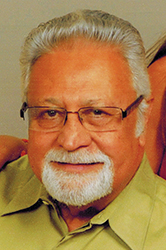 Born and educated in Hyderabad, Yezdyar S. Kaoosji lives in California. He has worked nationally and internationally serving nongovernmental and voluntary organizations as professional staff, trainer and management consultant.