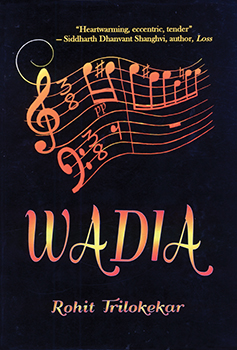
Wadia by Rohit Trilokekar. Published in 2023 by 1889 Books Ltd, Unit A, 82 James Carter Road, Mildenhall, Suffolk, UK, IP28 7DE; www.1889books.co.uk. Pp: 223. Price: Rs 599.
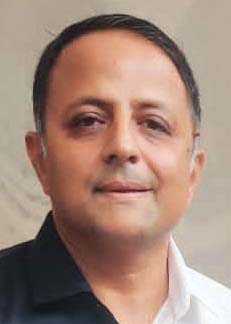
Rohit Trilokekar’s (pictured) Wadia is a delightful novel. He portrays an eccentric Parsi, Rustom Wadia, who late in life suddenly wants to find his roots. This search, with two of his friends, is a compelling read, a very absorbing, perceptive and engaging outsider’s view on the Parsi community.
Wadia is 71 years old and, like many Parsis, extremely passionate about Western classical music, especially Beethoven’s piano piece Für Elise. Though the music is beautiful, the first few bars have been overplayed and the tune is easily recognizable as it is often used in manually operated elevators to remind users that the doors have to be shut. It is commonly used as a ring tone for cell phones and in Taiwan Für Elise is played by garbage collectors to summon residents to bring out their trash (as notes Wikipedia). Wadia considers this piece Beethoven’s magnum opus; he plays the record on his vintage gramophone daily and weeps. It is even the password for his computer. These first two bars are reproduced on the cover of the novel and the reader soon becomes aware that this piece would be central to the novel.
Trilokekar starts his novel by introducing us to the Wadia clan; in fact, there are so many of them that the reader tends to get quite lost. First, there is the great-grandfather, Jamshed. He adopts a "menial slave” who had been brutally kicked by his master, Kenny Shah, for innocently staring at his daughter, Petunia, while she was playing Für Elise on the piano. Jamshed names the boy Dhunji. Probably inspired by Petunia’s playing, Dhunji develops a great passion for music and excels to such an extent that Jamshed and he go to London to participate in a piano competition.
Piano and piano-playing play a very vital role in the novel. Trilokekar builds up suspense for the reader: What transpired in London that Dhunji never played the piano again? Petunia, who was studying in London, would have completed her studies around the same time. Did she take part in the same competition? Dhunji’s grandson Rustom, the protagonist of the novel, is himself a promising and talented piano player. Why did his father instruct his teacher never to teach him to play Für Elise? History seems to repeat itself. Rustom was to perform at the London competition. Why did his father decide against it at the last moment? And why did Rustom’s father give away a German Steinway, one of the premium brands of pianos, for nothing? And who is the child with Down’s syndrome in the photograph, who is named Elise?
When Rustom suddenly decides that he has "to get some clarity about ‘his roots,’” he approaches his friend Anil Velkar, who uses Facebook to trace Petunia. Not only do they manage to trace Toral Shah, Petunia’s great-granddaughter, they also discover her address. This is the starting point of Rustom’s search. Trilokekar takes us on a hunt to seek the solution of this mystery. One clue leads to another and the final denouement takes place in Udvada and Pardi.
In addition to a very interesting and tightly plotted novel, Trilokekar creates very plausible characters, whether Parsi or not. Rustom is an endearing and extremely well-drawn character with just the right amount of Parsi characteristics and eccentricities. Like many Parsis, he is a bachelor, loves his dhansak, finds it difficult to imagine a meal without a non-vegetarian dish and enjoys his cup of tea. But Trilokekar portrays him as a lonely man who has lavished his affection on his pet cat and parrot who are no more. Rustom wonders what is the point of sitting at the head of a table, when the other chairs are empty. He struggles to find meaning in his life and eventually realizes he is the master of his own fate. Taking his life into his own hands he goes to the Willingdon Club to eat Eggs Kejriwal, something he has not done for a very long time. And decides it is possible to end his loneliness by allowing a woman into his life.
Whereas Parsi novelists tend to get more involved with details of controversies, rituals and customs, one probably needs a non Parsi who is more distanced from the community to provide a different perspective. Trilokekar certainly manages to do this. FIRDAUS GANDAVIA
Gandavia holds a doctorate in English literature and is a retired chartered accountant. He is a compulsive reader of fiction.