A wealthy Parsi barrister called Bomanji Captain, though married, was a lonely heart in Rangoon in the dying years of the 19th century. In 1899, when Bomanji was a sprightly 48, a Goan Christian named Jones landed in Rangoon with his comely allegedly Parsi wife called Rebekah (though she claimed her original name was Meherbai). She was employed by Bomanji as his housekeeper. Bomanji was known throughout Rangoon to be a man with a large heart. He provided her comfortable independent accommodation and the best physician available to look after her. She gave birth to a child called Bella. Soon after Bella was born Bomanji suddenly became tired of the murky weather of Rangoon and migrated to England in 1900, urging his brother Shapoorji to look after the mother and child. Unfortunately, both Jones and his wife succumbed to tuberculosis in quick succession, leaving Bella an orphan. Thereupon, the kind Shapoorji and his wife, who were childless, treated Bella as their daughter. She was rechristened Goolbai.
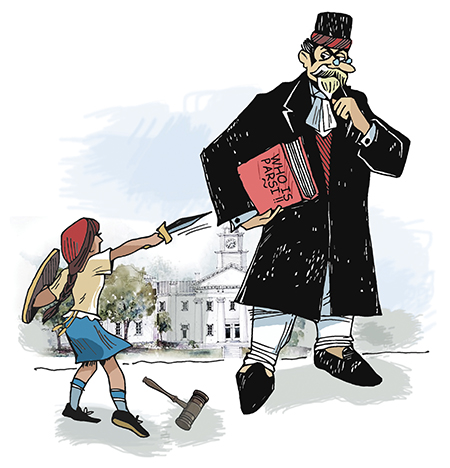
Illustration by Farzana Cooper
When she entered her teens, Shapoorji wanted her navjote done. The head priest of Rangoon would not oblige, even though Bomanji was the sole trustee of the local agiary trust and the Captains were eminence grise in Burma. The dastur of Poona was commissioned and he navjoted Bella. The girl regally entered the Rangoon agiary on Jamshedi Navroz of 1915 and participated in the religious ceremonies, much to the chagrin of the Rangoon Parsis, including Bomanji’s other brother Merwanjee, who became the principal force opposing her entry into the community. Bella had defiled the sanctity of the fire temple by entering it, they said. A suit was filed to declare that Bella was not entitled to the rights, privileges and benefits of any Parsi trust or institution and had no right to enter the fire temple.
A lot of evidence was adduced to show that her mother was a Parsi. This was ostensibly done to distinguish this case from that of Suzanne Tata, both of whose parents were not Parsis. Bomanji’s long-time doctor testified that Meherbai alias Rebekah looked like a Parsi, spoke the Parsi Gujarati dialect and wore a kor ni sari with a mathabanu. The opponents countered by saying that she was of poor Christian parents in Goa and had possibly worked as a servant in a Parsi household and therefore knew and adopted Parsi mannerisms. Bella, like Suzanne Tata, was an outright convert, neither of whose parents was a Parsi, alleged the orthodox. Even Bella’s dark complexion was inappropriately referred to. There is no material on record to show what Bomanji’s complexion was.
The trial judge held in favor of Bella. Upon appeal, Bella won again. So Merwanjee determinedly appealed to the highest court, His Majesty’s Privy Council in London. Merwanjee’s son was a barrister who appeared against Bella. This must have helped in keeping the legal costs down.
When the matter finally came up before the Privy Council, Bella, at 25, had already married a Parsi, which was perhaps Shapoorji’s prime objective. This had now turned into a family feud. Much evidence had been tendered and many witnesses examined by both sides. Justice Dinshaw Davar, the avowedly orthodox judge who had penned the famous Petit vs Jeejeebhoy judgment of the Bombay High Court, had packed his bags to appear as an expert witness against Bella, but was felled by a heart attack. He was thus spared the uncharitable remarks of the Privy Council about his long and verbose judgment traversing many irrelevant issues.
Their Lordships of the Privy Council were not interested in whether Bella’s mother was a Parsi or not. In a famous sentence, they said that in determining her race, her maternity was not relevant. The period was 1915 to 1925, and naturally therefore no arguments were made at any stage of this litigation about equal treatment of members of both sexes who had married interfaith partners.
Over the decades since this controversy, there has been much speculation as to why Shapoorji (and Bomanji who survived him and often visited Rangoon from London) did not bite the bullet and testify that Bella was Bomanji’s natural biological child. Mitra Sharafi, in her scholarly and brilliant dissertations on these controversies (from whom much material has been gratefully taken in this column), is convinced, like this columnist, and most of Rangoon, that humongous amounts of time, energy and money, for decades, were not spent to assert the rights of some servant child. Neither Shapoorji nor Bomanji were crusaders for reform.
Circumstances screamed that Bella was indeed Bomanji’s love child. Alas, there was no mother to testify; there were no DNA or paternity tests, and the embarrassment to the Captains must have been too intense to admit that Bella was as much a Captain as Merwanjee, whose opposition stemmed more from his eye on Shapoorji’s inheritance, which was lost to Bella. Had Bomanji been a devil-care-less libertarian, Bella vs Saklat would have never happened and later been cited a thousand times by the orthodox and the reformists in Bombay.
Unlike Davar’s rambling judgment, the Privy Council’s was crisp and clear. The issue before it, they said, was not whether Bella’s conversion to Zoroastrianism was valid or not. The question for determination was whether a child of a non-Parsi father, converted thus, was entitled to the benefits of Parsi trusts including fire temples, like a natural born racial ethnic Parsi. No, Bella was not so entitled, answered their Lordships. But if the trustees decided to permit her entry in the fire temple, they could do so, ruled the Council.
Shorn of legalese, in a nutshell, the position emerging from the Petit and Bella judgments is: Zoroastrianism not only permits but enjoins conversion (these are the words of the ultra-orthodox Davar). However, after arrival in India, Parsis have never converted. Children of interfaith married Parsi men though are deemed full Parsi Zoroastrians, but not those of interfaith married Parsi women. The intention of the founders of community trusts is paramount. When they were making the trust, did they contemplate converts to be beneficiaries? The answer is "No.” Herein lies the catch. Did such founders want anyone both of whose parents were not Parsis, to be beneficiaries of their trusts? If the answer is "No,” then it must apply to both genders. However, even the orthodox (save and except the fringe elements) concede that if the father is a Parsi, the children qualify. It is this logical inconsistency which is being challenged now before the Supreme Court of India.
Whether Petit was merely an opinion (obiter dicta) or not, Bella is certainly the authority for the proposition that the child of a Parsi father and a non-Parsi mother is entitled to the same privileges and rights as a Parsi both of whose parents are Parsis. But did their Lordships examine or expressly hold that the reverse proposition was incorrect? Except for saying that maternity was immaterial, nothing was determined. This is what will be argued soon before the Supreme Court of India in the Goolrookh Gupta and the Sanaya Dalal cases; as also in an identical issue before the Calcutta High Court. Almost a century later, Bomanji’s Bella will be in the limelight again.
Berjis Desai, lawyer and author of Oh! Those Parsis, and recently Towers of Silence, is a chronicler of the community.