The Global Working Group grapples over
the formation of international institutions to
assist Zoroastrians
Parinaz Gandhi
"Who in his right mind would want to donate after seeing Jal Shroff’s offer to help?” remarked Bombay Parsi Punchayet (BPP) trustee Kersi Randeria. He was referring to a comment by the founder president of the Federation of Zoroastrian Associations of North America (FEZANA) Rohinton Rivetna who while addressing the regional representatives at the Global Working Group (GWG) meeting on December 21, 2018 at Dadar’s Palamkote Hall stated, "There are more billionaire entrepreneurs in our community capable of supporting our infrastructure needs than at any other time in our history. Unfortunately it is our failing that we have not brought them on board and made them aware of the urgency of our needs.” In his PowerPoint presentation Rivetna stressed that the community in the diaspora needs physical infrastructure in the form of community centers, institutes for Zoroastrian studies, regional headquarters, senior citizens homes, etc.
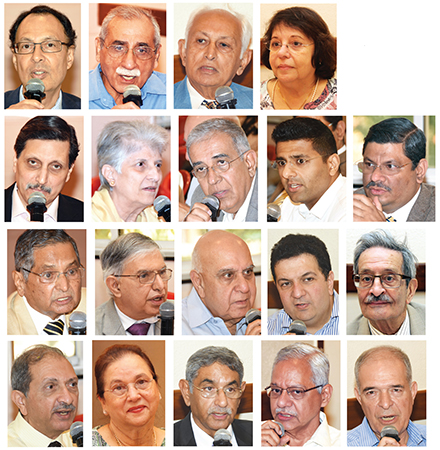
From l, top row: Neville Shroff, Rohinton Rivetna, Homi Gandhi, Behroze Daruwalla;
2nd row: Yazdi Desai, Armaity Tirandaz, Kersi Randeria, Viraf Mehta, Xerxes Dastur;
3rd row: Burjor Antia, Sam Balsara, Dinshaw Tamboly, Javid Canteenwala, Rusi Dalal;
4th row: Farrokh Rustomji, Meher and Kersy Bhesania, Yazdi Tantra, Khodayar Attaie
Clockwise from above l: Anahita Desai, Aban Marker Kabraji,
Shehnaaz Khambatta, Cawas Panthaki
Hong Kong philanthropist Shroff’s offer to aid The B. D. Petit Parsee General Hospital with a magnanimous gift of Rs 160 crores to build a new state-of-the-art hospital has met with dogged opposition from a small section of the community (see "Will it go through?” pg 22).
"Those who criticize are very loud and vocal,” confirmed Randeria. When member of the legislative assembly Mangal Prabhat Lodha gave funds for the renovation at Doongerwadi, the Punchayet was faulted, "Kom bhikhari thai gaich ké (Has the community become impoverished)” that it needs funds from a non Parsi)? However when the BPP issued appeals in the Press a month ago seeking funds for Doongerwadi "everyone was conspicuous by their silence with the exception of one donor” who has made a commitment of Rs 25 lakhs. BPP trustee Xerxes Dastur felt that "if we publish the accounts of BPP, with donor engagement, more will be willing to pay.”
An Organization for the Resettlement of Zarathushtis could "render assistance and succor to Zarathushtis who have migrated to one region from another,” believe Rivetna and current FEZANA president Homi Gandhi. The two had come well prepared with a document for the proposed organization, specifying the preamble, purpose, duties and responsibilities of two coordinators from each region who could guide those seeking to relocate, and Intent to Resettle Form. Gandhi referred to a Zarathushti from Iran awaiting refugee status in Tbilisi, Georgia, and the efforts of the World Zoroastrian Organisation (WZO), London to assist him and safeguard his property in Iran. "Invite WZO (London) to join the GWG,” recommended Gandhi. [The WZO Trust Funds in India (WZOTF), headed by Dinshaw Tamboly, is represented on the GWG — editors). Around three decades ago, WZO’s attempts to constitute a representative international body could not succeed due to its liberal leanings and insistence on giving equal weightage to individuals and organizations within its membership.
In London, £ 150,000 was raised for a Zoroastrian Senior Citizens Home, reported Javid Canteenwala and Rusi Dalal of the Zoroastrian Trust Funds of Europe (ZTFE). But when members started having doubts on the feasibility of managing such a facility, they are now exploring the possibility of setting up a Parsi Wing in an existing center where the infrastructure and volunteers can be shared.
A quarterly bulletin to give a voice to the Zarathushti diaspora will be compiled by Behroze Daruwalla representing FEZANA, if volunteers from different regions send regular updates of their activities.
Creating an International House in Bombay to accommodate overseas Zarathushti visitors would be an "impossible task,” said Yazdi Desai, president of the Federation of the Parsi Zoroastrian Anjumans of India (FPZAI). He referred to an alternative arrangement with one of the five star hotels to provide a room at a concessional rate. If they block a room for 100 nights a year at ITC Grand Central in Parel, he expected the tariffs per day to be around USD 50 to 60 but said he would share details of the rates once they are finalized.
Religious responsibilities
From a donation of one crore rupees facilitated by GWG executive chairman Neville Shroff of Hong Kong last year, 114 mobeds and 31 widows of mobeds aged over 60 years have been shortlisted for assistance (see "Favoring formalization,” Parsiana, January 7, 2019). To pay a monthly grant of Rs 15,000 to 120 full-time practicing mobeds under 60 years of age GWG would require Rs 2.2 crore annually.
A profile of the 75 mobeds registered under the Athornan Mandal-WZO Trust Funds Full Time Mobeds Welfare Scheme revealed: 65% have a monthly income of Rs 15,000 to 20,000, 43% are single, 76% are undergraduates and 24% are graduates. Their limited monthly income comes in the way of finding suitable marriage partners. Whilst they were all under 35 years of age when they registered for the Scheme, 35 of them are now over 40.
"The future of the community is dependent on a continuous stream of young mobeds,” stated Sam Balsara, chairman of Madison World, who along with Dastur Khurshed Dastoor of Udvada and Tamboly has accepted the responsibility of aiding priests in India.
Currently there are around 25 children studying in the Dadar Athornan Institute, stated Dastoor. He further referred to the last survey conducted by the Parsi Resource Group in 2006 according to which "there are only 30 children eligible to become navars.” Even assuming all of them are compelled to undergo navar training, the pool of priests is dwindling. "It is a ticking bomb,” summed up Tamboly, advocating the need to address this issue urgently.
FPZAI honorary secretary Farrokh Rustomji suggested that mobeds should be assured of a minimum wage with stipulated fees for the different rituals they perform. Dastoor explained that "a fixed rate is not feasible.” Barring five to seven agiaries that are under the management system (where the priest is paid a fixed monthly emolument by the trustees) the rest fall under the panthaky system with variable work assigned to the mobeds who report to the panthaky. He also regretted that some agiaries refuse to increase the emoluments of their serving priest but when he leaves and they have to hire another one, they consent to pay more than double the salary.
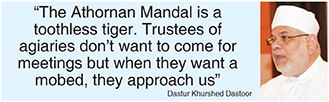
"The Athornan Mandal is a toothless tiger. Trustees of agiaries don’t want to come for meetings but when they want a mobed, they approach us,” admitted Dastoor. Each agiary should provide for a five lakh rupees medical insurance for every mobed attached with them, he recommended.
The North American Mobeds Council has stipulated rates for different ceremonies, stated FEZANA vice president Arzan Wadia. In London, members of the laity usually pay a little more than the prescribed guidelines, revealed Canteenwala. Wondering whether such financial directives would be acceptable in India, Dastoor admitted, "It may depend on who proposes (the rates). If I propose, it won’t be done…”
"The BPP will be happy to give an advisory,” stated Xerxes Dastur but Khurshed Dastoor was not convinced. When Khurshed and Tamboly were tainted on the social media for approaching different fire temples in their efforts to procure data and assist languishing agiaries in India, "did the Punchayet support us saying this is a GWG project?” asked Khurshed. (At that time Khurshed and Tamboly were anathema to the World Alliance of Parsi Irani Zarthoshtis controlled FPZAI — editors). Reconciled with the regular criticism that "Dasturji paisa khai java maagéch (wants to usurp money),” he sought to forewarn the community leaders that they should commercialize their unutilized temple and burial ground properties before they are encroached or the government requisitions them.
He cited the instance of the dakhma property in Piplod in Gujarat which had been bulldozed by a builder. He referred to another dakhma that had become a den for nefarious activities. Even plans to plant bawal on vacant lands, though ostensibly well-meaning, would take 15 to 20 years to be lucrative by which time it may be too late to save the land, he feared.
In Neemuch, Tamboly mentioned that after WZOTF made possible the renovation of the mobed quarters, there was an appeal to assist with the renovation of the agiary. One donor was willing to pay for the renovation if given an assurance that the property will not be sold. Liaising with the Neemuch mobed for the last several months, he regretted there has been no progress. "You went to the mobed, not to us. We have a donor ready,” stated Desai noting he is a trustee there. "If a mobed writes to us, we write to him,” responded Tamboly. When Canteenwala enquired regarding the population remaining in Neemuch, Tamboly informed him that 19 Parsis live there.
Gandhi felt that this "Indiacentric problem” could be solved by appointing a chief executive officer with a suitable salary who could take necessary legal/administrative action. Balsara explained the ground realities when an individual appointed by them to go to each agiary to collect information "started getting negative feedback and criticism. It is a sinister problem. There is tremendous negativity in the Parsi population in Bombay.”
Wadia was appreciative of the Empowering Mobeds initiative spearheaded by Tamboly, Dastoor and Binaifer Sahukar where they impart skills that can be effectively used by the priests. He referred to the panthaky of one agiary creating a WhatsApp group to keep connected with the laity in his parish.
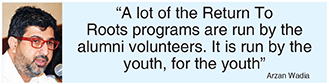
Before the official start of the GWG meet, there was a quick round of self-introductions by the youngsters from Canada, New Zealand, Pakistan and USA participating in the fifth edition of the Zoroastrian Return to Roots (RTR) program. The various activities organized by RTR enable young adults from the diaspora gain insights into the Parsi culture, lifestyle and organizations in India. The three principal RTR organizers are Dr Shernaz Cama, Parzor director, Aban Marker Kabraji of Pakistan who is regional director, Asia, of the International Union for Conservation of Nature, and Wadia. Marker Kabraji thanked "the key donors who have supported us” and gave credit to Wadia, "without whom nothing would be possible.” As reiterated Wadia before the youth exited the Palamkote Hall in around 15 minutes, "A lot of the RTR programs are run by the alumni volunteers. It is run by the youth, for the youth.”
The nearly six-hour GWG meet ended with the screening of Zarathushtra — The story of his life, produced by Meher and Kersy Bhesania of Dubai in association with Adi Pocha of Squirkle Productions in Bombay. The story is an adaptation of the article written by Dastur (Dr) Firoze Kotwal in Meher’s anthology, Zarathushtra and the Origins of Zoroastrianism, she noted. Both the book and the film were released at the 11th World Zoroastrian Congress in Perth in June 2018. Only 50 copies remain of the book that is being sold for Rs 2,300, mentioned Meher who looks after the arts and culture portfolio at GWG.
Those attending the GWG meeting were: Armaity Tirandaz, Kersi Randeria, Viraf Mehta, Xerxes Dastur, Anahita Desai, Cawas Panthaki, Shehnaaz Khambatta from BPP; Meher and Kersy Bhesania from Dubai; Homi Gandhi, Arzan Wadia, Rohinton Rivetna and Behroze Daruwalla from FEZANA; Yazdi Desai and Farrokh Rustomji from FPZAI; Neville Shroff from Hong Kong; Dastur Khurshed Dastoor and Sam Balsara from India; Khodayar Attaie from Iran; Yazdi Tantra from the World Zarathushti Chamber of Commerce; Dinshaw Tamboly from WZOTF; Rusi Dalal and Javid Canteenwala from ZTFE. The Press was represented by Jam-e-Jamshed, Parsi Times and Parsiana.