If Zoroastrianism made saints, the First Dastur Meherji Rana and Dastur Jamshed Kukadaru would be near unanimous choices. However, suggest the name of their master, Dastur Azar Kaiwan Azar Gushasp, and eyebrows will be raised — and not only of the ultraorthodox. On the one hand, Kaiwan was the undisputed spiritual giant of the faith, but on the other hand he had undeniable Sufi linkages, to put it mildly. This creates a huge dilemma for the orthodox. As the perplexed nuns sang in The Sound of Music: How do you solve a problem like Maria?
The French scholar, Henry Corbin, describes Kaiwan as the founder of the "Zoroastrian Ishraqui” school which marked the "revival in Islamic Iran of the philosophy of light taught by reputed sages of ancient Persia.” Kaiwan is believed to have "received the teachings” of these ancient sages in his dreams.
Believing in other faiths is a cardinal sin according to the thinking of the ultraorthodox. To respect all religions is acceptable, but to follow the practices of any religion other than Zoroastrianism is taboo. For one of the greatest Zoroastrian saints in India to have had other religious affiliations, is a disaster. That Kaiwan did so is grudgingly conceded by the conservatives.
In 1618, the 85-year-old saint died at Azim Abad and is buried in neighboring Patna, Bihar (a state which also has strong Buddhist connections). A dargah or a mausoleum containing his remains, like that of a Muslim pir, stands today in the Patthar ki Masjid, looked after by a mutawali or a caretaker, and is worshipped by followers of all faiths, though mainly Muslims. Recently, Parsis discovered the mausoleum and have begun to pray there.
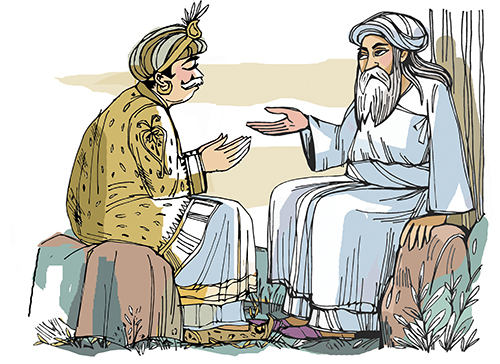
Illustration by Farzana Cooper
Born in 1533 in Iran, blue blooded on both sides, almost minor royalty, Kaiwan was a highly evolved soul. The followers of Ilm-e-Khshnoom would have us believe that he was one of the Abeds (masters, super evolved beings) of Daemavand Koh, who rebelled, in a manner of speaking, by insisting that spiritual progress ought not to be restricted to the inhabitants of this exclusive sanctuary. Even the common man should be included, he believed, and felt he ought to step out of the Koh into the outer world to accomplish this mission. Even more provocatively, he argued that adopting and absorbing practices of other faiths was permissible. He apparently lost the debate, exited, and never went back (though according to Khshnoomists, in later life the prodigal son desperately wanted to re-enter but was denied permission).
Kaiwan landed in Surat, then went to Navsari, visited Kashmir and Agra (Sufi strongholds), and settled down in Patna; which may appear, upon first blush, to be an odd choice. The purpose was to remain within the jurisdiction of the greatest Mughal Emperor Akbar, who tried to found a new secular religion called Din-e-Ilahi (Divine Faith) that greatly aligned with Sufism, the soft mystical devotional sect of Islam. According to Theosophical literature, Akbar was a high initiate, who later reincarnated as one of the Masters of the Great White Brotherhood, perfected beings of great power who spread spiritual teachings through selected humans. The Emperor loved to interact with saints of all religions and was himself a Sufi sympathizer.
Kaiwan’s fame had by then spread far and wide. Reportedly, he had the power of bilocation, that is, he could be seen simultaneously at many places, had powers of divination and clairvoyance, could turn base metal into gold. Akbar invited him to visit his court. Kaiwan reportedly refused. The Emperor is then said to have himself gone to meet the saint. Following that meeting, Kaiwan directed his principal disciple, one Meherji, to attend Akbar’s court. Meherji mesmerized Akbar by exposing a low grade tantrik magician as a charlatan. So impressed was the Emperor that he is stated to have started wearing the sudreh and worshipping before the fire; and, according to retired Supreme Court justice Rohinton Nariman, Akbar nearly converted to Zoroastrianism. The legendary musician Tansen composed a song extolling the long bearded Meherji who was gifted land by the Emperor. Upon his return to his native Navsari, Meherji was given a hero’s welcome and designated as the first High Priest, Dastur Meherji Rana. Meherji’s master though kept a low profile all this time.
Many of Kaiwan’s views have not found favor with the orthodox. These include transmigration of souls, celibacy, fasting, mortification of the flesh, practicing austerities: all clearly Sufi principles. His manner of living itself was Sufi. He was a vegetarian, spartan, ascetic. The Khshnoomists state that this great soul committed "spiritual transgression” by adopting practices of different prophets and different religions and his disciples were not all Zoroastrians. Research scholars agree. Kaiwan’s disciples included "seven Muslims, two Jewish rabbis, a Christian and a Brahmin,” along with "Zoroastrian mobeds.” Several Islamic Sufi scholars too were disciples of Kaiwan.
As a result, the Khshnoomists say, Kaiwan committed what are termed sins of the soul. He supposedly had an unhappy life and a tragic end, though Khshnoomists are tight-lipped about the details. Their reluctance to do so highlights the dilemma they face. This is further compounded by the most venerated Dastur Kukadaru having declared that Kaiwan was his master who provided the miraculous capsule prayers or nirangs, to be recited in times of distress. Kukadaru was famous for this.
The language of some of these nirangs contains several Sufi expressions and invocations. Kukadaru himself was an alchemist, as narrated earlier in this column. Sufi exponents often came to pay their respects to the pious priest.
Though Kaiwan is said to have advocated celibacy and abstinence, several sources say he had a son called Kaikhushroo. However, other sources submit that Kaikhushroo was not his son but a spiritual successor, which appears more plausible.
Quite a few writers, including Sir Jivanji Modi, the orientalist who presented a paper on Azar Kaiwan at a conference in 1930, mention that the title "Dastur” for Kaiwan was a misnomer and could have been a subsequent addition. It appears that he was never a priest though his father could have been one in his native Iran. Perhaps, the title was added much later, in a feeble attempt to Zoroastrianize him. Even the Khshnoomists themselves refer to Kaiwan as "Hazrat” — the mode of address for all Sufi saints.
Modi termed the beliefs of Kaiwan and his disciples as "somewhat Sufistic with a mixture of some Indian practices of yoga,” while Dastur Maneckji Dhalla considers them as "the earlier doctrines of Sufism and developed under Hindu mystic influences.” Dhalla, the arch liberal, was of course sceptical of Kaiwan’s claims of divine revelation.
Kaiwan’s association with Islam, even its softer Sufi interface, is too much for Khshnoomists and other traditionalists to digest. His universality and secular approach make them distinctly uncomfortable, with their insistence on following only the Zoroastrian faith. However, Kaiwan’s status is so exalted in the spiritual hierarchy, further enhanced by the First Dastur Meherji Rana and Kukadaru being his disciples, that the orthodox simply cannot ignore him. For a former inhabitant of the Daemavand Koh to be a liberal, free thinking multi religionist is hard to swallow.
That is why few Parsis outside scholarly circles have understood this great Zoroastrian saint. That is why his name is often excluded from the hallowed names recited during prayers. That is why the ultraorthodox term his life a riddle.
Berjis Desai, lawyer and author of Oh! Those Parsis, and recently Towers of Silence, is a chronicler of the community.