Nicole Mody releases her cookbook showcasing recipes from Bombay’s beloved art district
Farrokh Jijina
Thirty-two-year-old Nicole Mody is currently walking a few inches above the ground, she tells Parsiana. Her cook book, Flavours of Kala Ghoda – recipes from the art district was released on the second day (February 7, 2016) of the Kala Ghoda Art Festival (KGAF) in her home city Bombay by food critic and print and television journalist Vir Sanghvi, along with Maneck Davar, chairman of the Kala Ghoda Association and Brinda Miller, festival director. "Vir called it a delicious book, imagine!” she exults, talking to Parsiana on the sidelines of a panel discussion where she shared the stage with Sanghvi and Rahul Akerkar, restauranteur who set up the Indigo chain of fine dining restaurants in the late 1990s. The session was moderated by independent food and wine writer Antoine Lewis and was held at the David Sasoon Library Gardens, immediately after the release of the book at the Cross Maidan.
At the panel discussion, left to right: Rahul Akerkar, Vir Sanghvi, Nicole Mody, Antoine Lewis
In keeping with the theme of the panel discussion, "Mapping culinary journeys,” both Sanghvi and Akerkar reminisced about famous restaurants of Bombay, many of which have morphed into other restaurants or have wound up. Taking geographical liberties, they extended the boundaries of the art district of Kala Ghoda to Churchgate Street and beyond! Both Sanghvi and Akerkar bemoaned the homogeneity of Bombay restaurants at present. "The food at each of the new restaurants is their version of another restaurant’s,” said Sanghvi. "Even the decor is the same,” added Mody. Akerkar was hopeful that new trends and new restauranteurs would emerge soon. Both Akerkar and Sanghvi were proponents of small stand alone restaurants. "I would rather go to a Soam rather than a Fatty Bao,” said Sanghvi, rooting for simple Gujarati food over the fancy restaurant chain.
Mody briefly described how she put together the recipes that went into her book. "Most of the restaurants and chefs we worked with were forthcoming with their recipes. Some were not, and had to be ‘persuaded,’” she said with a smile.
Maidan matters
The KGAF has a special place in Mody’s heart. She started ‘curating’ for the festival five years ago. Curating involves choosing and finalizing the events, which until last year involved mainly demonstrations by celebrity chefs, discussions focused around the culinary arts and food stalls put up by restaurants that populate Rampart Row, the main venue of the festival. One year into the operation, she was joined by her cousin Roxanne Bamboat. Both have jointly put together the food section of the festival since then.
"This year our food demonstrations and talks have been tailored around fresh, organic, locally grown food,” says the festival website. "In 2016, we expanded to the Cross Maidan, which till last year was the venue for the performing arts only,” reveals Mody, who is also a food blogger, cricket and dance enthusiast. A section of the maidan has 39 food stalls, for the first time as part of KGAF, showcasing "a mix of the Bombay food scene” state Mody and Bamboat. Talking to Parsiana on February 11 while keeping a watchful eye over the goings-on at the grounds, Mody states that repeat fairgoers will have more than just 39 cuisines to choose from, as over the 12-day fiesta, some stalls will change hands and a new incumbent will come in the place of the previous ‘outlet.’
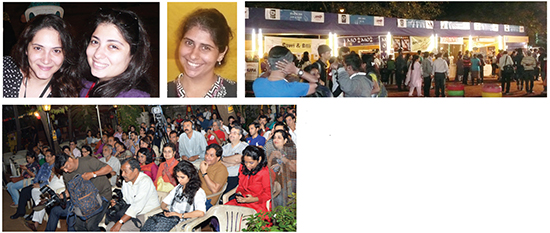
Top, left to right: Mody with Roxanne Bamboat; Perzen Patel;
a view of the stalls; Audience at the panel discussion
The stalls include well established names like SodaWaterBottleOpenerWala, the newish upmarket eatery serving Parsi food (chicken farchas and berry pulao) besides Goan chorizo pao, and The Bar Stock Exchange, a trendy new chain of restobars. Also present are home cooks and small businesses. "Do stop at Sadhana Tai’s stall,” prompts Mody pointing towards the stall from where the aroma of fresh sea food being fried percolates to where we are chatting. "My personal favorite,” she affirms. Perzen Patel who caters Parsi cuisine under the name of Bawi Bride Kitchen (See "Nothing like a secret recipe,” Parsiana, September 21, 2015) has teamed up with another eatery, Hungry Cat Kitchen and their outlet is branded Bawi and Billi. Urvaksh Hoyvoy’s Parsi-da-Dhaba, the restaurant on National Highway 8 that connects Bombay with Ahmedabad and Delhi "will be here from tomorrow,” Mody mentions.
The cousins are involved not only in the selection of the stalls but in continuous monitoring to ensure that quality and standards of hygiene are maintained. "We have to ensure that they are indeed selling what they have contracted with us (the festival association) to sell,” says Mody. The curators do not see the Ballard Estate Festival as competition to the Kala Ghoda event. "They are not an ‘art-art’ festival,” she stresses, stating that the new festival at the old business district of Bombay does not cater to the cultural needs of the public as does KGAF.
What shape will the food section of the festival take in 2020 we ask the two curators. "Oh my, that’s a long way off!” retorts Mody whereas Bamboat smiles to herself. "We have always believed in making small incremental changes. We started off with only discussions about the culinary arts. Now we have all this,” Mody indicates, waving to the crowds milling around the food stalls. "We will continue to make incremental changes,” is their last word on the subject, as they get busy answering queries from Patel, who joins them for a breather from her stall.
Parsiana will carry a review of Flavors of Kala Ghoda in a future issue.