Teaching systems need to be altered to prepare
students to cope in an age of artificial intelligence
Dr Coomi S. Vevaina
Dr Coomi Vevaina, founder director for Connection Education and Management, who retired as professor and head of the Department of English, University of Bombay, has two PhDs — in literature and education. She describes herself as an "educator, writer, storyteller.” On March 16, 2019 she delivered a TEDx talk at the Somaiya Vidyavihar on the Global Tipping Point Summit scheduled to be held in Bombay in January-February 2020. With her permission, Parsiana reproduces extracts from her talk.
Once upon a time there was a little girl who desperately wanted to be a teacher when she grew up. Every year she wrote to Santa Claus for a blackboard and chalk. One day, fed up with the same request year in and year out, Santa wrote back to say, "Why can you not ask for ‘normal’ things like other little girls?” In her naivety the little girl joyfully ran to her dad exclaiming: "Dad, you and Santa have similar handwriting.”
Now, a lot of girls and perhaps even boys, want to become teachers when they grow up but this little girl’s dream seemed absurd because she was "dumb” at studies. Her rank would be 29 out of the 35 students in her class and her school reports would read: "Your daughter looks at the water filter all day as if her life depends on it!” The little girl hated school, was jeered at by her classmates, was miserable, lonely and a big cry baby with only one friend, but she refused to give up dreaming of becoming a teacher.
Dr Coomi Vevaina: education for the future
By now, perhaps, many of you may have guessed that the miserable little girl was me! At around the age of eight, I moved to a better school and completed high school but I still did not enjoy studying! In the second year of college one teacher changed everything for me — she virtually changed my life! My curiosity, passion and imagination were so ignited by the way she taught literature that I knew I wanted to be an inspirational teacher like her. After that I was unstoppable, and went on to complete a doctorate in literature, another doctorate in education and so on. I was extremely fortunate to have had such a teacher in my life; millions of other students are not so lucky.
Though based on my own experience and observation, it would be foolish for me to say that the education system is a total failure because it does work for some, but stifles the majority and leaves out 264 million children worldwide who remain unschooled, according to the latest United Nations Educational, Scientific and Cultural Organization report.
Forgive me for sounding alarmist but as futurists like Gerd Leonhard say, humanity will change more in the next 20 years than it has in the previous 300 years. Historian Yuval Davis Harari cautions us that human beings as individuals and humankind as a whole will increasingly have to deal with things nobody ever encountered before, such as super-intelligent machines, engineered bodies, algorithms that can manipulate your emotions with uncanny precision and the need to change your profession every decade.
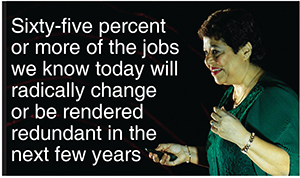
We educators like to believe that we are preparing our students for the future but we actually have no clue as to what kind of jobs we are preparing our students for. Sixty-five percent or more of the jobs we know today will radically change or be rendered redundant in the next few years.
Will our present assembly-line system of education enable our children to even survive, let alone thrive in 2030, 2050, 2070 and thereafter? The answer is a resounding ‘No.’ With the coming together of biotechnology and artificial intelligence, we all need to think of ways to overhaul education completely and that includes our learning objectives, outcomes, pedagogy, assessment, before 2027 when computers are likely to match the capacities of the human brain and perhaps also display emotional intelligence. We need to act quickly to reach what is called the critical mass for a change in education before it is too late. What do we mean by the critical mass?
"The Hundredth Monkey,” story which is rooted in fact, illustrates the concept beautifully. Off the shore of Japan scientists had been studying monkey colonies on many separate islands for over 30 years. In order to keep track of the monkeys they would lure them out of the trees by dropping sweet potatoes on the beach. One day, an 18-month-old female monkey named Imo started to wash her sweet potato in the sea before eating it. I imagine that it tasted better without the grit and sand or pesticides, or maybe it even was slightly salty and that was good.
Imo showed her playmates and her mother how to do this; her friends showed their mothers, and gradually more and more monkeys began to wash their sweet potatoes instead of eating them, grit and all. At first, only the female adults who imitated their children learned, but gradually others did also. One day, the scientists observed that all the monkeys on that particular island washed their sweet potatoes before eating them.
Although this was significant, what was even more fascinating was that this change in monkey behavior did not take place only on this one island. Suddenly, the monkeys on all the other islands were now washing their sweet potatoes as well — despite the fact that monkey colonies on the different islands had no direct contact with each other.
The anonymous 100th monkey tipped the scales for the species and the result was change. Rupert Sheldrake’s Morphic Resonance theory tells us that only one percent of people are needed to jump-start a change in consciousness and five to 25 percent, to reach the tipping point. To reach the critical mass, every single person is important. Needless to say, whatever change we want to make can only be made in the Now.
With regards to education, there are three things we could begin doing immediately: customize education and help our students locate their specific intelligences, strengths and talents and assess them accordingly; downplay discipline specific information and create a new toolkit of life skills to enable learners to develop healthy minds in healthy bodies; and work towards a change in consciousness. This is more necessary now than ever before. Contemporary thinkers believe that for every rupee or dollar spent on developing technology, the next should be spent on changing consciousness. It is only a change in human consciousness that will allow humankind to co-exist with technology and prevent artificial intelligence from trumping humanity.
Those interested in effecting a change in education may contact Dr Coomi Vevaina by e-mail at csvevaina@gmail.com