Two researchers discuss Bombay Parsis’
connection with the slave trade in the colonial city
Farrokh Jijina
Certain Parsis of Calcutta are also reputed to have been slave owners in the (19th) century… Whether any members of the community owned them in Bombay, we have no information. Most probably they did,” noted city historian Jeejeebhoy Rustomjee Byramjee Jeejeebhoy (JRB, 1885-1960) in an essay titled "Slave trade in old Bombay” in the 1931 issue of the Sanj Vartaman Annual. JRB’s composition is part of JRB Jeejeebhoy’s Bombay Vignettes: Explorations in the History of Bombay, a compilation of 41 of his essays edited by researcher Murali Ranganathan (see "City chronicler,” Parsiana, December 21, 2018).
Jeejeebhoy condemed "these un-Christian transactions (that) reveal what great height, or rather, low depth the enslaving of their fellow human beings was carried (out) and encouraged by the English.” Quoting from the Calicut Observer of August 1875, the historian notes that "about the year 1875, a Parsi bought at Cochin a 10-year-old ‘stripling’ for Rs 100 and sold him to another rich Parsi at Bombay for Rs 150.” The latter being without any children, brought up the youth as his own son and "entrusted him with the management of all his affairs and on his death left him his entire fortune.”
Jeejeebhoy notes that "in 1774, one Mr Cooper, on his leaving Bombay for England took with him his ‘servant’ Manuel Fernandez.” (Ranganathan confirmed to Parsiana on August 3, 2021 that Cooper was a Parsi.) Noting that the designation of "servant” was only a euphemism, Jeejeebhoy states that "on reaching the British Isles, the master and servant fell out and the latter complained to a magistrate that he was a slave… The magistrate, being apprised of the real fact, forthwith gave Fernandez his liberty and his shackles fell.” Dismissed by Cooper, the stranded derelict applied for relief to the East India Company authorities who sent him to Bombay at the Company’s expense. "The Bombay government thereafter were directed to investigate in future whether persons attending passengers came under the category of servants or slaves and the passenger was required to pass a bond to the effect that if any slave on reaching England was made free, the master should defray the expenses of his return to India.”
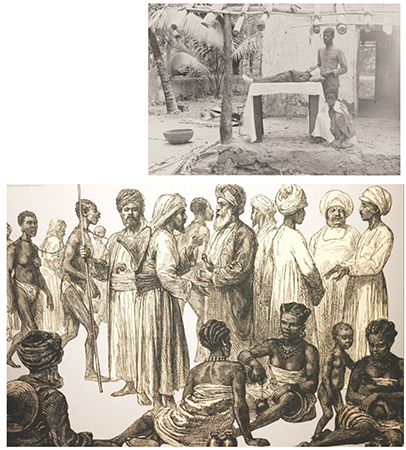
Top: Death of Jimmy in the Bombay plague. Photo: Capt C. Moss, 1897, from the Wellcome Collection;
above: slave market in Zanzibar with Indian traders Photo: The Illustrated News
Ranganathan noted in an article in the online newsmagazine The Wire on July 31, 2020 that "men and women from all communities in Bombay were involved in this lucrative business” of slavery. Citing an example from records of the Mayor’s Court, "the highest court on the island of Bombay in the 18th century,” he stated that the subject of a case was the "ownership” of one slave girl named Mankoor. "Her ownership could first be traced to one Allee Memon ben Abood who sold her on March 24, 1786 to Bomanjee Cawasjee Parsee and Sheik Noor Mahomed for Rs 190.” A week later, they sold Mankoor to Sek Calloo Havaldar for Rs 255. "In November, Havaldar sold her to tailor Rutton Bai for Rs 291, making a modest profit after seven months.” Rutton Bai retained Mankoor for two years before reneging on a deal to sell the then 15-year-old Mankoor to one Bhoychund Tricum for Rs 275, noted Ranganathan. "How Mankoor served her mistress during this period is not recorded,” he adds, tongue-in-cheek. "The Court found merit in Bhoychund’s case and ruled that Rutton Bai had to pay him back the money with interest and costs. It was just a routine commercial dispute as far as the mayor and his aldermen were concerned.” Ranganathan informed Parsiana on August 4, 2021 that the records do not specify if Rutton Bai was a Parsi, she "could well be (one).”
The researcher states that throughout the 18th century the Bombay government procured slaves from Africa, mainly purchased at the slave market in Zanzibar, either for its own use or for onward transmission to the East Indies. "Bombay was evidently the clearing house for slaves imported from Africa,” he wrote. Though the "import and export of slaves” was forbidden in Bombay by law in 1813 as part of a law enacted all across the Indian Ocean, "penalties were rather light: six months imprisonment and a fine not exceeding Rs 200. The slaves were to be sent back to their place of origin or allowed to remain in Bombay at the discretion of the magistrate.”
At the dawn of the 19th century, many Bombay citizens, both Indians and European, owned slaves who were part of their household, noted Ranganathan. When Dady Nusserwanjee (1734-1799), also known as Dadysett, made his will in 1794, "he settled minor bequests on his six African (or Siddi) slaves. He also instructed his son Ardaseer Dady to arrange for the male slaves to be married.”
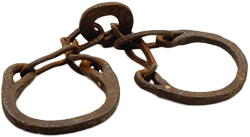
Slavery was outlawed by the British parliament in 1837 and its naval forces tried to suppress the slave trade across the world. "It, however, did not have an immediate impact and slavery in various forms continued to persist in Bombay and elsewhere,” claimed Ranganathan. The Zanzibar slave market was closed only in 1876, he wrote.
"There might have been no African slaves in Parsi households in the 1870s but their descendants still lived in Bombay, generally in precarious conditions,” noted Ranganathan. The researcher states that in the aftermath of the Parsi-Muslim riots in early 1874, a group of 20 Siddis, who were returning after a day’s work on board a ship, were set upon by a gang of Parsis. Quoting from The Times of India (February 23, 1874), Ranganathan stated: "The Parsis appear to have become terribly alarmed. Blows were struck. Both parties ran wildly in all directions. The Siddis hid themselves. The Parsis, however, have no excuse for maltreating the unfortunate 20; but in the present excited state of things, Siddis should, as far as possible, be prevented from going through the Fort, as the very sight of them creates an excitement amongst the Parsis not easy to be allayed.”
Slavery manifested itself in the flesh trade too. When the Sir Pherozeshah Mehta-established Bombay Chronicle of April 6, 1917 published a lead article titled "The Slave Market of Bombay,” the issue could no longer be ignored, wrote Ranganathan. It related to the murder of a sex worker by a brothel-keeper: "A story of slow torture and ultimate doing to death of a forlorn woman, which was told in all its detail in the court, is one so full of repulsive and unprintable horrors.” The newspaper opined: "Many are aware no doubt of the extent to which slave traffic in Bombay flourishes; few can have suspected the existence of such things as this case has revealed.” It called not only for legal reform but also for an "awakening of the conscience of the citizens of Bombay.”
The official suppression of slavery did not reduce the demand for human labor across the globe, wrote Ranganathan. "This led the British to formulate a system of indentured labor who were shipped from India to its colonies in West Indies, South Africa and elsewhere. Bombay was one of the embarkation points for this export trade. Even within India, large numbers of laborers were transported to tea estates and other industrial complexes under a similar arrangement. This system, which spawned a network of coolie-catchers, soon came to be recognized as slavery in all but name.”