Farrokh Cooper’s 75th birthday was a cause for celebration for
the 3,000 strong employees and collaborators of Cooper Corporation
Parinaz Gandhi
A nearly 20-foot floral garland, big enough to envelope three persons, was carried up to the dais by the staff of Cooper Corporation Private Limited in Satara. The main subject of their adulation was their chairman and managing director Farrokh Cooper whose 75th birthday on January 13, 2020 was a jubilant occasion for his workforce, his international partners and collaborators, as also his family and friends. The other two encircled by the garland were Farrokh’s wife Mahrookh and daughter Manisha who were given credit for accompanying and inspiring him on his journey to keep improving the performance of his company that has a group of 11 manufacturing sites with over a thousand machines engaged in researching, designing, manufacturing and supplying precision engineered products worldwide, from engines and generators to crankshafts, pistons and flywheels.
The function at Satara’s Yashwantrao Chavan MultipurposeAuditorium started with a seven-minute audiovisual presentation that captured the highlights of Farrokh’s life of seven-and-a-half decades. Viewing himself as a "son of the soil,” this "Marathi manoos (Maharashtrian man)” with a degree from the Poona Agricultural College had planned to work in the agricultural sector. The humble chairman who still happily rides his bicycle and motorcycle had to change lanes when his elder brother Saam was seriously injured in an accident requiring Farrokh to take over the family business started by his grandfather Dhanjishah. With his persistence for the last five decades Farrokh has been able to steer the company’s expansion programs such that to date they have exported products worth over Rs 3,000 crores. His dream product being the tractor manufactured at Cooper Corporation, the agriculturist believes he must be "the first Parsi in the world to make tractors.”
From l: Bomi Bhote, F. Cooper, Rahul Bajaj, Dr Purvez and Simon Grant, Mahrookh and Manisha Cooper
Known to be "a very stubborn man,” the master of ceremonies told the audience of a thousand plus who had gathered in the auditorium that the event planners wanted the function to last for two hours but Farrokh was determined that it should not stretch beyond 60 minutes. He insisted his accomplishments did not warrant a two-hour session. And even though he "has brought great wealth to India,” he remains a man content with his few possessions, repeatedly wearing the same clean clothes to work, only recently acquiring his third pair of shoes, sporting a Breitling watch gifted by his mother-in-law 45 years ago, using his Parker 51 pen that has been giving him good service for the last several decades... He may not be interested in splurging money on himself, yet he will happily extend alms, in lakhs, if anyone in need approaches him.
After the screening of the audiovisual, the next item on the day’s agenda saw Farrokh present a cheque to Rahul Bajaj, chairman of the Grant Medical Foundation in the presence of Dr Purvez Grant, managing trustee and chief cardiologist of Ruby Hall, Bomi Bhote, chief executive officer and Simon Grant. Bajaj is a "very humble man, always determined to grow — his country, his company, his thoughts,” remarked Farrokh. The amount was not disclosed but in his brief address Purvez Grant referred to the "fantastic, huge donation” that will be used for the upgradation of Ruby Hall and to finance the costs of children requiring heart surgery. As jested the master of ceremonies, if Bajaj wonders where this money has come from, it is money earned from the sweat of the brow, money earned from Bajaj shares and money earned from being a supplier to Bajaj!
On behalf of the Manufacturers’ Association of Satara, president Surendar Amabardar and secretary D. T. Bhosale felicitated Farrokh and Bajaj on the dais.
Greetings that had poured in for Farrokh from different corners of the globe were conveyed in an audiovisual: Harry Canning from England expressed that it was "fun working with you.” Stuart Gibson of UK spoke of different generations from his family who not only installed world class centrifugal casting machinery but also upgraded foundry technology at Cooper Corporation. He commended Farrokh’s "inspirational leadership qualities and generosity to employees, family and friends.” Hannu Nurmi from Finland stated that Farrokh exhibited "determination and perseverance which in Finnish they call sisu.” He considered Farrokh "brave to invest in technological development and manufacturing, exhibiting enthusiasm and personal commitment that made it easy to find mutual understanding.” Gianluca Bertossi of Italy, director of Wartsila Worldwide commented on Farrokh’s "leadership and customer dedication” making Coopers one of their world class suppliers of cylinder liners. Brian MCulam, director of Jaguar Landrover, UK thanked Farrokh for providing quality cylinder liners and appreciated his "grit, determination and hard work to run a manufacturing enterprise despite his former education in agriculture.” He further commented on the "organization culture (at Cooper) that looks after its people because of which there are very low levels of attrition.” Victor Chavez who opened the doors for Coopers to do business with GE Transportation admired Farrokh’s "vision and execution.”
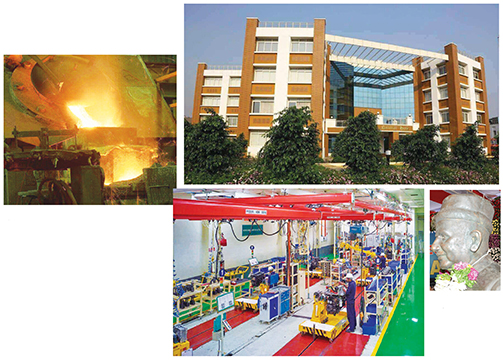
Top and above: Cooper Corporation manufacturing plant in Satara;
above: bust of founder Dhanjishah Cooper
Foundry specialist Detlev Michael, a renowned foundry technologist from Germany, summarized Farrokh’s principle: "Buy if necessary. Make yourself, if possible. Have both ears in market development and if there is a real chance, begin the work and launch it.” Horst Kind of Germany recalled how they chose liners from Coopers to replace a Japanese supplier. Martin Hill, vice president of Ricardo, Prague, who has been responsible for all Cooper designs for the last 12 years considered Coopers as his "favorite customer. It has been a pleasure to work with you. You are a special type of person who makes a lasting impression.”
The most endearing tribute came from Paul Knoebel, president of KJM Custom Component USA, who had specially come down with his wife, brother and colleague to join in the celebrations. He recalled the words of Mahatma Gandhi who said "it is difficult but not impossible to conduct strictly honest business.” According to Knoebel, Farrokh has "accepted that challenge with his art of brinkmanship, negotiation and, most important, compassion for our fellow men that Farrokh demonstrated almost on a daily basis.” He took out from his pocket a navy blue Parsi topi and covering his head revealed that he and Farrokh both cover their heads with a topi when they talk four or five times a week. "It is a sign of our mutual respect and belief in God.” For nearly two decades they conducted business without a written contract, he added.
Having observed her father working since she was a small child, Manisha commented, "A lot of people look up to you… You are the biggest guidance ever… Thank you so much for what you’ve done in life for me.” Their marital union, said Mahrookh, "has been a long run, a roller coaster ride of ups and downs over the years but we’ve survived very well and achieved a lot.” Contributing to his success, she said, was "the loyal support and dedication of the members of the staff and work force,” pointing to the employees seated on the balcony of the auditorium.
Knowing that news and fake news make headlines today, "I don’t know how much you should believe,” said Farrokh, tongue in cheek at the start of his acceptance speech, adding, "If there was an award for fake news, there is a good chance it could have been won by this evening’s audiovisual presentation.” Known to speak ex tempore with his wit targeted at the chief guest, since he was the guest for the evening he said he would stick to a fixed speech from his cell phone "to keep up with technology otherwise unfortunately one falls behind.” Born with a proverbial golden spoon in his mouth, but posthumously after the unfortunate demise of his father Nariman, he commented that "many a man his life has sold for that metal to behold!”
Privileged to complete his schooling in England, for him, the biggest inheritance was goodwill that is "something money cannot buy. Goodwill is in the heart. Goodwill is in emotions and goodwill opens many doors that money can’t.” Having walked in and out of situations not knowing which door will lead to whom, he remarked, he never misses an opportunity. Grateful to his family members and supporters "for their enormous love and affection for me without which I could not have done anything,” he referred to the innumerable occasions in his career when life had hung by a thread and help came from Lalchand and Walchand Hirachand on one occasion, from the Kirloskars on another, and a chairman of a bank who extended him a loan despite him not banking with them.
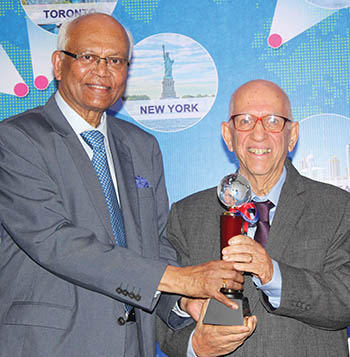
F. Cooper (r) receiving WZCC Award from Dr Ramesh Mashelkar Photo: Jasmine D. Driver
Collaboration with foreign companies has resulted in the creation of several thousand jobs in Satara, he noted. "Satara is very much on the world map in the automobile industry,” he confirmed. He has won 47 awards and recognitions from industry stalwarts like Ashok Leyland, Aditya Birla Group, JLPQ Land Rover, Harley Davidson, Kawasaki Motor Manufacturing USA, Bajaj Auto, Kirloskar Oil Engine Limited, as also from many chambers of commerce, the latest being the World Zarathushti Chamber of Com-merce (WZCC) Outstanding Zarathushti Entrepreneur of the Year that was conferred on him nine days before his 75th birthday (see "Talent, technology and trust,” pg 34).
Valuing goodwill
"I don’t work for trophies. I am out of the mainstream of Parsis,” stated Farrokh. With only five Parsis remaining in Satara, Farrokh was happy to bond with community members from all over the world at the WZCC awards function at the Rhythm Resort in Lonavla on January 4. It was close to midnight when Parsiana finally managed to corner him for a brief interview after the awards to get an update on the progress of his company since the last time we interviewed him (see "With vision, mission, passion,” Parsiana, February 7, 2011).
Their customers being Fortune 500 companies from USA, UK, Germany, Finland, China, Austria, Spain, Italy, Sweden, Netherlands and Taiwan, Farrokh mentioned that he was asked to set up a factory in America but "I’ve no desire for a green card. They buy from me instead… all types of high-tech foundry products.”
Witness to many industries closing down in Satara, he commented, "Ours is the only lasting unit employing over 3,000 people. Businessmen have to create their own environment.” According to him the government is pro industry, granting subsidies when new plants are commissioned and a certain number of people are given employment. "Every day is rewarding. Every day we achieve something.”
Initially reluctant to give his assessment on where the Parsi community is headed, he asked rhetorically, "You want me to start more controversy?” Subsequently he commented, "I don’t understand why we are wasting time on small issues when there are bigger issues at hand. Why are a large number of Parsis emigrating from India and succeeding out of India? Why can’t they succeed in India?”
The Cooper family continues to support the fire temple in Satara that is over 100 years old with a full-time priest. In the early part of the last century the community numbered 200 in Satara but are now down to five — besides him, there are Mahrookh, Manisha, nephew Zal Cooper and his wife Kavita. Religion to him is "something personal. We don’t have to impose it on others or reach a point where we start conflicts. Let each worship the way he/she wants otherwise the religion will die.” In the western world they are reinventing themselves whilst living in a new milieu. Why should we tell them how to live?
Not aware of philanthropic activities undertaken for priests, Farrokh queried, "Why don’t we hear about Parsis doing social work other than what is expected under corporate social responsibility?”At Coopers they extend aid for child welfare, medical assistance, education, starting libraries, computer literacy, for those in jails…
To keep himself physically and mentally rejuvenated, Farrokh enjoys the outdoors, walking, exercising, photographing, listening to all kinds of music and reading. Unlike his grandfather Dhanjishah Cooper who was the first chief minister of the former Bombay Presidency, politics does not interest Farrokh who thinks "it is too crowded.”
He attributes the success of his company to the "enormous amount of goodwill and property left by his ancestors.” His personal contribution to the growth of the company has been through "leadership, commitment, transparency.” To prospective entrepreneurs he advises: "You must know what you don’t know, find out someone who does, and listen (to that voice). Count your blessings and lighter your cross will be.”