The community viewed from outside
Pushpender S. Rashtrawar
When I was a boy of around 10 in the late 1960s we moved to Orient Row in Park Circus, Calcutta. This was an elegant area with residential houses on one side while on the other side was a large park. In one of the houses, around 100 m away from ours, lived a fair-skinned elderly gentleman, Mr Umrigar, who had endeared himself to all. He would greet everyone while walking down the street and chat with them. He was always well dressed and sported a golf cap. He was fondly known as Parsi Baba, or perhaps it was Bawa. He was reportedly related to Polly Umrigar, the Test cricketer. We missed him when he moved.
We resided in 4/3F Orient Row. The adjacent plot was vacant. Then came 4/2 Orient Row, perhaps the most modern structure amongst mostly older ones. Two Parsi pilots flying with Indian Airlines, Mr Bhagwagar and Mr Framroze, had married two sisters and lived in the same two bedroom flat on the first floor. Framroze was tall and stocky, with a peculiar waddling gait. He often smoked a pipe while walking down the street. His wife was a working woman and every morning an Impala car would come to transport her to office. We later came to know the car belonged to her British boss. On some evenings, strains of music would float out of their window. This was my first introduction to Western classical music, which remains a lifelong interest for me. The music was terrific with thunderclap like crescendos. As a young boy, I imagined that musicians were performing live in that flat. Framroze was interested in philharmonic orchestra music which he played most of the time. When I was older and visited their flat I saw huge speakers, around four to five feet high and two feet wide. I’ve never heard anything close to their sound with the exception of Avery Fisher Hall, New York and the National Centre for the Performing Arts in Bombay. All my attempts to find anything close were struck down by my wife, Anamika, on the ground that it would disturb the neighbors.
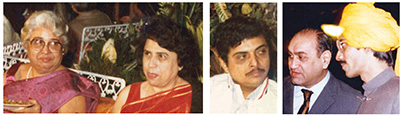
From l: Wives of pilots Bhagwagar and Framroze; Hormuz Bhagwagar; Framroze and author
As we came of age, both the pilots retired. Bhagwagar was friendly with some of the neighbors, but Framroze kept to himself. He remained occupied with his microscope and slides. He also tinkered with cameras. Mr Latif, who was known to my father as they were fellow Freemasons, owned a reputed camera repair shop in Calcutta. Reportedly, even Satyajit Ray’s cameras were repaired by him. Latif frequently visited Framroze to discuss difficult camera related problems.
Framroze had no children. The Bhagwagars had one son Hormuz who was friendly with us. For some unknown reason Hormuz jumped from the fifth floor terrace of a nearby building. Fortunately he survived without any permanent damage, but was given the nickname of flying Parsi by youngsters in the neighborhood.
Mr Chandna, a Parsi chartered accountant working for Tata Steel, lived close by. According to my friend, Chandna was an eccentric accounts officer, not interested in rising up the hierarchy. My friend, who visited Tata Steel often on work, had seen him speaking in Gujarati with Russi Mody, then managing director of the company, and slapping him on the back. Chandna had mastered the use of calculators. On weekends, a number of cars would be parked in front of his house; he gave lessons in the use of calculators. My chartered accountant friend once commented that perhaps even the manufacturers were unaware of the advanced uses their devices could be put to.
In 1979 I met with a serious accident due to which my legs were badly damaged. It took more than a year to get back on my feet when I could walk with crutches. One evening, I was walking painfully down Orient Row with a friend when a motorcyclist halted beside me and asked in a commanding voice, "What happened son?” I was startled and explained the sequence of events. He said, "Come to me with your X-rays and reports, I’ll help you.” I found out that he was Dadi Bulsara, the legendary contact karate expert. I was afraid to go to him because of the precarious state my legs were in. Later I learnt that Balsara had worked with disabled people.
Every evening I could hear the "Hoo!” and "Haa!” sounds made by his students as they practiced in the neighboring park. The evening sessions were relentless and would not stop even during the heaviest downpour. Balsara’s contention was that you have to be prepared for any circumstances. My friend joined his classes for a brief while. Within a week his entire back became black and blue because of all the rolling and dragging of the body on the ground. The training was not meant for sissies. Balsara’s classes turned out outstanding individuals ready to work for law enforcement agencies or as professional bodyguards, the best and toughest in the trade. Balsara also trained policemen and defence services personnel. He became a legend in his field.
In 1998 I came to Bombay to work in the Bank of Baroda’s Worli office. I often had to write long circulars relating to my region to be sent to all the offices in India. To ensure that the content was precise and the language correct, I needed to consult the dictionary. One day the dictionary was locked in a Godrej almirah and the person who had the key was absent. I was desperate, as the communication was urgent. My colleague, Silloo Bharucha, offered to loan me her personal dictionary provided it was handled with care. It had sentimental value for her as she had been using it since her school days. Silloo was around 40 at that time, so the dictionary was at least 25 years old. It was covered with brown paper over which there was a transparent plastic cover and finally a sheet of newspaper. When I turned the pages, it made a crackling sound as if I was opening a new book. I once visited Silloo’s home at Gamdevi where she and her sister resided with their ailing mother. The sisters never married. Silloo was tall and slim and would have made a great wife and mother.
I owned a National Panasonic music system with a radio and tape recorder. It had excellent speakers but it required some repairs. Mr Dara, my wife’s colleague, advised me to go to one Mr Firdaus staying in a flat near Grant Road station. Firdaus was a thorough professional. He was very good at his job but one had to pay whatever he decided. I later took my daughter’s digital piano to him for repairs. I once had to collect my equipment while Firdaus was not at home. He had instructed his sister to finalize matters with me. She was a really nice lady who taught geography in a school. I immediately developed a silent crush on her. Both she and her brother were tall and good looking but had remained single. Don’t they have matchmakers in the Parsi community?
I was always on the lookout for recorded Western classical music but did not necessarily want to buy new tapes. Anamika told me that her colleague, Dara, staying in Dadar Parsi Colony was keen on Western classical music. One weekend we went to his place. Dara had an excellent high end music system and regularly purchased Western classical tapes. He also had a good duplicating system and became a source of music for me during my stay in Prabhadevi. Dara too was unmarried.
At Bank of Baroda, Ms Yasmin, known for her toughness, fairness and integrity, worked in the human resources department. Sometime in 2005 the government decided to appoint Dr Khandelwal as the managing director of the bank. He was headstrong and known to be ruthless. Yasmin had worked with him earlier and they did not get along. As soon as the news of Khandelwal’s appointment was confirmed, Yasmin put in her papers. She was not willing to alter her stance.
In 2006 I was transferred to the New York Branch of our bank. My long awaited desire to watch Zubin Mehta perform live came true. Mehta was guest conductor at New York Philharmonic orchestra when my family and I watched him conduct at the Avery Fisher Hall at Lincoln Center. During the interval I noticed that a large number of Indians had come, the women resplendent in saris and the men in suits. There was not a seat to spare; Mehta was a hugely popular figure.
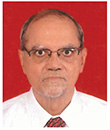
I
Pushpender Rashtrawar: in awe
n 2010 we returned from the USA and Anamika re-joined Bajaj. She went to Poona with the kids. Neel, my 12-year-old son, had been learning to play the violin in New York. We arranged violin lessons for him in Poona, but it did not work out. When our upright piano arrived from the US along with the rest of our household goods, Sheel started piano lessons with Ms Farida, a kind Parsi lady. Soon Sheel passed her Grade 6 of the Trinity College exams. Farida had sweet looking twin sons. But her place was located too far. We were looking for a teacher living closer to Kalyaninagar for Neel. Eventually we decided on Dr Ernavaz Bharucha under whose training Neel made rapid progress. Bharucha was an elderly Parsi lady who lived alone in a large flat in a double storied structure in Koregaon Park. The flat had very old furniture and artefacts. On display was a photograph of Bharucha as a pretty young girl. She had graduated from the Armed Forces Medical College in Poona but had perhaps never practiced medicine.
Bharucha was a thin woman with grey hair who never smiled. I would accompany Neel for his lessons whenever I was in Poona. She would intersperse her teaching with low volume scolding. Neel, a boisterous and naughty child, was overawed by her. The teacher student relationship became one of tormentor and tormented. I once asked Bharucha whether Neel could really learn to play the piano proficiently and was shocked to hear her say in her expressionless voice that he was perhaps one of the best students she had ever taught! I was at my wits’ end to understand her attitude.
In 2012, when Neel was 14, I received a call from Bharucha complaining that Neel had come for his lesson after smoking and she could no longer teach him. I pleaded earnestly, promising her that it would never happen again. But the heartless voice held a note of finality. Judgment had been passed; there was no proviso for appeal.
Soon after, we moved to Uday Baug and Neel started taking piano lessons from a talented young pianist, Tinaz Irani, in Salunkhe Vihar. She was also strict and though Neel was up to his usual tricks he made good progress and passed Grade 4 of Trinity College with distinction. By 2015, I had taken voluntary retirement and often accompanied Neel for piano lessons. I thought I too could learn to play the piano and requested Irani to teach me. Her reply was a resounding "NO!” By this time Neel was in senior school and his piano lessons were discontinued. We later found out that Irani had married and relocated to Cyprus.
My interactions with Parsis have been interesting, to say the least. I find them honest, fair in their dealings and upfront in behavior. They are humane with their servants, a trait I respect. They readily go into detail on many subjects, a rare aptitude. My only grouse is: why do so many remain single? And even when they marry they often have no children or just one offspring. Why are they in self-destructive mode? It will be a sad day if this interesting community should fade away.