"There may be hundreds of converts though converts who are navjoted may number only in dozens,” stated author-philosopher Alexander Bard of Sweden when visiting Bombay earlier this year. While Bard who has been invited to speak at the Stockholm School of Economics and universities around the world had professed his commitment to Zoroastrianism since his initiation in 1990, his companion on his recent trip, Joachim Lummer’s sedreh pooshi was performed last year by Mobed Kamran Jamshidi.
To describe themselves they prefer to use the term "Ashavan – follower of the truth,” to reiterate their commitment to Asha or truth and to distance themselves from undesirable druj. Bard said they are unable to keep count of Ashavans in Sweden but the largest number would be those of Iranian and Kurdish descent returning to their ancient religion. Having escaped from the mullahs, many can’t make a public display of their faith. Those married to them, and the group of converts would be included in this community of Ashavans.
From l: Joachim Lummer, Ervad Danesh Dastoor and
Alexander Bard at Asha Vahishta in Poona
In the process of raising funds to build a fire temple in the countryside in southern Sweden, they were hoping to purchase property this year. Some of the converted Zoroastrians being engineers, Bard was hoping they would be able to erect a temporary structure soon, followed by something permanent a few years down the line.
"Sweden is very secularized.” Islam is the fastest growing religion in the country. "There are a lot of Buddhists with 500 Buddhist centers,” observed Bard who has co-authored six books with Swedish literary and art critic Jan Soderqvist. His last book Process and Event, under the banner of Futurica Media, wherein Zoroaster and Zoroastrianism feature frequently took five years to write. It reflects his "30 years of thinking,” he told Parsiana. The back cover of the English translation of the book that runs into 604 pages invites the reader "to join in a breathtaking expedition that takes us from the infancy of religions in the form of magic and superstition via Persian mystics and iconoclasts to the age of enlightenment, modernity and artificial intelligence. Bard and Soderqvist carry out a necessary and radical rewriting of the history of western ideas and explain why man’s search for the divine inevitably leads us to a messiah machine with an agenda of its own.” For his next book he is studying Sufism that is "much older than Islam, providing a bridge between Zoroastrianism and Islam that is very much needed.”
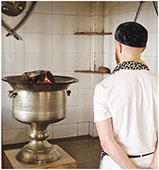
In the presence of the sacred fire
Bard resides in an abode he describes as "monastery” with three other Zoroastrian converts. His 90-year-old mother and four siblings follow different faiths. Lummer, who sat with Jamshidi for months to learn the Avestan prayers, stated that he enjoys going deeper into the philosophy of the religion. He mentioned that his siblings are not interested in religion but was happy to inform us that his girlfriend described herself as a Zoroastrian when filling her visa application.
Wearing of the sedreh-pooshi is a daily ritual for 64-year-old Bard although he may not keep them on his body at all times. "I have a box of kustis,” he told Parsiana when he visited the editorial office in January 2025. His regular practice of the tenets of the faith involves concentrated meditation — humata; promising to be in Asha mode — hukhta; practicing righteousness — hvarshta. At the end of the day he analyzes his three observances: "I go through this loop every day.” Lummer, 34, admitted, "I need coffee first thing in the morning after which I go to the pool for a swim every day.” He then sits on his yoga mat "to meditate, clean the mind, review what I did yesterday, what I can do better today.”
"It is so comforting to meditate in front of a fire. Meditation is active contemplation; it is not passive. It is a commitment to a path forward,” declared Bard on his return from Asha Vahishta, The Zoroastrian Centre in Poona that welcomes individuals from all faiths. Lummer too found the experience at Asha Vahishta "incredibly inspiring.”
In addition to Swedish, both Bard and Lummer are conversant in English and German. Bard also knows French and Spanish and is in the process of learning Avestan and Sanskrit. Lummer is currently learning Spanish. Delighted with the warmth and generosity of Parsi families they had met in Bombay, Bard declared, "We are here to learn about the Parsi contribution.” Lummer too looks forward to returning to India when research brings him back.