The Jehangir family made a perilous journey by sea and road to England in 1952
Jehangir Sarosh
Each evening, after work, my father Sarosh Khajotia had a ritual. He would ask the gardener to water the garden and the sitting area, partly to cool the place and partly to settle the dust. He would sit on his chair and if it was the mosquito season, one of his children would rub citronella oil on his feet and lower legs to keep the insects at bay. We lived in a wing of the hotel that was his business. The hotel was on the main Bombay Agra trunk road, always referred to as the GT Road (Grand Trunk Road), an ideal location because of the passing traffic. We had moved to this site during World War II. I presume it was Dad’s foresight, for this brought soldiers to the hotel and bar, especially the officers who were passing by in convoys on their way from the port of Bombay to the Burmese front.
The hotel was set in about five acres of land, with a long driveway from the road which ran along one whole side of the square plot. One evening, while Dad sat for his evening drink, a green Morris Minor drove in through the gates. As the convertible top of the Morris was down, one immediately noticed the three unusual characters looking very tanned and wearing what seemed like balaclavas.
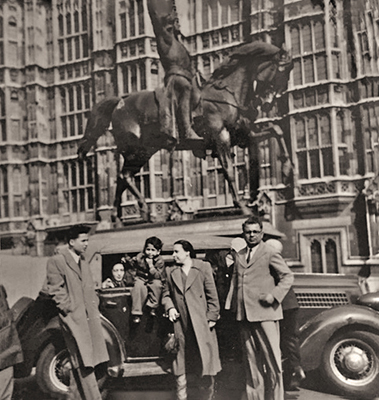
The Jehangir family and their car at Westminster, London
Our curiosity was aroused firstly at seeing such an unusual car, and we are all enamored with cars; added to that was the unusual mode of dress. We moved in unison to investigate. We realized that all three of them were women… Europeans. This was three years after India had attained independence in 1947, when most of the British had returned home.
The women were French. They had driven from Paris and were now on their way to Colombo, Sri Lanka. I think it was at that moment that our father decided he was going to drive to London: if three ladies could do it, surely he could, for he had toured India extensively and participated in various car and motorcycle rallies. Also, the hotel business was not doing so well now that the convoys had stopped and the British had gone.
Next morning the Morris Minor and its occupants drove out and turned left towards Bombay. We were never to see them again. But what began as a passing remark: "Let’s drive to London,” became an enterprise that changed our lives.
Dad was an electrician by profession but he had to give that up when he lost his right arm in an accident. He was working on a contract for a meena-bazaar (a funfair exhibition) when a huge generator broke loose while being unloaded and instantly amputated his arm. While the others were panicking, he got into his car and drove himself to a hospital. The loss of an arm did not deter him from participating in motorcar or motorcycle rallies. It was this spirit that was to enable him to drive to London.
Dad’s adventurous spirit required a reason to visit England. He decided that my two older brothers, Firoze and Rohinton, needed to be educated in their chosen professions, so he would drive to London, find the appropriate colleges for them and then return.
The conversation over the next few weeks revolved around the viability of the venture. This was not a case of driving out of our compound and asking someone, "Excuse me, which way to London?” There was also the question of passports, visas, availability of petrol, spares for the car and even which car to take.

The car being offloaded at Khorramshahr, Iran
We had two 1938 Ford convertible models with V8 engines. This meant we could cannibalize spares from one and create one reliable car from the two 12-year-old models. Day after day Rohinton, Dad and I would remove parts from each of the vehicles, compare which were better, clean them, place on new rubber seals and do whatever was necessary to bring the fuel pump, carburettor, dynamo, distributor, ignition cables, etc to their pristine state. It was a labor of love and hope.
There was continuous conflict while planning the route. Should we take the shortest or most scenic enabling us to see cities such as Kabul, Baghdad and Damascus, etc? The first priority however was to get to England economically. Every 20 miles meant another gallon of petrol, every extra day meant more money. The shortest route had to be found.
We discovered that Pakistan would not give Indians visas to travel to Afghanistan and then on to Iran, so we decided to take the car to Iran by sea. We found that the Scindia Shipping Line would transport the car from Bombay to Khorramshahr, a port some 80 miles south of the oil city of Ahvaz. This meant we had to travel some 375 miles south to reach Bombay.
After many family discussions it was decided that our mother would join us as well as my young brother Darius and I on the expedition. My sisters, Roshan and Piloo were to remain in India and await our return. So now there were six of us who had to fit into the car along with the luggage, bedding and other necessities. A roof rack was not possible as the car was a convertible with a soft canvas top. We converted the top to a hard one using wood and canvas. Perspex side windows were made to keep out the cold. The car, with registration number MBK 573, had done 82,600 miles already but looked smart and the engine sounded good. The year was 1952. Loaded with baggage, a spare jerry can of petrol, two spare wheels and fan belts, sparkplugs and distributor caps we began our journey.
The boat called the Dara was grubby and heaving with humans. As we were travelling deck class, we had to claim a space on the deck, fighting with other passengers, each family with their bedding, pots and pans, cans of water and the most essential Primus stove. We were told to spread out our blankets and sit on them to ensure no one could impinge on our territory. This was to be our home for the next 10 days.
As the Dara sailed out on October 9, 1952 on the Arabian Sea, we waved goodbye to our relatives, not realizing that we were bidding farewell to India and would not return for years and then only as visitors.
Three days later the Dara anchored offshore in Karachi and someone on a boat pulled up alongside, shouting "Sarosh! Sarosh!” It was Dad’s cousin who had come to greet us. It was a joyous reunion after many years of tense political relations between India and Pakistan.
As Khorramshahr approached we packed our belongings with due consideration regarding what was needed for the journey: light clothes for the deserts of Iran, warm clothes for the snows of the Alps and Mount Blanc. The quay was heaving with people disembarking as my father went to see about the car. Fortunately, it was one of the first cargo items to come out of the hold. As it was being hoisted up by the crane with just four ropes around the wheels it swayed and seemed to slip to one side as it was lowered. All was well, however, and Dad thanked all concerned. He sat behind the wheel and handed over the crank to one of the boys, refraining from using the "self-starter” in case the battery was low. The choke pulled the gears in neutral and a thumbs up was given for cranking. The V8 engine purred away as only a Ford V8 engine could.
The long drive to London, some 6,000 miles, began in a car that was overloaded with the six passengers, baggage, rations and spares. As we headed out of Khorramshahr and into the desert we inquired of a truck driver about the route to Ahvaz. He explained that there were many routes for in the rains some tracks became impassable so one just creates another track that leads to Ahvaz 80 miles away. The rule is never to lose sight of the telegraph line. Look out for the poles and you will get there, he advised. Ahvaz impressed us as this was the first realization that we were in Iran. A totally different country and culture to us. No one spoke Hindi, Gujarati or Urdu, and few spoke English.
Our next stops, Kerman and Yazd, held a special significance, being two strongholds of Zoroastrianism. We felt at home with these small communities — descendants of people who had held onto their religion and culture for 1,400 years despite persecution. At the time of our visit the Zoroastrians were enjoying a respite due to the less hostile reign of the Reza Pahlavi dynasty which continued till the overthrow of the Shah in 1979 and the return of Ayatollah Khomeini.
Leaving this homely community was when the true adventure into the unknown began. The travel through the deserts of Iran, the mountains of Turkey, the communist countries of Yugoslavia and Bulgaria, a Europe that was recovering from the ravages of war (cities like Trieste were occupied and divided between four nations), then through the snowy mountain passes of Italy and Switzerland to reach France where we crossed the English channel and viewed the White Cliffs of Dover.
The adventure of 6,000 miles through these countries, not knowing what lay ahead, whether petrol would be available in the next city or how to handle the accident we had in Yugoslavia are stories for another day.
It was a beautiful, sunny, winter morning on December 2, 1952 when we drove into London. I cannot recall the journey through the suburbs but what is still vivid in my mind is the drive to Marble Arch through Park Lane with Hyde Park on our left. All those black cars and funny looking Austin and Morris taxis. It was just wonderful to be there, to recognize all those names we only knew from playing Monopoly.
We made our way through Oxford Street and Regent Street to the world renowned Piccadilly that somehow did not live up to our expectations, and we felt even greater disappointment at seeing Buckingham Palace. Its sombre look just did not feel like a palace to this Indian who was used to the grand ornate palaces of the maharajas. London was different from what we had imagined it to be. I am sure it was the glorious sunshine that made an everlasting impact on me.
The euphoria of being in London soon diminished as the meager amount of rupees worked out to virtually nothing in sterling and soon ran out. The hopes of further education shattered, my two brothers and I were quickly put to work to pay for daily necessities.
It was then that it dawned on us that we were no longer tourists and students but immigrants. Without money there was little prospect of returning to India in the near future. The realization affected my parents the most. To them, India was home where they had friends and relatives and thus a desire to return.
Some 20 years later, when we did return to India for a holiday, it was no longer home. We realized Britain was our real home.
Thus we live with divided loyalties, seeking an identity while we, after 65 years, still remain foreigners in a land we think and feel is home.
Even with that caveat, we are thankful to those who welcome us. To those who shout and tell me to go home, I reply: "Yes I am on my way home, in Bushey, in Hertfordshire.”
Edited and reprinted from faith initiative, Issue 37