Calligrapher Perin Pudumjee Coyaji’s
second book illustrates the little known
text of Ahura Mazda’s 1,001 names
Farrokh Jijina
When Poona-based copywriter turned calligraphist Perin Pudumjee Coyaji was at Bombay’s H. B. Wadia Atash Behram on the eve of her twin sons’ navar initiation process in 2013, the priest in attendance "bade me follow him into a large side room where lay a pile of old, dusty books on a windowsill… He wished for us to accept any of these texts lying there.” Spotting a booklet in Gujarati "which distinctly looked like 1001 Names of Ahura Mazda,” Pudumjee Coyaji helped herself to it. "The little Gujarati booklet by Ervad Edulji Karkaria with a preface dated August, 19, 1951 by Ervad Rustom Dinshah Dastur of the Meherjirana family was carefully placed in my studio cupboard and shelved in the recesses of my mind!” she told Parsiana on August 27, 2023.
Two years later, when she mentioned to Parzor director Dr Shernaz Cama that she had a Gujarati book of 1,001 names of Ahura Mazda, "Cama’s eyes widened, having never heard of this… Almost all the Parsis I spoke to hadn’t.” Cama insisted, "Give it to me. I’ll have it put into Avestan and you can use calligraphy to design something for us for the (then) forthcoming Threads of Continuity (TOC) exhibition.” Parzor facilitates preservation and education of Parsi and Zoroastrian culture.
When the calligraphist received the Avestan version done by Ervad Jamshed Sidhwa of Gurgaon, she started thinking about the artwork with "every fear assuaged by Cama.” Adding a disclaimer about the Avestan spellings, she presented the 1,001 names to the community for the first time at the TOC exhibition in Delhi in 2016.
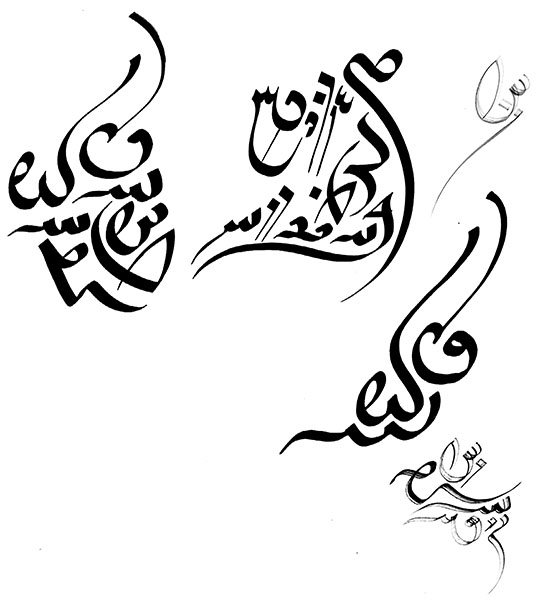
Samples from her depiction of the 1,001 names of Ahura Mazda
Perin Pudumjee Coyaji Photo: Hemant Chaturvedi;
Pudumjee Coyaji’s self-published coffee table book, The Zarathushtrian 1001 Names of Ahura Mazda: Avestan Calligraphic Expression and English Translation, was launched by her parents Dinky and Kaikobad Pudumjee at a function at the Poona Club, on August 15, this year. She had earlier self-published Zarathushtrian Kusti Prayers, Calligraphy in Avestan, Gujarati, English and an English Translation (see "Loving the letters,” Books, Parsiana, September 21, 2005).
The artist’s study of calligraphy began in 1996 with her mentor Achyut Palav. For nearly three years she traveled once a week from Poona to Bombay, spending the day studying and returning home in the evening. "Though I had already been asking around for a while if there was something like an Avestan script… nobody I asked could answer me! I was often dismissed with the fact that they used to teach it to aspiring priests at the madressas,” she had told us in an earlier interview.
"Spiritual experiences through this period confirmed its relevance to my inner journey,” Pudumjee Coyaji noted, telling Parsiana, "I felt I had been guided by Dastur Azar Kaiwan, the 16th century Zoroastrian mystic… There were many dreams and visions to confirm this.” The names did not leave her. She "recited them almost daily…Their power when pronounced one after the other, is akin to a magic spell.”
At her request, Ervad (Dr) Rooyintan Peer, who is well versed in Avestan, agreed to proofread the names. Meanwhile, she "spent hours daily, scribbling thumbnail calligraphy sketches of each name, often 12 to 15 options!”
She then roped in designer Zehra Tyabji. "Not having any formal art training, I needed her keen, critical eye to identify the best of my sketches.” Ex-colleague of 30 years, art director Raju Gondhalekar was brought in to design the book. Pudumjee Coyaji’s uncle, renowned puppeteer Dadi Pudumjee, Padma Shri awardee, was "stupefied to see her scribbles.” He arranged for her to meet with his old National Institute of Design teacher, typographer Mahendrabhai Patel, "who wanted to proceed to design the book with my ‘rough’ scribbles itself!”
In April 2022, Pudumjee Coyaji began work on the final artworks. "My tools were a thick marker, a dry marker and a metal nib. The style used is distinctly that of our Indian manuscripts, not based on the more fluid Iranian version of the script. Variations in the letterform have been employed and artistic license used to advantage.”
The self-effacing calligraphist told Parsiana, "I always stress that I am not a linguist, scholar or grammarian... I am able to follow the (Avestan) script just enough to slowly make out the word… My skill is limited to copying out the Avestan word or prayer in an artistic manner.”
Others involved in the project were writer and art lover Brinda Gill, "a beacon of positivity from day one,” calligraphists Raju Kulkarni and Santosh Karvande, and Anahita Shah who gifted Pudumjee Coyaji the required tools.
The artist said the 300-page, hard-bound, limited edition, believed to be the first book of the 1,001 names, is a calligraphic presentation in the ancient Avestan script with a preface by Peer, "It was a labor of love… The book is an offering… It has been inspired.”
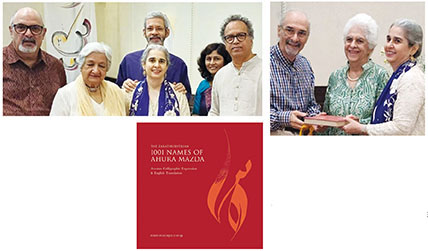
Top: from l: Dadi Pudumjee, Zehra Tyabji, Pudumjee Coyaji, Dr Xerxes Coyaji,
Shilpa and Raju Gondhalekar; Kaikobad and Dinky Pudumjee with Pudumjee Coyaji;
above: book cover
Pudumjee Coyaji at work Photo: Hemant Chaturvedi
The tome was funded by her family and friends, including the M. D. M. Jeejeebhoy Trust, businessman-philanthropist Cyrus Guzder, philanthropist Rati Forbes, Dinky, Dadi and close friend Roxana Tantra.
Pudumjee Coyaji informed Parsiana on September 1 that her submission of an abstract of the book was accepted for a paper presentation at the TypoDay forum in October. "This year the theme for this typography and calligraphy forum was ‘Sacred Script’ so on Dadi’s (Pudumjee) suggestion, I took courage and went ahead to present an abstract on the making of the book… Never presented a paper before… It is a matter of pride for the community that our ancient script will be recognized at this platform.” The 16th TypoDay event will be hosted by the Department of Applied Arts, Banaras Hindu University, in collaboration with the IDC School of Design of the Indian Institute of Technology, Bombay.
She intends to exhibit the many artworks she created in the course of the research for her book. "People will love to see them… They are a transformative experience… They will silence you… No, they will not be sold… I have had inquiries.” Interested in Jain philosophy, Pudumjee Coyaji has edited religious articles for a Jain friend. Future plans include a book on the "Avestan Ahun, a mystical symbol as well as a mantra which is akin to Devanagari Aum.”
"Much help is receivable”
Peer writes in the preface to Pudumjee Coyaji’s book that in scripture, there are only 101 names of Ahura Mazda available in a standard form, largely in Pazand. The writer of the Gujarati preface in the 1951 book cites a Persian couplet in support of the contention that there may have been 1,001 names: "Khudaa-I ke naamash hazaar-o-yak hast /Bahar naam khaandan basi chaareh dast (That Lord whose names are one thousand and one, and much help is receivable by reciting each one of them).” Karkaria "mentions that he had acquired the 1,001 names in some mysterious but divine circumstances (kudrati sanjog).” Besides this text, there is no other material available to ascertain the existence of 1,001 names, stated Peer.
The language of some words is mysterious and not understandable from any linguistic viewpoint. "Some of the names are repeated, several others occur in different inflected grammatical forms of the same Avestan word… The main difficulty, particularly in the first group of names, was about the most atrocious spellings and printing errors in Gujarati… This totally altered the fabric of some of the original names.”
In response to Parsiana’s request for more information, High Priest of the H. B. Wadia Atash Behram, Dastur (Dr) Firoze Kotwal stated: "There once seems to have existed 1,001 names of Ahura Mazda… In manuscript E50, housed in the First Dastoor Meherji Rana Library in Navsari, and written by the learned scribe Navroze Rustom Behram Darab Sanjana in 1148 AY (c1778 AD), he mentions the existence of the 1,001 names in Gujarati on folio number 319 v. as: ‘At some point in our history, there were 1,001 names of Shri Dadar Hormazd, and out of this, the learned dasturs have deduced 101 names from the Pahlavi books and the meanings of all these names are written in Pazand, which has been copied here in the ‘hendavi zuban (Indian language).’” The High Priest cautioned: "It is… important toscrutinize the authenticity of the names, as often the names of Dadar Hormazd are duplicated in such lists by either changing the verb endings and inflexions or by using words having the same meaning but in two or even three different languages.”
As stated Peer, "there is no academic or scholastic element attached to (Pudumjee Coyaji’s book)… It is the faith of the believers that trumps everything else.”
The book, priced at Rs 3,000 can be ordered from the distributor, The Word Bookshop, Poona, via Priti Jain at +91 93253 23300, email:
thewordbookshop@gmail.com.