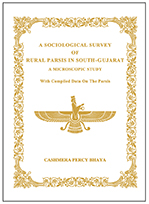
A Sociological Survey of Rural Parsis in South Gujarat: A Microscopic Study with Compiled Data on the Parsis by Cashmera Percy Bhaya. Published in 2024 by the author, P.O. Box 1171, Ruwi, Postal Code 112, Sultanate of Oman; email: cashmerabhaya@hotmail.com. Pp. 642. Price: Not for sale, for private circulation only.
Did you know that flourishing Zoroastrian merchant communities came up in both Kerala and Canton (China) at roughly the time of the Sanjan settlement?
Did you know that "the mainstay of the (early Parsi) migrants was trading and not agriculture”?
Did you know that a Parsi, Rustam Manek, was chief broker of the East India Company (EIC) and was the official responsible for getting the vital permission from Aurangzeb to set up the first EIC factory in Surat (which the local nawab had been resisting)?
Did you know that, while Christendom was having its Reformation, Parsi priests of Gujarat were exchanging letters (the Rivayats) with their colleagues in Yazd for over two centuries, trying to get back to their pure roots?
Did you know that Parsis cannot properly be called fire worshippers, fire being only the "residence of the divine nature, and not the divine nature itself”?
Cashmera Bhaya:
exceptionally wide reading
All of this information is fascinating but why does it appear in a book on the poverty of rural Parsis?
The answer to this is that Cashmera Bhaya’s book is actually two books in one. The first 175 pages, and the first section of every subsequent chapter — whether on marriages, death rates, agiaries, or whatever — is about Indian Parsis in general. The second section then studies the same theme with respect to the rural Parsis of the taluka just south of Surat, Choriyasi. This taluka is obscure but the names its villages gave to Parsis are known to all: Adajania, Amrolia, Bhathena, Dumasia, Ichhaporia, Randeria, Siganporia…
It should also be noted that the general sections describe current reality while the data on rural Parsis dates back to 1984-88, when Bhaya — then Bharucha — did her doctoral research. Forty years is a long time, time enough to turn sociology into history.
While this is an unusual book structure, it offers some opportunities for contextualizing rural Parsis in a single taluka within the larger Parsi demography. For instance, Bhaya correctly contrasts Bombay’s "never-married” (skewed towards professional "achievers”) to those in Choriyasi, who cited "financial difficulty” as the main cause for not marrying. But she misses others. For instance, it is intriguing why rural Parsi birth rates are as low as Bombay’s given that the urban problems of space and middle class aspirations are less relevant. In general, the book is more encyclopedic than analytical, more a distillation of Bhaya’s exceptionally wide reading (endnotes make up 40% of the book!) than a piece of original research.
Much of Bhaya’s 1980s portrait of the Parsis of Choriyasi is unsurprising. Very few had studied beyond Std X, the Parsi community around them had declined due to urban migration, and the agiaries and dakhmas that a larger population had once sustained were fast closing down. On the other hand, it was surprising that the service sector, and not agriculture, was their main source of income. Also, despite their rural location only 32% of families owned livestock of any kind, 12% lived in houses made of bamboo and cow dung and 28% were already being aided by Parsi charitable trusts. Bhaya reports that soon after the release of her study, World Zoroastrian Organisation Trusts was established in 1991 to help the Parsis of rural Gujarat, with a total of seven crores rupees (USD 809,936) spent on their rehabilitation through 2021.
Why did more rural Parsis not keep livestock, given that only 35% (and only seven percent of the women) were "engaged in any economic activity at all”? Why did only nine percent show any interest in migrating to a city, despite their grinding poverty? Bhaya does not pose or answer these questions because her study is entirely based on quantitative surveys. No attempt was made to supplement it with qualitative data gathered through interviews and focus groups. For what she calls a "microscopic study” this is a missed opportunity for in-depth understanding. While one understands that "thick description” and the importance of narrative had yet to reach Indian sociology in the 1980s, some follow-up work could have been done in subsequent — and less positivist — decades.
Dr CYRUS VAKIL
Cyrus Vakil, with a PhD in British and colonial history from Yale University, recently retired as principal of Bombay International School.