A new medical facility will tend to head and neck,
and women-specific cancers
Text: Farrokh Jijina Photos: Homyar Mistry — Homz
A donation of Rs 25,000 given over 25 years ago by a grateful patient became the foundation of the corpus that germinated into the establishment of CanCare Trust’s newly built Punya- shlok Ahilyadevi Holkar Head & Neck Cancer Institute of India (PAH-HNCII) in Bombay’s Mazagaon area this August. The culmination of senior oncological surgeon Dr Sultan Pradhan’s "long held dream,” the 17-storey, 93-bed hospital "could not have been done” without the input of trustees Dr Roshan Chinoy, senior histopathologist, and Dr Meher Elavia, senior anesthetist. The professional paths of Pradhan, Elavia and Chinoy have intersected and intertwined since 1975, the most recent being at the erstwhile Prince Aly Khan Hospital (see "The Parsis and the Prince,” Parsiana, December 21, 2015).
In the spanking new board room of the Institute, on August 18, Pradhan, the soft spoken doctor of five decades’ standing told Parsiana about the making of the facility and their future plans.
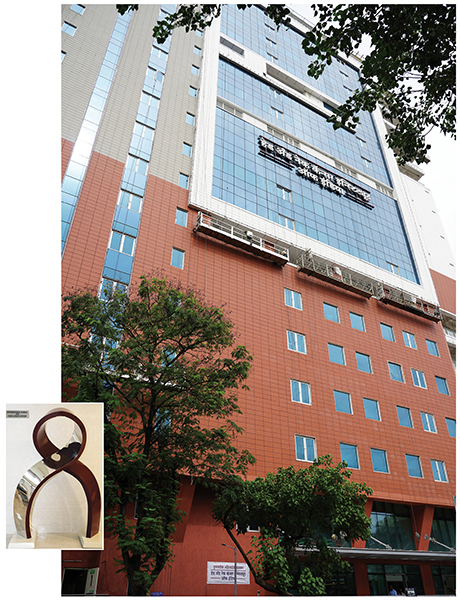
Above: Punyashlok Ahilyadevi Holkar Head & Neck Cancer Institute of India;
inset: installation depicting international symbol of head and neck cancer in foyer
Above: The "C" team, from l: Drs Prathamesh Pai, Roshan Chinoy, Sultan Pradhan, Meher Elavia
Top row: patient rooms; 2nd row: operation theater (l); waiting for consultations
Remembering the first donor
The multi-storey structure includes an 11-bed unit for day-care chemotherapy and recovery; three basements house radiation therapy, stores and bio-waste rooms, with minimal parking. The upper stories have consulting rooms as well as single and twin sharing rooms for patients. In one such room overlooking the harbor, Elavia tells us that the room rates and the rates for services are comparable to those of the Tata Memorial Hospital (TMH).
While walking the Parsiana representative through the facilities, it is evident Elavia is in the know of every little detail of the setting up of the Institute, from the cost of the project (Rs 246 crores… "and we are debt free”) to who has donated which painting to the Trust. The modular, state-of-the-art operating rooms are her pride and joy. "Three of the six operating theaters have facilities for teaching students remotely.” The 12-bedded intensive care cum high-dependency unit (HDU) is modular. "When we need more beds for intensive care, we can quickly use the ones in the HDU,” stated Elavia.
Services include an outpatient department, radiology, pathology, chemotherapy, and radiation oncology. A sterilization unit is located on the sixth floor. The Institute is inching towards its intended staff strength of 350. A cafeteria is in the making. Cashless admissions under health insurance will be possible soon. From a terrace on one of the higher floors Elavia points to a plot to the south of the building. "There is space for expansion in the future,” she stated.
The other CanCare trustees are senior chartered accountant Yezdi Malegam, senior financial services professional Nasser Munjee, senior pathologist Dr Avinash Phadke and human relations specialist Reshma Naidu. The medical director of PAH-HNCII is Dr Prathamesh Pai.
The land for the facility on which earlier stood the Devi Ahilyabia Holkar Municipal Maternity Home was made available to the Trust by the Bombay Municipal Corporation. (Daring yet devotional, during her rule from 1767 to 1795 Ahilyabai earned respect for the Holkar dynasty in present day Madhya Pradesh.) Under a memorandum of understanding with them, the Institute will provide beds for needy municipal employees and their associates where treatment will be provided either free or at subsidized rates.
Pradhan told us that some of their surgeries are minimally invasive. "With laser surgery, for instance, it is possible to operate on the larynx (voice box) and remove a small part instead of total removal …Trans-nasal surgeries of the skull are now possible… both these are minimally invasive… We take tissue from other parts of the body to reconstruct the head and neck… This is micro vascular surgery… We did one just today.”
All health care is about solid partnerships, he believes. PAH-HNCII will provide palliative care for advanced cases with the assistance of the Cipla Foundation. "For those newly diagnosed with the illness, there will be counseling at our Cancer Rehabilitation Center” run by survivor and lead volunteer Anahita Vesuvala, along with survivor-volunteers. Their collaboration with the Salaam Bombay Foundation will help spread awareness among street children on the ill effects of tobacco and other substances.
"We will reach beyond those who come to us,” stated Pradhan. One of their objectives is training ear-nose-throat, and oral and maxillofacial surgeons in public hospitals who are the first point of contact for people afflicted by the illness. Post-graduation fellowship in head and neck cancers will be offered to these medicos, stated Pai. Their training courses would include rotation stints with TMH. Focused courses on healthcare management and nursing are also on the cards. Chinoy’s histopathology laboratory will undertake training for general pathologists to enable them to interpret reports accurately, she said.
Pradhan stated he has been active in spearheading specialized training in the Sion, Nair and King Edward Memorial Hospitals in Bombay and B. J. Medical College in Poona for over 25 years. This was with funds provided by the Narotam Sekhsaria Foundation. "We want to do it across the country,” he stated. Outreach camps are proposed in Himachal Pradesh and Bihar, with training in PAH-HNCII.
Head and neck cancers include those of the oral cavity, voice box, salivary glands, thyroid, paranasal sinuses and skull base. The estimated number of cases of cancer in India for 2022 was 14,61,427, according to the National Institute of Health. "Thirty percent of these are head and neck cancers… Among these, oral and thyroid are the commonest, but not among Parsis and Sikhs… they do not smoke, generally,” stated Pradhan. Cancer in women — breast, cervix, uterus and ovarian — is another thrust area for the PAH-HNCII. "We feel there are inadequate facilities for women and we are here to fill that need,” stated Pradhan.
"There is an impression that breast cancer is high among Parsi women. I am very sure it is not more common than in other communities… It is just that you are a small community, so the illness gets magnified.” Pradhan believes that Parsi women in the 1950s and 1960s normally flocked to Parsi surgeons in TMH so the problem appeared to be larger than it was.
Foundation of gratitude
When he was a young doctor, Pradhan recalled that among his first patients was a woman who had breast cancer. Over the next many months, she became very fond of the budding surgeon. "She would bring me pickles and even knitted a sweater for me.” In 1997 after she died from another cancer, her son went to the doctor with Rs 25,000. "I never take money as gifts from any patient… but he said it was his mother’s dying wish. ‘Maajhe doctor la dya (give it to my doctor)… He will know how to use it.’” Coerced into accepting the money, he set it aside as the corpus towards a trust fund he had been mulling over for many years. "That is the heartbeat of the Trust,” he told us. Wondering about a name for the unborn Trust, he narrated that Chinoy spontaneously said, "CanCare, of course.” That kind, first donor’s photo will now occupy a prominent spot in the Institute.
As stated Pradhan, "If you love your profession, there will be gratitude.”
"A good space to work in"
Showing Parsiana around the new Institute, Elavia states that they have used extremely soothing colors in the public areas and the rooms "to create a calming environment.” Pointing to a large framed piece of embroidery in the registration area, she attributed it to Chinoy’s pandemic handiwork. Some paintings have been donated by eminent physician Dr Farokh Udwadia. The artworks include prints of icebergs created by sculptor-scrapturist Arzan Khambatta. "These are my grandson Varun’s paintings,” Elavia stated, pointing to some abstracts near the laboratory. You get a sense that for both Elavia and Chinoy, PAH-HNCII is not just a place to work in, or even something they have set up. It evidently means much more, just as it does to Pradhan.
Artwork giving out "positive energy"
Khambatta, who has been involved with two artworks in the reception area, shares this sense of "family.” "Mehroo Aunty (Elavia) called me to the facility long back… I was told this was a pet project of Dr Pradhan, who happens to be the most modest human being, in spite of being one of the topmost oncologists.” Elavia told Khambatta the "entire project was built by donations from well-wishers and ex patients. Any place which has so many well-wishers is a good space to work in,” he stated. Requested to design three pieces for the foyer, one of the end products was a three dimensional version of the cancer ribbon international symbol. "This I created from stainless steel, and also managed to get the exact burgundy color … They wanted a feel good piece which inspires visitors. So I created this human that emerges from the ground upwards. He/she seems to bloom and grow in a healthy manner. It has these leaves which have positive words engraved on them. I do hope that patients get at least some positive energy from the piece.” Khambatta was also involved in designing the donor wall. "Here I gave them a bas relief design, and composed the plates in a way that the whole wall appears like a work of art itself, plus has the flexibility of adding more names in the future.”