The multifarious activities of the Federation of Zoroastrian Associations
of North America are handled by 23 committees
Parinaz Gandhi
This is nothing else but resurgence in our North American community,” commented Homi Gandhi, president of the Federation of Zoroastrian Associations of North America (FEZANA) when commending the efforts of individuals who have "volunteered hundreds of their personal hours” to serve as chairs and co-chairs of the 23 FEZANA committees. Seventeen of them, present at the 32nd annual general meeting of FEZANA in Orlando, on May 3 and 4, 2019 presented the highlights of their activities in the preceding year. The commitment of the office bearers of FEZANA as also the co-chairs of the Congress Committee was highlighted in "Faith in FEZANA” (Parsiana, July 7-20, 2019).
The organization’s website fezana.org can be considered "the gateway to FEZANA,” remarked vice president Arzan Wadia who is also chair of the Information Technology Committee. Last year they saw over 20,000 visitors with the maximum in the months of March (because of Navroz) and in July (because the deadline for educational scholarships is August 1), he referred to the findings by his co-chair Arzan Lali. The traffic is coming from Facebook and local association websites, they have noticed. The website is also used to order items from the Zoroastrian Shop, one such being an online request for sudrehs from Brazil.
For the six FEZANA Scholarships and 11 Endowed Scholarships, 78 applications were received last year, stated Dr Dolly Dastoor, chair of the Academic Scholarships Committee. Fifty-one applicants were undergraduates and 27, graduates. Scholarship amounts ranged from $ 1,000 to 5,000 (Rs 68,980 to 3,44,898) with a total disbursement of $ 38,000 (Rs 26,21,221). Dasatoor noted that currently scholarships are granted to "one in four applicants. We should aspire for one in two.”
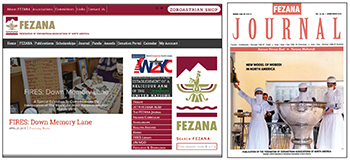
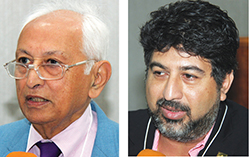
Top: Homi Gandhi (l) and Arzan Wadia; above: publication and portal of FEZANA
The FEZANA Scholarship "immensely helped me for my masters program,” revealed Parshan Khosravi, chair of the Seventh World Zoroastrian Youth Congress (7WZYC), who volunteered to help the community once the Congress is over. Charitynavigator.org lists many charities with a guide star rating that could be tapped into, said Dr Behram Pastakia, chair of the Information Receiving and Disseminating (Publications) committee, urging the community to avail of these funds. He also referred to the efforts of the Zoroastrian Faculty Network under the aegis of the Global Working Group (GWG) that mentors students to optimize their potential. "If the youth take responsibility for the community, the future of FEZANA is safe,” believes the FEZANA executive.
Houtoxi Contractor of California stressed that for scholarships, "Our North American kids should get preference over millionaire kids from India.” In favor of giving "discretion to the committee,” Gandhi advised them to keep a balance. Observing that in Vancouver "scholarship recipients are rich,” Alayar Dabestani with business interests in USA and Canada enquired if scholarships could be made dependent on the income level of parents. The weightage, as decided by the committee, is 40% on academic performance, 40% on need, 10% on co-curricular activities and 10% on community involvement, revealed Dastoor, adding. "We are not rigid; very flexible.” Recalling the cheque he had received when he studied at the University of Tehran, Dabestani has over the years been "giving to others in need. It is not contractual. No one forced me.” He was able to help 120 students in Iran, he reported. When about 120 alumni of FEZANA scholarships were approached, "only seven offered to pay back,” mentioned Wadia.
For the Performing and Creative Arts Scholarship, five applications were received of which three were granted scholarship, stated Committee chair Nazneen Spliedt. Each of the recipients was awarded $ 1,000 (Rs 68,980).
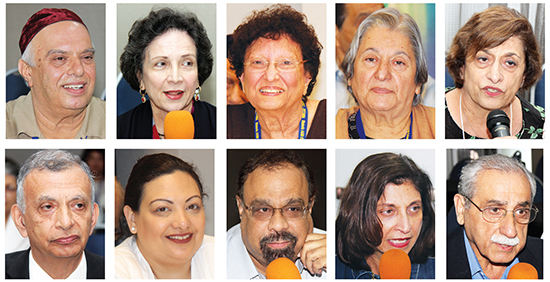
From l, top row: Hosi Mehta, Houtoxi Contractor, Dr Dolly Dastoor, Nazneen Spliedt, Aban Rustomji;
2nd row: Dr Behram Pastakia, Afreed Mistry, Bomi Patel, Mahrukh Motafram, Rohinton Rivetna
From l, top row: Behram Irani, Ratan Mistry, Adil Masani, Lovji Cama, Rustom Kevala;
2nd row: Arman Ariane, Alayar Dabestani, Dr Anne Khademiyan, Parshan Khosravi
As part of its efforts to "promote awareness of FIRES (FEZANA Information Research Education System)” an opportunity to showcase itself came up at two major events during the preceding year: Parliament of the World’s Religions (POWR) in Toronto and inauguration of the Bhandara Atash Kadeh in Houston, stated Aban Rustomji, chair of FIRES Committee. At the POWR, a booth on Zoroastrianism introduced the principles and practices of the Zoroastrian faith to members of other denominations. To coincide with the inauguration of the Atash Kadeh in Houston, FIRES had organized an exhibition "Down Memory Lane” recreating scenes from Parsi lifestyle of yore.
Rustomji was particularly appreciative of the magnanimous donation of $ 20,000 (Rs 13,79,600) from author Bapsi Sidhwa and the gift of treasured manuscripts by Cyrus Bharucha and Ervad Bomanshah Sanjana. Additionally books were donated to FIRES from the collection of Kaikhosrov and Piroja Irani as also Pallan Ichaporia. FIRES offered to share the duplicates in their collection with FEZANA member associations but the response has been tepid.
From October 11 to 13, 2019 they will be organizing a seminar conjointly with the Society for Scholars of Zoroastrianism when the speakers will include Dr Almut Hintze, Dr Jenny Rose and Kersi Shroff. The community needs to promote authors of children’s books, she recommended.
As chair of the External Affairs Committee, Bomi Patel mentioned that he attended the GWG meeting in Perth in 2018. When Hosi Mehta of Chicago enquired, "Why is GWG private? Why can’t we be observers?” Gandhi explained that it is a "group of Federations/regions” with representation restricted to two members from each pocket. Mehta though persisted, "The more open the meetings, the better for the community.” This practice is prevalent wherever the meetings are held, stated Wadia, citing the example of Bombay where a thousand members of the community may want to attend a GWG meeting there if it is kept open.
Thanking donors for their endowments, Mehta and Contractor, co-chairs of the Zoroastrian Unity and Welfare Committee noted that in 2018 they sent out six appeals and were able to help more than 13 individuals and four organizations financially and in kind. They appreciated the efforts of Dinshaw Tamboly and his WZO (World Zoroastrian Organisation) Trust team in India whose legwork ensured the funds are genuinely helping the deserving. The goal of this committee is to have a liaison member from every association.
Adil Masani who manages the FEZANA investments noted that "50% investments in stock, 40% in bonds and 10% in cash… are doing extremely well.” "Our investments continue to outperform benchmark indices,” stated Ratan Mistry, chair of the Funds and Finance Committee. He was happy to note that FEZANA disbursements on program activities increased 15% over 2017. The FEZANA website has introduced a donation portal to simplify donor interaction and showcase specific causes and objectives where donors can contribute. He also emphasized the need to maintain a data base of donors. Issuing 19 appeals during the year, he mentioned how one of these did not generate a satisfactory response. The reason given was: it was too long, running into four pages. Apparently many FEZANA appeals are not reaching the grassroots because perhaps member associations feel threatened that individuals from their area would divert funds to another cause instead of supporting the local association.
Describing their quarterly publication FEZANA Journal as a "brilliant, scholastic contribution,” Gandhi confirmed that it is "appreciated by the academic community.” Faced with "declining readership” they are left with 597 subscribers, revealed editor Dr Dolly Dastoor. "How do we sustain ourselves if there is no help from FEZANA or from families? We may have to fold up,” she regretted. "Why don’t we send out digital copies to everyone?” enquired Rustomji urging those present to promote FEZANA Journal so that "Dolly does not have to ask for funds.” Mehta referred to the community habit where one person subscribes and five others borrow that copy. He equated that to "stealing someone’s property without giving them their due.” Wadia felt that membership association fees should factor in subscription to FEZANA Journal. Arman Ariane offered to sell 200-300 copies if despatched to their California Zoroastrian Center before Navroz.
Wadia referred to the e-version of the monthly FEZANA Bulletin "not trickling down to members of associations.” He requested the association office bearers to forward the Bulletin to their members or to share the email addresses of members with FEZANA, assuring them that "we won’t use it for marketing.” When tracking the progress of FEZANA Bulletin, they found that in response to the 101 email alerts sent by them, "only 27% are reading them and only three percent are clicking the links… Since emails are getting antiquated, we should enhance social media presence,” opined Wadia. Among the emails generated by FEZANA, the ones most opened are those seeking critical assistance or conveying sad news. While the young may take two weeks to respond to an email, their response on Instagram is very good, confirmed Dr Anne Khademiyan, president of the Zoroastrian Association of Metropolitan Washington Incorporated.
"None of us is thinking of the North American Mobeds Council (NAMC),” regretted Rohinton Rivetna, chair of the Infrastructure committee. While FEZANA serves a secular need, NAMC meets religious needs, he stated, urging every family in North America to "cultivate an ethic of giving” that is an essential ingredient for reaping the reward of garothman behest (highest place in heaven). If each family could contribute $ 1,000 (Rs 68,980) a year towards their "Garothman Account” that could support community causes like one’s local association, FEZANA and NAMC. When soliciting bequests, he felt FEZANA should stress on philanthropic goals of building and supporting community institutions, to differentiate it from charity.
The yeoman service by the UN-NGO committee that is identifying and aligning projects with the UN goals has boosted FEZANA’s image in the interfaith fraternity. To continue its status as a UN recognized nongovernmental organization, FEZANA has to periodically report on initiatives undertaken by member associations in support of the 17 sustainable goals of the United Nations, stated UN NGO co-chair Afreed Mistry. She urged members to send details on their work concerning the environment.
Providing an overview of the activities undertaken under the FEZANA banner, Pastakia referred to Dina McIntyre of the Gatha Study Circle launching a website in a bid to help the scriptures to be understood. Since Navroz is regarded as an intangible heritage, FEZANA should endeavor to get a postal stamp on Navroz issued by the US government, he added. Programs like "Front Yard Friday” that offer opportunities to know one’s neighbors or "MakeSoil” that powers a global movement to make soil while capturing carbon, beautifying one’s neighborhood, reducing food waste and restoring nutrients to our food, should be encouraged, said Pastakia. Since he also chairs the Zarathushtis Without Borders Committee, he referred to the efforts of North American individuals undertaking novel programs like the "Elephant listening project in Central Africa,” dental care in the foothills of the Himalayas, addressing the issue of preventable blindness in a refugee camp in Albania…
"There is need for age appropriate lesson plans and material” for children who attend religion classes, stressed Lovji Cama who chairs the Education, Conference and Scholarship (Religious Education) Committee. Sharing the findings of their survey, he further reported the need for education sessions for teachers and parents. He announced that funds for the Khorshed Jungalwala Memorial Lecture have not been utilized (a subsequent announcement from FEZANA stated that the 2019 Khorshed Jungalwala Memorial Lecture will be delivered by Rosheen Kabraji at the 7WZYC) and "money is running out for the Mobed Faridoon Zartoshty Religious Education Scholarship for which the family will be approached again.” Afreed Mistry offered to share with other associations the handbook released by the Zoroastrian Society of Ontario that offers guidelines on religious topics to be covered for five age groups.
When FEZANA’s second 10-year plan ends in 2022 it should be replaced with a five-year plan with tangible goals, recommended Mahrukh Motafram, chair of the Strategic Planning Committee. Opting to step down as chair because she felt FEZANA needed "someone with fresh eyes,” she further recommended that the constitution should be "brought up to speed” and the FEZANA committees be "reviewed and consolidated.”
Rustom Kevala, chair of the Public Relations Committee, recommended that for masses to understand the term Zoroastrianism they need to engage with Religion News Service and to coordinate with FEZANA committees and interfaith organizations.
As chair of the Coordination and Planning Committee, Wadia candidly remarked, "FEZANA is amazing at making policies and strategic plans. Where we lack is implementation. We have to be accountable for the new plans.” Referring to a master survey that will be announced in the next three months, he urged the respondents to be "brutally honest.”
Reports by FEZANA member associations will be featured in a forthcoming issue of Parsiana.