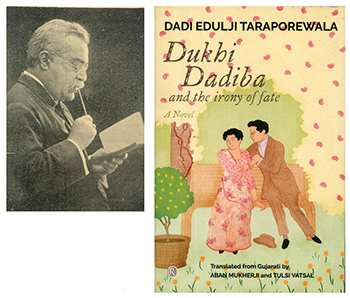
Dukhi Dadiba and the irony of fate by Dadi Edulji Taraporewala. Translated from Gujarati into English by Aban Mukherji and Tulsi Vatsal. Published in 2023 by Ratna Books, an imprint of Ratna Sagar P. Ltd., Virat Bhavan, Mukherjee Nagar Commercial Complex, Delhi 110009. Pp: viii + 314. Price: Rs 699.
Aban Mukherji and Tulsi Vatsal have done yeoman service by translating Dadi Edulji Taraporewala’s (pictured on pg 198) Dukhi Dadiba and the irony of fate from its original Gujarati into English. The novel tells the story of Dadiba, a poor but young and handsome music teacher who falls in love with his pupil, Pareen, the daughter of a wealthy family. Though both seem to love each other and promise to remain faithful, fate which is ironical as the title suggests, has other plans.
Taraporewala transports the reader to a graceful world of Bombay (which the translators have called Mumbai, probably in consonance with the original Gujarati name used for the city) at the end of the 19th century. It is a time when the Parsis were adopting the manners of the British and wealthy young girls studied music and English. Houses were called "castles” and lawyers had names like Branson and Richardson. Doctors who were called for medical emergencies all had foreign names: a European doctor is called for when one of the characters has a fever, and the novel opens with Dr Martin who is attending to the dying Ardeshir Bahadurshah. Ardeshir makes a deathbed confession to his wife Ratanmai, his daughter Aaimai, and his son Jehangir, that he has another son, Rustom, from an earlier marriage, with whom he has lost all contact. The family is totally unaware of this, but Ardeshir makes Jehangir promise to do his utmost to find the missing son and share his estate with him, an oath Jehangir undertakes to fulfill "even at the cost of his own life.”

Aban Mukherji (l) and Tulsi Vatsal
The family moves to Bombay and here Taraporewala introduces us to another wealthy family, that of Darashah Dubash who is keen to have his beautiful daughter Pareen married and sets his sights on Jehangir who is "educated, cultured, handsome and well-mannered” but above all comes from a wealthy family: Darashah is a social climber who cares for little other than money — a man obsessed with wealth and status. To his dismay, Darashah finds that Pareen has set her heart on Dadiba, who reciprocates her affection, but this is a match which for him is inconceivable. Though she has sworn undying love to Dadiba, Pareen is weak, easily impressed, shallow and fickle. In spite of her promise that the place Dadiba has in her heart "will never be taken by another,” when faced with the usual dilemma of whether to marry for love or for money, she breaks down under the constant goading of her father and marries Jehangir.
Taraporewala creates a sympathetic portrait of Dadiba, the piano teacher who is summarily dismissed from his job when he confesses to Darashah that he and Pareen are in love. When he hears that Pareen has agreed to marry Jehangir, he is heartbroken and travels all over the country to assuage the heartbreak he has suffered. At the end of the novel, he is a bitter man whose life has been poisoned by the unfaithfulness of the only woman he loved. So strong is his disillusionment that he is determined to remain a bachelor for the rest of his life.
Taraporewala’s skill at creating lifelike and convincing characters is evident. Jehangir seems to be a go-getter; once he sets his mind on marrying Pareen he makes sure that his competitor is out of the way. However, the nasty side of his character is seen the moment his half-brother Rustom is found. He refuses to fulfill the promise he has given to his father merely out of selfish, egocentric and personal enmity rather than face the indisputable evidence that Rustom has been finally identified.
The one character who stands out is the mother, Ratanmai. Though she loves her son immensely, she is quite aware of right and wrong. She would never give false evidence under oath and stands by her concept of truth, decency, honor and justice in spite of the love for her son. In fact it is her testimony on which the case between Rustom and Jehangir is decided.
The novel is tightly plotted and there are twists and turns which occasionally tend to stretch the imagination. But the reader is never bored and the novel, which is remarkably well translated, is an easy, enjoyable and entertaining read. The original novel, published in 1913, was first serialized in Gujarati from 1898 in a monthly magazine, Masik Majha, which Taraporewala edited. The translators have done an excellent job of editing and removing repetitive episodes which the author used in the novel which must have been reprinted from the serialized version the magazine had carried.
There are almost 25 carefully executed and atmospheric illustrations which are almost non-existent in contemporary fiction. These have been painstakingly and charmingly portrayed by M. V. Dhurandhar (1867-1944), a well-known painter of the time.
Taraporewala (1868-1914), a prolific Gujarati poet, novelist and playwright, has written 18 novels of which this is probably the most famous. There are several occasions in the book when the author speaks directly to the reader. It is interesting to note that at the end of the novel he informs the reader that the publication "is based on (a) real incident.” Many of the protagonists were alive when he wrote the book. A note on the rear cover by Deepak Mehta, a literary critic, terms the novel as the "forerunner of ‘docuficiton’” and reveals that the author met and interviewed some of the persons who became characters in his novel.
The Ratna Translation Series has translated several works from different languages over a period of time: one of them has been long-listed and another won the Award of the Valley of Words, a not for profit which has become a "pan-India celebration of Indian writing and artistry,” as noted on their website.
One can only hope that Mukherji and Vatsal continue their efforts and unearth more novels written by Parsi writers who have unfortunately dropped into oblivion.
F. G.