Priests killing each other and each other’s patrons over ritual business. Violence erupting in the streets with sickening regularity. Secular courts being moved over purely ecclesiastical issues. The most sacrosanct being moved from one town to another. The innocent being ostracized. Matrimonial alliances being prohibited. Fatwas (diktats) issued and flouted. People wrongly accused, and even hanged.
Believe it or not, but this is what the Zoroastrian priests did a few centuries ago. A far cry indeed from our present day docile panthaky (manager of an agiary) hesitant even to swat a fly. English playwright William Shakespeare’s Montagues and Capulets in Romeo and Juliet would have developed an inferiority complex had they seen the bloody feuds between the Sanjanas and the Bhagarias, both prime priestly sects. It was such crass commercialism that even today’s most business minded panthaky would have cringed.
In 1516, when the Holiest of Holy, the Iranshah fire, was shifted to Navsari from Sanjan, tension resulted. Navsari was ruled by the Bhagarias [derived from bhag (share); those who were co-sharers of the income from religious ceremonies performed for their clients]. Navsari was the Vatican and the Bhagarias were masters of ritualistic perfection. Along with the Iranshah came those who were His guardians — the Sanjana priests. Hectic negotiations ensued resulting in an agreement between the two sects that the Sanjanas would exclusively perform all ceremonies and obligations relating to the Iranshah while permitting the Bhagarias to exclusively cater to the behdin (laity) families. With the passage of time, some enterprising behdins, however, spotted an opportunity to break the Bhagaria monopoly over rituals and encouraged the Sanjanas to pray for their families at much lower than the prevailing market rates. The Bhagarias were furious, enraged.
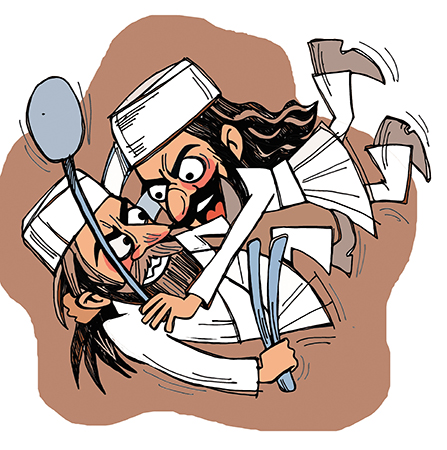
Illustration by Farzana Cooper
Elongated spoons used to offer sandalwood to the holy fire (chamach) and long tongs (chipyo) were improvised to break a few spinal cords. In those days priests bristled with aggression and were very macho. Violence and riots spilled over from the streets of Navsari into neighboring Surat, ruled by a Muslim nawab. Dissatisfied with the ability of Parsi institutions to uphold the sanctity of the agreement, a mobed from Surat knocked on the doors of a civil court presided over by a hakim (judge) administering Sharia law. The trigger-happy hakim promptly ordered that one behdin be imprisoned and several others whipped in public. Aghast at the manner in which their clients had been mercilessly punished, the priests foolishly petitioned the hakim to free the behdins (imagine a writ of habeas corpus before a hakim in Surat!), and were themselves whipped black and blue.
Extremely sore bottoms all around and widespread violence finally resulted in a decree by consensus in February 1687 that the behdins were at liberty to select whichever priest from whichever panthak (there were five major ones) they desired to perform the religious rites.
A few decades later the Bhagarias once again got into the act and appealed to a civil judge to suspend the decree. The disputes continued until 1733, when the Iranshah was temporarily moved to Surat to safeguard it against Pindhari gang attacks in Navsari. The differences continued to fester until the Iranshah came to finally reside in the tiny hamlet of Udvada, once again under direct Sanjana control. Had it not been for these disputes, the Iranshah would have continued to remain in Navsari. The miffed Bhagarias consecrated their own atash behram in Navsari, in 1765. The Sanjanas loudly protested that there cannot be two atash behrams within a radius of 125 miles.
The Bhagarias had the upper hand over the Sanjanas who were compelled to send their boys to Navsari to be initiated into the priesthood (navar) at the most ancient fire temple in India, the Vadi Daremeher in Dastur Vad, Navsari. The Sanjanas retaliated by filing a plethora of complaints in the court of the ruling Gaekwads of Baroda, which resulted in the imprisonment of several Bhagaria priests.
One fine day the Bhagarias simply locked the door of the Vadi Daremeher to prevent the Sanjana priests from performing any rituals. As a result, for nearly five decades, the Sanjanas faced many difficulties in performing ceremonies and rituals. Of course, this was not without precedent. Earlier, the Sanjana priests had similarly prevented the Bhagaria priests from entering the Atash Behram housing the Iranshah which was then under Sanjana control.
The Sanjana priests later approached the court to permit them to perform ceremonies for the behdins. However, the court upheld the original agreement between the two sects and told the Sanjana priests that if they wished to perform rituals for the behdins, they must also let the Bhagaria priests serve the Holy Fire and perform related rituals. This compromise was too bitter a pill to swallow for the Sanjana priests who regarded themselves as the sole protectors of the Iranshah. There was no option for them but to leave Navsari, which they did in 1740, taking the Iranshah to Udvada.
The Sanjanas fought amongst themselves as well. Dastur Edulji Sanjana, first dastur of the H. B. Wadia Atash Behram, was a maverick. Apart from blowing the bugle of rebellion against the stiff upper lipped Bhagarias, he broke with the tradition of sharing the ashodad (offerings left by the worshippers in the Atash Behram) and appropriated all the money for himself. The priests went to court against their misappropriating boss, and won the case. Sanjana told the court too to go for a walk, and the disgruntled priests left Wadia and joined the Dadysett Atash Behram. Sanjana alleged that they had indulged in violence and got two of them imprisoned. Sir Pherozeshah Mehta had the priests, who were furious at the crafty Sanjana, released.
Dastur JamaspAsa (who would soon be the first dastur of the eighth and last Anjuman Atash Behram) became a bitter opponent of Sanjana, and had his brother imprisoned for libel against JamaspAsa. Sanjana, in the meanwhile, accused his enemy of having performed the navjote of nine children of non-Parsi mothers.
Bad blood continued to simmer over the centuries. Leading merchants of Bombay declared their allegiance to one or other of the two priestly power blocs, further aggravating the factional bitterness. This added impetus to the famous calendar wars between the Shahenshahis and Kadmis (see "Violence over a calendar,” Parsiana, February 7-20, 2022). The Kadmis established three atash behrams of their own (Banaji and Dadysett in Bombay and Vakil in Surat).
Not that the Shahenshahis were united. The continuing undercurrent of hostility between the Sanjanas and Bhagarias flared up when the former, in charge of the Wadia Atash Behram, cocked a snook at Navsari by conducting the navar ceremony of aspiring priests in Bombay. The Bhagarias could not believe that the Navsari navar monopoly was being so unceremoniously disregarded. If the modern laws of competition had been applicable, the Bhagarias would have been held guilty of unfair trade practices on multiple occasions.
The Sanjanas became persona non grata in Navsari (no "giving daughters” in marriage; no Sanjana navars in Navsari). As this column has narrated in detail earlier, the Empire struck back and created the last and eighth atash behram of India, the Anjuman Atash Behram, just across the street from the Wadia (controlled by the upstarts who had dared to rebel against the dharam ni tékri, as Navsari was known) (see "The eighth atash behram — I and II,” Parsiana, December 7-20, 2021 and December 21, 2021-January 6, 2022).
The Petit vs Jeejeebhoy case too was a proxy war owing its origin to these renewed Sanjana-Bhagaria hostilities, even though outwardly it emanated from a Parisian romance of the late Ratanji Tata.
The current refrain of the ultraorthodox is that we no longer have priests of yore. Thank Ahura Mazda.
Berjis Desai, lawyer and author of Oh! Those Parsis, and recently Towers of Silence, is a chronicler of the community.