J. B. H. Wadia of Wadia Movietone pioneered the making of movies
in various genres, including stunt films and political documentaries
Shyam Benegal
Noted filmmaker Shyam Benegal’s article has been reprinted, with permission, from Wadia Movietone, a catalog for the online auction from the estate of Riyad Wadia, November 2021.
Cinema came to India within a couple of years of its invention in the last decade of the 19th century. Dadasaheb Phalke is considered the Father of Indian Cinema as he was the first filmmaker to have produced the very first full-length film in India that could be shown theatrically all on its own. This was in the year 1913. Overnight, it replaced live theater with cinematic features. This was the beginning of the Indian film industry which soon became the second largest in the world after Hollywood.
(Ardeshir Irani directed India’s first sound film, Alam Ara and produced the country’s first color film, Kisan Kanya — editors)
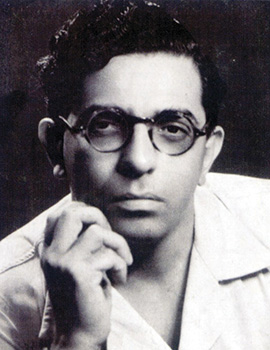 Before long, enthusiastic film pioneers made films in Bombay, Calcutta and Madras for the rapidly expanding cinema audiences all over the country — from urban centers to second and third tier cities and towns. Among the growing tribe of filmmakers and their film production companies, there was one unique company which began making films in 1928.
This was Wadia Movietone, started by an intellectually accomplished, politically conscious Parsi from an elite background — Jamshed (JBH) Wadia (pictured), a descendant of the legendary Wadia shipbuilders, who was meant to pursue a career in law or finance with the approval of his conservative family, but who was enamored of — nay, obsessed with — cinema from the very first moment he encountered it through the work of the Lumiere Brothers. Turning his back on a more conventional path, JBH embarked upon his chosen profession in 1928, when cinema was still silent, learning all he could about films in a relatively short time from others who had embarked upon this new art just a few years before him.
His early films, encompassing Arabian Nights and swashbuckling scenes, are a testament to the outsize influence Hollywood stunt films and actors had upon him — figures like Douglas Fairbanks and Pearl White. In 1934, JBH’s gamble in casting a white lady named Mary Ann Evans — with the screen name Nadia — in small roles initially and then as Hunterwali, the lady with the whip, in her full-fledged avatar as "Fearless” Nadia, proved a genuine pivotal moment in Indian cinema.
Hunterwali was among the most successful films of its time, transforming Nadia — born in Australia but raised in British India — into one of the most highly paid actors of her time and spawning a genre of stunt actors who sought to emulate her but never quite succeeded; she was in a class all her own.
As the Indian independence movement grew and JBH became more involved in it, he saw the stunt movie genre as an opportunity to move beyond entertainment for its own sake, to encompass "education through entertainment,” which became the studio’s motto.
 He envisaged the Nadia/Hunterwali persona as an embodiment of women’s empowerment — the very opposite of the demure, shrinking violet persona stereotypically depicted by many female stars of the time. Nadia’s films — with Diamond Queen (1940) the finest example, perhaps — often conveyed multiple social messages — the need for gender equality, literacy for the masses, ethnic and religious harmony and other essentials that an eventually independent India would need to build and prosper as a fledgling nation.
JBH’s nationalist politics had brought him into close proximity with the leading members of the Indian National Congress such as Mahatma Gandhi, Jawaharlal Nehru, Rajendra Prasad, Sarojini Naidu and other leading lights of the freedom movement. He meticulously documented on film the political rallies and speeches of these great national leaders. Among these films is a documentary he made on the Haripura Congress session held in 1938. The films are an excellent historical record preserved on celluloid of landmark events of the freedom movement in the last two decades before India’s independence.
While JBH was a visionary, his brother Homi (younger than him by a decade) was a practical, down-to-earth businessman who had joined the Wadia Movietone Studios and directed many of the early feature films the company produced, before eventually launching his own banner of Basant Films.
Homi had a decades-long relationship with, and eventually married, Nadia. The reason they didn’t marry until the early 1960s was opposition from the larger Wadia family — although JBH constantly encouraged his brother to throw convention to the winds and follow his heart, emulating the themes that the brothers and Nadia personified in their films. Despite occasional artistic differences, the brothers worked closely together throughout their careers, helping each other out on their films, with their respective banners housed under the same physical studio lot at Chembur in Bombay.
Revolutionary influences
JBH had a wide range of interests and hosted several nationalist as well as international revolutionary figures of the period at his celebrated Bombay home of Casa da Vinci on Worli Sea Face, where he and his wife Hilla held gatherings featuring politicians, musicians and poets.
Among the friends and guests who enjoyed their hospitality was Manabendra Nath Roy, the founder of Radical Humanism, a prominent left-wing ideologue and former colleague of several of the political leaders who shaped the modern world, such as Emiliano Zapata who led the Mexican Revolution of 1916 and Vladimir Lenin, the leader of the Russian revolution of 1917. As it happened, Roy had travelled with Lenin in the sealed train that took them from Switzerland to St Petersburg in Russia. That single event is considered the beginning of the first successful communist revolution in the world — the Bolshevik Revolution that led to the creation of the Soviet Union.
Roy eventually became disillusioned with communism and the excesses carried out in its name under the regime of Joseph Stalin with whom he had fallen out of favor — prompting Roy to eventually found Radical Humanism, which took the Humanist movement to a new level by espousing a radical cleansing of superstition, bigotry and other entrenched social ills that he saw as impeding post-independence India’s chances of success as a genuine democracy.
Roy was not only a mentor, but became one of the Wadias’ closest friends; along with his German-Jewish wife Ellen Gottschalk, Roy spent considerable time with Jamshed and Hilla at Casa da Vinci. So close was the friendship that JBH’s first grandson was named Roy after the revolutionary leader.
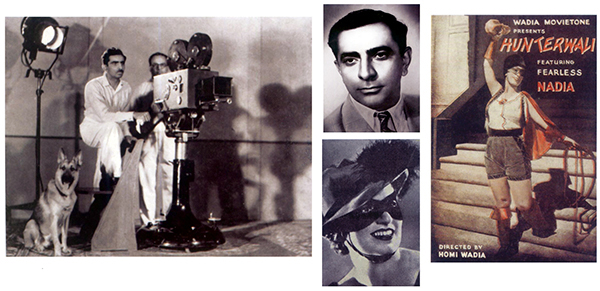
Clockwise from above: action at the studio; Homi Wadia; film poster of Hunterwali; Fearless Nadia
Above l: stained glass depiction of Wadia family crest;
above r: J. B. H. Wadia receiving award from Indira Gandhi
Wadia Movietone legacy
JBH headed Wadia Movietone from its inception in 1933, through the heyday of talkies well into the 1970s, producing almost a hundred films before the shutters finally came down on the production of feature films by the company.
Both individually and in collaboration with the Wadia Brothers and Basant Films banners, the company produced a wide range of films in various genres; stunt films, historical and mythological epics, fantasies, melodramas, and musicals including films propagating radical social reforms in Indian society. This output included the first Indian film without songs (Nav Jawan), the first Indian film produced in English, Hindi and Bengali (The Court Dancer), the first Sindhi language film (Ekta) and numerous films with landmark special effects (including films as vastly different as Toofani Tarzan, Aladdin and the Wonderful Lamp, and Sampoorna Ramayana).
Over the decades, JBH also spotted many a talented actor or actress at the very outset of their careers, nurturing them by offering them their first big breaks or other significant opportunities, including stars as varied as Feroz Khan (Reporter Raju), Mumtaz (Main Shadi Karne Chala), Helen (Veer-Rajputani) and Rekha (Saaz aur Sanam). He also signed on well-established stars, attracted by his films’ socially conscious themes, including Dilip Kumar and Nargis (Mela) and Prithviraj Kapoor (The Court Dancer and Ankh ki Sharam).
The Renaissance man who spoke and wrote in a number of languages from Hindi and Gujarati to Persian and Urdu was also deeply involved in the music and lyrics composed for his films — working closely with luminaries such as Naushad Ali and Shakeel Badayuni (Mela), Chitragupta and Kaifi Azmi (Saaz aur Sanam), and Bulo C. Rani (Veer Rajputani).
For both its varied output and the persona and motivation of its founder JBH, Wadia Movietone has a unique and prominent place in the history of Indian cinema. Even if it were known only for creating the Fearless Nadia/Hunterwali stunt genre, the studio would have a prominent place in the Bollywood pantheon.
But Wadia Movietone goes well beyond its films — incorporating the personality of its visionary founder and the legacy he quietly created on multiple fronts, from promoting feminism and social justice to helping establish the National Film Archives of India (NFAI) by encouraging the late Paramesh Krishnan Nair’s vision, realizing the importance of preserving film history for generations to come, with Wadia Movietone’s films among the very first deposits at the NFAI to help get it started. For all this, and more, Indian cinema — and indeed India itself — owes JBH and Wadia Movietone a huge debt.