Adventurous Parsis had gone to live in the remote Himalayan hill
station in the 19th century and thrived during the British Raj
Rusi R. Sorabji
Around 15 years ago while researching the Parsi settlers of Delhi during the early or mid-Mughal period I chanced upon the fact that the first Parsis arrived in Simla in the early or mid-1830s, in the Himalayan foothills situated at a height of 8,000 ft above sea level which in 1817 was described as "a middling-sized village where a fakir is situated to give water to the travelers.”
Who were these adventurous Parsis? Where did they come from? How did they make it to one of the remote seven high hills that constitute this sparsely inhabited mountainous corner of north of India that in 1800 was foreign territory, part of the Kingdom of Nepal and occupied by a few Gurkhas and lots of wild life?
According to Wikipedia, "By the late 1830s, the city also became a center for theater and art exhibitions. As the population increased, a number of bungalows were built and a big bazaar was established in the town. The Indian businessmen, mainly from the Sood (a mercantile people from Punjab) and Parsi communities arrived to cater to the needs of the growing European population.”
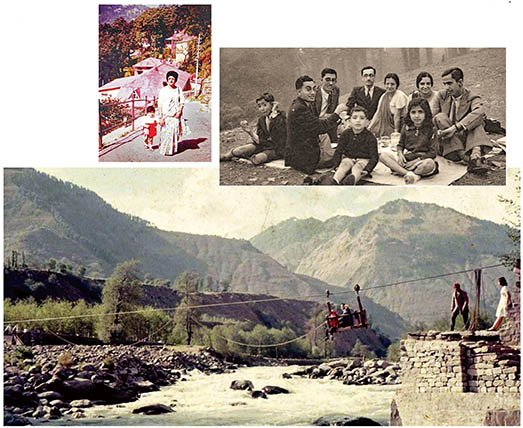
Clockwise from top: Shermin (l) and Villy Sorabji in Simla, 1969; Sorabji and Daeboo families picnicking on
Jakhoo Hill in 1940; four-year-old Daraius Sorabji and his teacher Ellen Vania crossing the Beas river
on a single rope suspended trolley bridge, 1968
On September 9, 1844 the foundation of Christ Church was laid. Soon after, The East India Company (EIC), assisted by the Maharaja of Patiala and some other Indian princely states seized the area from Nepal, then part of Patiala State where in 1819 the Company posted an Assistant Political Agent, Lt Ross who built the first wooden cottage in Simla, circa 1819. Three years later, in 1822 the first "pucca” house was built by his Scottish successor, Charles P. Kennedy.
Soon accounts of the cool climes and scenic environment of these hills induced scores of civil and military officers of the EIC to spend their holidays in Simla. Even the Governor-General of Bengal and the Scottish Commander-in-Chief of the EIC forces vacationed there in the late 1820s at the house that Kennedy had built. By 1830 there were 30 houses and a three-mile road with a bridge constructed on Jakhoo Hill. There were no proper roads, just pag-dandi — narrow unpaved pathways — zig-zagging up and down the hills all the way from Kalka to the north of Simla. Until the EIC built the Hindustan-Tibet road from Kalka to Simla in 1851, there were no bridges fording the many streams and rivulets between the two places. A few primitive rope bridges existed for crossing the rapidly gushing rivers.
I have a photograph of my four-year-old son Daraius crossing the thundering Beas River in 1968 on a single rope suspended trolley bridge accompanied by his school teacher Ellen F. Vania of Delhi. As they were being slowly pulled across, his young masi (mother’s sister) Daisy looks on anxiously. A photograph taken in 1903 illustrates what a bridge over fast flowing rivers on the way to Murree looked like 65 years prior. Only the very brave would risk using it, one or two persons at a time. How they managed to cross such streams with goods/luggage prior to 1850 is difficult to comprehend.
A train service jolting through 101 tunnels between Simla and Kalka was established only in 1903. Some of the divisional engineers on this pioneering project were Parsis. Journalist and friend, the late Khushwant Singh’s father Sir Sobha Singh was a contractor on this railway tunnel project. He was one of the two Sikh gentlemen who later built most of Lutyen’s New Delhi.
As one who has trekked the Himalayas extensively during his youth in the 1950s, 60s and 70s, I recall how difficult and exhausting it was for five young Delhi Parsis in their early 30s to trek downhill some 4,000 ft from Khajjiar to Chamba. While the rest of our friends took the long and winding road, we five decided to use the short cut through terraced fields and farms right down to town. After crossing the bridge on the River Ravi at the entrance to Chamba town, two collapsed from exhaustion. Luckily, there was a thatched shop next to the bridge selling fresh jalebis (Indian sweets) and hot milk which helped revive the two ladies. I had to buy the entire stock of jalebis as our friend Jeroo Billimoria had picked up one with her fingers, thereby defiling the lot, according to the irate shopkeeper!
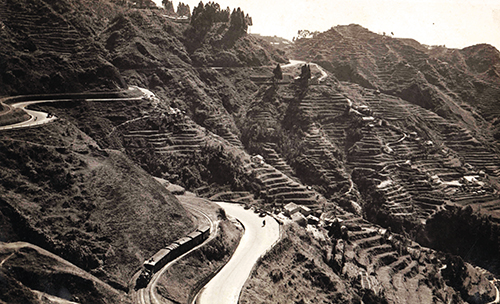
Train service between Simla and Kalka was established in 1903
At a prize distribution Jal and Tehmina Masters, and Meherbanoo Shroff (standing 5th, 6th and 8th from l)
On a fair day, this should have been an easy downhill walk in 1961, but that night while our group of 14 rested at the dak bungalow, a huge forest fire encircled the hill on the slopes of which Chamba town was perched. We left on the next bus to Dalhousie. I wonder how the pioneering Parsis of the early 19th century would have handled a similar situation while transporting household goods and merchandise on animal back. But they somehow managed it.
In the 19th century British families travelled with an enormous quantity of baggage, including provisions for several weeks. They took teams of porters as well as pack animals, bullock carts, camels and elephants. A family with three children, two maids, a cook, and four miscellaneous staff needed 32 camels, two bullock carts, three jampans (a kind of sedan chair), porters and a veritable moving farmyard of cows, sheep, goat and perhaps a dog or two. They would move along narrow mountain paths that disappeared in landslides with ponies and camels nervously skittish when approaching a sheer drop or when massive boulders suddenly hurtled down bouncing helter-skelter towards the path. Sometimes, if an unfortunate or careless porter fell into a ravine, the other porters would desert the group, running home to inform the family. In the early days there were no dak bungalows along the way where travelers could rest or take shelter.
One of the earliest Parsi settlers in Simla was the father of Sorabji Billimoria who had a high-end store on the Mall called Chinese Art Palace dealing in Chinese curios, traditional dresses and furniture, located near the steps going down to Lower Bazar. It was said that he had journeyed to China in the 19th century and become a trader in Chinese goods. Billimoria was also one of the two pioneering Parsis to establish a shop in New Delhi’s brand new Connaught Place, in the A Block, as soon as it was built in 1934-35. I am unable to recall the name of the other gentleman, but Khushwant Singh mentioned that he sold cheroots, cigars, cigarettes and liquor to the gora log (the British and Europeans). Today the popular confectionery and bakery, Wenger’s, is located in the same premises.
The Billimorias had three children. Their son Naval, born in 1921, became my uncle when he married my aunt Roshan Jal D. B. Irani in Bombay in 1949. The following month they moved to Karachi. Roshan became the popular "Ms Billimoria” to the girls of The Mama Parsi School from 1950 to sometime in the mid-1990s when she retired as vice-principal or assistant headmistress. Incidentally, Naval and Jangoo Jal Masters, also of Simla, were school buddies and boarders at St Joseph’s College, Nainital.
Naval maintained that many Parsi families who resided in the plains followed the British and the Europeans to the safer hill stations of Northern India such as Simla, Murree, Nainital and Mussoorie following the 1857 Sepoy uprising. However, there is sufficient evidence to show that prior to 1803, when the EIC’s British Resident moved his headquarters from Calcutta to Delhi, these flourishing Parsi traders, contractors, businessmen and ship chandlers were mainly concentrated in Calcutta and Rangoon, a thousand miles away from their home base in Bombay city or province. It was after September 1803, when the blind septuagenarian Mughal Emperor Shah Alam II was reduced by EIC’s General Lake to a nominal figurehead with his authority confined to the Fort in Delhi, that many professionals, traders and businessmen of Calcutta and Rangoon Parsis moved to Delhi and other North Indian towns where the EIC had established large military cantonments.
In the absence of proper roads and bridges, they either undertook the long journey on horseback or on animal (buffalo or camel) drawn carts with very little protection against the elements, flies or mosquitoes. Spending sleepless nights because of the jolting and bumping over rough roads and the long high pitched creaking noise from the un-greased wooden wheels of the carts took a heavy toll on their health. Some families preferred being transported in litters carried by bearers. A somewhat more comfortable way was to travel in palanquins. These were a kind of bed with a canopy, carried by two or four barefooted bearers who ran short distances carrying the palanquin and were replaced by a relief team of fresh bearers. Perhaps, like the rich and important English ladies, the Parsis too went upstream on the Ganges, a slow and uncomfortable boat ride to Allahabad, and then either travelled overland on the old Grand Trunk Road to Delhi or crossed over the "doab” and carried on up the Jamuna River to Delhi — a hazardous journey that took six months or more.
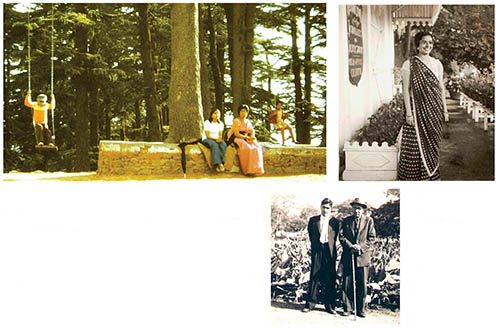
Clockwise from above (l): Sorabji and Karbhary offspring on Jakhoo Hill, 1974; Diana Daeboo outside
Hamilton and Company, Jewelers in Lower Bazaar; Naval and Sorabji Billimoria
Clockwise from above left: Postal service and glimpses of Simla in 2013 Photos: Hersh Acharya
Here I presume that if the young inexperienced gori memsahibs (fair ladies) from the British Isles could survive such a journey, our equally fair and adventurous sari wrapped "baijis” from Calcutta or Bombay and their businessmen husbands may have thought nothing of braving it. After all "the Parsis were a sensible people… Amongst other English customs they have accepted,” commented the wife of a senior EIC officer approvingly, "is cricket.”
For the Europeans, an inescapable fact of life in India was the harshness of its climate — the oppressive heat, violent torrential rains, flooding and sudden sand storms that blew away everything in their path. Just when they had had enough of this, the hill stations were discovered around the mid-19th century and the queen of them all was Simla.
An ancient 1903 Underwood & Underwood picture of Lowrie’s Hotel or old Royal Hotel in Simla takes my thoughts back in time some 80 years when we Sorabjis of Delhi spent our school summer vacations in this hill station, the summer capital of the Raj. In 1940 the fork in the road at Lawrie’s Hotel that went up past the big YMCA building led to the summer residence of some eminent Parsi families whom our parents knew from Delhi. The road also led to the over 8,000 ft summit of the hill, to the Jai Hanuman temple palace of the monkey king and queen of Jakhoo.
Taking the high road led to the summer residence of my friend and the first captain of the Delhi Parsi cricket team of the 1940s and 50s, Jal F. Masters, his wife Tehmina and their children Jangoo, Nargish and Lily. Masters’ navy blue blazer bore the insignia of the Defense Ministry Cricket Club. Masters’ daughter Nargish married Shapur Jambusarwalla of Indian Airlines, while Lily wed our friend Minoo B. Billimoria of Coca Cola, both of New Delhi. Jangoo married Nargish from Ajmer. His daughter Zenobia Panthaki co-authored the book on Field Marshal Sam Manekshaw that was released at the Delhi Parsi Anjuman five years ago. Jangoo’s sister Nargish now lives in Bombay; one of her two daughters lives in the UK while the other resides on the eastern coast of the USA.
Dosibai and Dinshaw Framjee were Jal Masters’ sister and brother-in-law. Along with their sons Keki and Minoo, they also lived in Simla. Keki and his wife Sheroo had three children: Rusi, Tehmi and Bapsy. Minoo and his wife Pilloo had a daughter, Geeta. Jal’s brother Dr Nuserwanjee F. Masters, his wife Tehmina, son Nariman and daughter Freny also lived in Simla.
Some 100 yards from Jal’s house and a little way up the hill on a gentle slope lived the Daeboos with their grown-up offspring Diana and Minoo. Daeboo was the manager of Davicos, the leading restaurant and bar on the Mall in Simla and in New Delhi where it was located above Regal Cinema. Davicos was one of the first to have a bar, a band and a proper wooden dance floor in both cities. Its bakery producing English and French confectionery was very popular throughout northern India. During some summers in the 1940s the visiting Sorabjis were their guests. While Diana married and settled in Bombay, Minoo was with the Ministry of Defense in Delhi during World War II. He lived with us in Delhi and rode to work on a bicycle. It might interest readers to learn that the "Made in England” Hercules bike cost only Rs 40 then. In those days only three makes of bicycles were available in India, and they all came from England. BSA was considered the best, followed by Phillips and Hercules.
In Simla, taking the lower road on the fork led to the Cheerail Falls and Argyle House, the summer residence and eye clinic of Dr Sorabji Pestonji Shroff, his charming wife Meherbanoo and their sons Jameshed and Minoo. This was one Simla Parsi family we three Sorabji children, Manijeh, Soli and I, feared visiting unless accompanied by two or more adults, for some distance before Argyle House were the Cheerail waterfalls, supposedly the home of Cheerails, ugly witches with their feet pointing backwards. Like the ones in Shakespeare’s Macbeth, but more ghastly! However, we never got a glimpse of them probably because we closed our eyes and held on tightly to an adult’s hand while passing the falls!
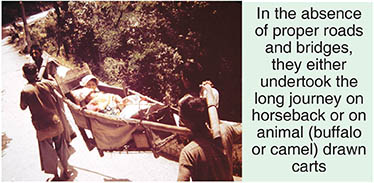
A ‘doolie’ or palanquin carrying Daraius and Shermin Sorabji
A three-rope bridge over the Jhelum river in 1903 Photo: Underwood and Underwood
I was Dr Shroff’s first or probably only non-ophthalmic patient, for he administered a jab of ‘liver extract’ injections twice weekly on my butt while we were in Simla. I have many fond memories of the kind and soft-spoken doctor and his wife in Simla and Delhi. Meherbanoo and my mother-in-law Gool Karbhary were good friends. After they had read the Gujarati magazines and weeklies, the Shroffs passed them on to the Karbharys, and this continued even after both families moved to Delhi.
Originally from Lahore, Dr Shroff went to Delhi in 1913 after qualifying as FRCS (Fellow of the Royal College of Surgeons) from Edinburgh. He had a long and distinguished career as an ophthalmic surgeon during which he served a grateful nation and the Parsi community. In 1933 King George V bestowed upon him the Kaiser-I-Hind Medal for his services to country. Thirty years later, the President of India presented him with the Padma Shri. His son Minoo followed in his footsteps, and today grandsons and great-grandsons are top specialists in various branches of eye care. They are helped by the grandsons’ spouses Niloufer and Rukshana in managing the various Dr Shroff Eye Hospitals in the National Capital Region and elsewhere. Thanks to Dr Shroff, Delhi has a hospital with a Parsi name that recently celebrated its centennial year.
Not many people are aware that as municipal councilor of Delhi way back in 1919-20 Dr Shroff was largely responsible for releasing funds and naming India’s first and largest shopping center in New Delhi: Connaught Place. In keeping with the Shroff tradition, Niloufer and Rukshana are also actively involved in Parsi anjuman matters; their current project is recording the history of the fast disappearing Parsis of Delhi and North India.
I wonder whether the Edinburgh returned doctor had named his residence Argyle House after a Scottish clan, sweater or socks, or whether the house had already been named so by a Scottish builder or former owner. On subsequent visits in later years I discovered several beautiful places around Simla and particularly west of Summer Hill bearing names reminiscent of the Lake District and Scotland: Windemere, Buttermere, Grasmere and Annandale. Places that brought back haunting memories of the romantic poets from a bygone era, and romantic indeed were these very scenic places that many found "untrodden since creation.”
Some distance from the Shroffs’ Simla house was the residence of Shavaxshah Ardeshir and Kumi Lall with their two girls — Nargish and, and I think Silloo. Nargish lives in Bombay while the other resides in London. Kumi hailed from another Master family on Simla’s Jakhoo Hill. In 1947-48 Shavaxhshah became secretary to the last Viceroy of India, Lord Mountbatten and also to the First Governor General of India, C. Rajagopalachari. In the 1960s he was director of Spencer and Company Limited, Kelvinator of India Limited and other companies. In Bombay they lived on Pedder Road. Another Delhi businessman, Zal R. Irani, chairman of Spencer and Company and Kelvinator of India Limited, had a summer house north of Simla on the road to Kulu on the left bank of the Beas River.
Bachelors Adi Daruwalla and Jimmy Pajnigara of Simla were employed in the Defense Ministry in 1940. Sappy Dinshaw, who joined them in 1941, once told me that it was his first job. He was then 20 years old, his salary was just Rs 100. All three bachelors later lived in the Connaught Circus. Pajnigara lodged at Ms Mody’s Guest House where his co-resident was India’s first photojournalist, the famous Homai Vyarawalla. The other two Simlawallas lived in Ms S. M. Mehta’s guest house. The tall Pajnigara was a member of the Delhi Parsi Cricket Club. He died in a scooter accident in Delhi Cantonment sometime in the late 1960s.
Going towards the Ridge and Bandstand from Lawrie’s Hotel in Simla is the Christ Church. Proceeding along the Ridge towards Scandal Point below on the right hand side towards Lakkar Bazar was the Parsi owned Blessington Hotel with a large outdoor skating rink. It also had a pool room and billiard tables which made it very popular with Europeans and some Parsis. I don’t think I ever knew the names of the Parsi owner or staff, but one of its longtime residents was a Mr Jassawalla who later married the owner’s daughter. By 1945 they had settled down in New Delhi. Jassawalla was later made a Khan Sahib and lived on Old Mill Road.
To be continued