Alumnae of The Mama Parsi Girls’ Secondary School value the training
they received at this prestigious institution that completed 100 years
Parinaz Gandhi
Learning needlework at the age of seven years. Perfecting one’s handwriting skills. Conforming to the expected standards of grooming and discipline. Picking up time management and organizational skills.
Students across different generations have not forgotten the life lessons they imbibed during their years of study at The Mama Parsi Girls’ Secondary School (MPGSS) in Karachi. Currently in its centenary year, the School continues its endeavors to see a
Mamaian leave the portals of her alma mater as "a well-balanced, good human being… a future mother or a career woman who will hopefully do her bit for the progress of her nation.”
In recognition of this prestigious institution’s contribution to female education, Pakistan Post issued an eight rupees commemorative postal stamp and first day cover. A silver plated coin was also released to mark the landmark event. Celebrating its centennial birthday on April 1, 2018 with a jashan for Parsis and a milad for Muslims, the evening function on the same day was graced by the governor of Sindh Mohammad Zubair. Nineteen of their nearly 200 staff members were felicitated for their 40+ years of dedicated service to the School.
"Moving with the times, many things have changed but our motto – ‘Let humility, charity, faith and labor light our path’ — has remained,” reminded the 90-year-old School chairperson Dr Banoo Noshir Mama.
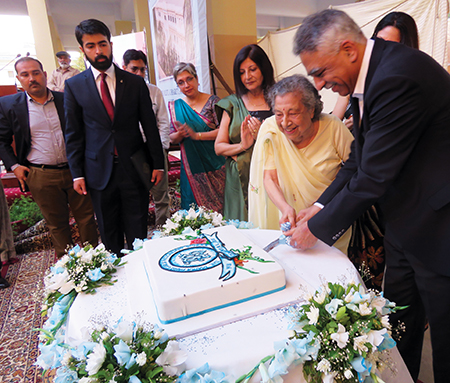
Cutting the centenary cake (from r) Mohammad Zubair, Dr Banoo Mama,
Dr Shernaz Ferozepurwalla, Furengeez Tampal and other invitees
"Parsis being highly respected in Pakistan as a hardworking, honest and a dedicated community, the MPGSS is very much sought after by parents vying to admit their daughters in our School,” revealed its principal Furengeez Tampal. "Emphasis is not only laid on producing academically successful students but also well-groomed, young ladies equipped with knowledge, discipline, zeal and confidence to meet the challenges of daily life,” she added in her email response to Parsiana.
A series of events marked the centenary year. An interschool art and craft competition, a throwball tournament and an English debate competition were hosted by the Mama School in which nearly 15 schools from Karachi were invited to participate. The alumnae who keep in touch through the Old Girls’ Association organized two centenary meet and greet events in 2018. Under the leadership of Nancy Yazdani (née Bharucha), around 80 alumnae got together for a three-day reunion in Dallas, USA.
One of the ex-Mamaians Khursheed Kotwal (née Javat), organized a symposium "Dare to Dream” last October when 16 successful ex-students from different walks of life inspired the current seniormost batch with their stories of struggle and persistence. Last November, the School hosted a three-day research based exhibition "Kaleidoscope of Colors” to convey how colors impact everyday life. January saw them celebrate with a grand concert, "Forge On.”
The centenary year will be brought to a close on March 31, 2019 with the release of the yearbook Mamaian that will encapsulate the celebrations over 12 months and students’ work.
Engaging educators
Prior to the establishment of The Mama School, Parsi girls in Karachi had been receiving elementary education in The Parsi Balak Shala and the Bai Virbaijee Soparivala (BVS) Parsi High School established in 1859. As the number of girl students increased, in 1903 Eduljee Dinshaw first proposed the establishment of a separate high school for girls. In 1911, he once again made a plea with a generous donation of Rs 50,000 but the proposal lay in abeyance. Finally Jamshed Mehta, the first mayor of Karachi, used his powers of persuasion to collect donations totaling Rs 5,10,000. Khan Bahadur Ardeshir Mama contributed Rs 3,00,000, Mehta’s father Nusserwanji, the sole trustee of the late Nowroji Pochaji gave Rs 1,35,000, and Dinshaw’s family donated Rs 75,000 that helped establish the School in 1918. Since Ardeshir Mama was the largest donor, it was named The Mama School in memory of his parents. "He regarded life as a duty and spent all his wealth for the welfare of fellow human beings. He took a lot of interest in the civic life of the city and was also the mayor of this metropolis,” the School website introduces its founder.
Initially the institution functioned from the BVS, and in 1919 it was shifted to the Mama Mansions until the new palatial edifice was ready in 1925. From the first batch of matriculation students sent to the Bombay University in 1920, Dina Dotiwalla stood first class first in the province of Sind among the girl students. After partition in 1947, at the personal request of Quaid-e-Azam Muhammad Ali Jinnah, admission was opened to girls of all communities, recalled Banoo Mama.
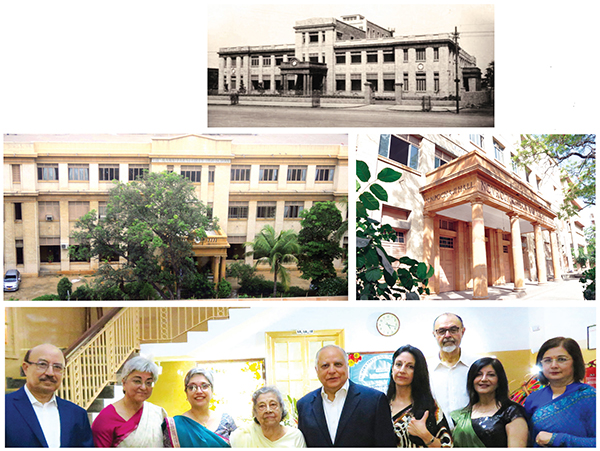
Facade of the Mama School in Karachi in the early 20th century (top) and 21st century (middle); School managing
committee members (from l): Soli Parakh, Roshan Mehri, Furengeez Tampal, Dr Banoo Mama, Shahveer Byramji,
Dr Delara Mavalvala, Kairas Kabraji, Dr Shernaz Ferozepurwalla, Kermin Talati
Clockwise from top l: Mama School students at a prayer session; art and craft competition;
assembly; prize winners with Tehmi Patel (sitting 2nd from l); throwball match
Postal stamp, first day cover and silver plated coin
released for the Mama School’s centenary
Over the years philanthropic Parsi families have assisted the School. The entire first floor of the New Wing was made possible thanks to a generous donation of Rs 22.50 lakhs from the Cowasjee Foundation. Another generous donation of Rs 15 lakhs was made by The Jehangir Rajkotwala Trust. Dr Burjor Anklesaria’s contribution of Rs 13 lakhs helped build the Anklesaria Hall in memory of Cowashah Anklesaria. Many other Parsi trusts and individuals gave generously too.
Among the administrators who made a lasting impact on the School was D. P. Kotwall, fondly known as "Kaka Kotwall,” Khan Bahadur Sheriarji Contractor who was the deputy director of public instruction of Bombay Presidency, and Rustom Divecha who was the chairman, Board of Secondary Education, Karachi Region. Three committed ladies who have served as honorary secretary of the School were Gool Minwalla, Meher Patel and Mani Cowasjee.
The first of eight principals who built the School into a reputed institution was J. Kelly who served for less than a year. She was followed by an Irish lady Mary Boardman who has been given credit for making it "one of the best schools in the subcontinent.” Cowashah Anklesaria who was the principal of Virbaijee School was summoned to officiate as principal of Mama as and when circumstances required. Iris Thompson who served as principal for 28 years was much loved by her students. Goola Shroff who had served as vice principal under Thompson for an equal number of years succeeded her as principal for five years until she passed on the mantle to Mani Contractor. She served as principal for 17 years. Zarine Mavalvala, a strict disciplinarian took over in 1991 and served for nearly two decades until she was succeeded by Tampal in 2010.
The present managing committee is chaired by Banoo Mama. Working with her are Soli Parakh, trustee; Nerges Jamasji and Dr Shernaz Ferozepurwalla, joint honorary secretaries; Nusserwan Rustomjee, treasurer; Kairas Kabraji, legal advisor; Shahveer Byramji, Dr Delara Mavalvala, Roshan Mehri and Kermin Talati as members, and Tampal as ex officio member.
"Starting with about 50 Parsi girls, we now have 2,142 girls,” reported Banoo Mama, adding, "Our beautiful old building still stands with several new structures added on. New programs and curriculum have been introduced. We now work in two shifts – morning and afternoon.” Noted Tampal, "The School achieves cent percent results year after year at both boards, the Cambridge Assessment International Examination and Aga Khan University Examination Board with some girls making it to the merit lists of high achievers.” Over the years, the co-curricular activities have increased with English and Urdu Literary and Dramatic Societies, Red Crescent, Mama Cadets and Girls Guides, and the School band.
Memories of Mamaians
At Parsiana’s request, three alumnae reminisced on their student days. Further, excerpts are reprinted from an article in the Karachi daily Dawn, penned by an alumna. They had addressed their lady teachers respectfully with a Miss/Mrs prefixing the surname but as per the Parsiana editorial style we have removed it.
Colorful floral welcome on the School’s centenary
Tehmi Patel who joined in 1944
I started school aged five years in kindergarten. My teacher was Shireenbai. A very stately looking lady in a sari, her hair in a bun, with her sari gracefully covering her head. In class one Jerbai taught us all subjects through the day. Class two was under Anklesaria, who married and became Feniwalla. One of the subjects she taught was needlework and at the tender age of seven years I was taught how to hem properly with a smack on my back and to this day I utilize that knowledge. Gujarati was the medium of instruction till class four.
From class four all our lessons were taught in English. Our class teacher was Amy Mulla. When Pakistan came into being in 1947 we all had to learn Urdu taught by Iqbal.
In my school days there were 20 Parsi girls and five Muslims in my class. Today there are not many Parsis left in Karachi. We also had a free hostel for the convenience of girls whose families lived at a distance. There were free meals for girls whose parents were disadvantaged and freeships given to some students as well. This was in the able hands of Ghati who was a great disciplinarian.
Sewing, knitting, embroidery was taught by Rodriguez and then Rabadi. Laundry we learnt under Divecha and cookery was taught by Jerbai. Her teachings are invaluable to this day. Her objective was one should be able to taste each ingredient together yet separately!
Singing was non-negotiable. Every day there were exercise classes. Sports and religious studies played a major role in the curriculum. Each month five prayer days were designated when we attended prayer sessions for an hour each. Perviz Majainah was our French teacher. Another teacher who taught with passion and vigor.
When I look back at my school days, I fondly think of all my teachers. Thompson our principal, Gool Shroff, maths, Mani Contractor, domestic science and French, Hamilton and Jacobs, singing, Val D’eremo, history, Rodriguez, embroidery, Rabadi, sewing and knitting, Khorshed Engineer, geography. She taught with passion! When she read a paragraph, it was like she was there.
Shafi was our pattawalla, and his job was to ring the bell as soon as the 40-minute period was over. Though he could not read or write or tell the time he instinctively knew when the 40 minutes were over!
They say that the school days are the best days of your life. For me they most certainly were. Long may this institution flourish to enrich young minds and long may it continue to prepare young girls for adulthood.
Niloufer Mavalvala who joined in 1968
While there is so much to be thankful for in the 10 years I spent at Mama School, what has stuck with me most throughout my life is the sense of discipline this education instilled in me. I don’t believe discipline is merely a matter of obedience to others; rather it teaches obedience to oneself. Qualities like time management and organizational skills are matters of self-discipline that are invaluable to reaching your goals, no matter what they are.
Besides academics, we were fortunate to have sports, debating, laundry, cooking and needlework, each of which has helped us prepare for the real world. Participation and competition are an integral part of confidence building. Sportsmanship, teamwork and excellence builds character. All of these are the underlying characteristics of learning at Mama School.
My life story has been one of taking on opportunities as they come. I’m grateful to have had the opportunity to pursue my dreams. Writing cookbooks has taken me on an exceptional journey which has enriched me with a range of experiences and life lessons, from frustration to joy to humility to pride. I am quite certain perseverance was an attribute Mama School inculcated in me.
While many dedicated teachers have influenced my life, the one whom I admire and remember most is Zarine Mavalvala. Her sense of fair play and her strong sense of living by her principles without any hesitation, has always left me amazed. Shernaz Makujina is the kindest of teachers. She has the patience of a saint having never raised her voice in her 52 years of teaching.
I share credit for my achievements not only with all those who have supported me since my Mama days and beyond but also the qualities I imbibed from my teachers, peers, family and friends: I have learned to be positive in the face of adversity and to create a vision and push myself to follow it through.
Zarnak Sidhwa who joined in 1978
I spent 10 most memorable and wonderful years of my life at the Mama School after I joined in Class 1. During my formative years, emphasis was laid on reading and neat handwriting by which all Mamaians are easily identified. The discipline, ethics and morals that were instilled in us at that time are a mainstay with all the ex-Mamaians whom I meet and who appreciate the value added to our lives by the School. Observing my teachers was an inspiration for me.
We would question our teachers: "How will this help us when we are older?” Subjects like Urdu deserve more credit than they receive, as now I have to converse in Urdu daily during my show. When I had just started my show on Masala TV, a viewer told her husband, "See that’s Zarnak.” Without looking at the screen he replied, "Impossible, it’s not Parsi Urdu! It couldn’t be her!”
Coming to my passion now, cooking! Cooking at home under the tutelage of my late mother Villie Sidhwa Ghadialy, was more of a necessity when I was growing up, than a passion. During my senior years at the Mama School, I attended my very first formal cooking class with Subhani. Here I learnt the basics of cooking. I still have the apron and the cap we used to wear during our classes. Spending afternoons in the huge hall of our kitchen in small groups, away from studies and experimenting with spices and raw ingredients, was loads of fun. I remember my first cooking exam in which I made kheema (mince meat) and parathas! Do I need to mention here I burnt the parathas and the kheema was half-cooked?
I distinctly recall in class 9 when I along with other Parsi students set up the Navroz table and our chief guest was the principal of the Karachi Grammar School. I completely froze when asked to explain the significance of the table and hid behind Alla Contractor, nudging her to give him a response! Years later, I found myself facing him again when my sons attended his School!
I was very fortunate to have studied at the Mama School where all students were treated equally without distinction of religion, social standing, etc. Further we have learnt basic skills like stitching, embroidery, painting, etc here. I fondly recollect the games and sports which were equally encouraged in the School.
I am very active on the School’s alumni page on Facebook as well and had attended the centenary gala held in April 2018 where I was honored to address the audience.
Maheen Rashdi who joined in the early 1970s wrote in Dawn
The high-ceilinged room with large, imposing windows framed in mahogany wood was a daunting setting for a 10-year-old, sitting alone on one of the wooden desks, taking her entrance test for one of the most prestigious schools in Pakistan…
At the time, it was the local answer to the finishing schools of the West, as education at Mama School was not restricted to class courses. It was a holistic approach which included instruction in manners and comportment; music and ballet; cooking and laundry; art and needlework, and also competitive sports…
Like most schools of the subcontinent, Mama School was also modelled on the British school system and placed students into ‘Houses’ named after its benefactors — Dinshaw (green), Mama (blue), Pochaji (yellow) and Contractor (red)… House tests determined who won the trophy on the annual prize distribution day, prompting students to work hard the year round.
Giving students ‘minus marks’ was yet another legacy adopted from the British school system… and the most ‘popular’ offences were not putting black ribbons on ponytail bands; making long ponytails, if short braids could be made; having long nails; shoes not being polished…
The most dreaded day of the year (was) the day on which a surprise cleanliness test was announced…to check girls’ hair, collars and socks…
Laundry classes were actually the most enjoyable, and no, it did not just entail washing clothes with a liberal dose of detergent. It actually included brass and silver polishing, where we learnt tricks of the trade such as what ingredients work best to remove old stains from silver or brass, or how to remove grease stains from clothes. And nobody scoffed at the ‘dirty work’ or ‘menial jobs’ taught to us.
It wasn’t just these domestic arts that were a focus of the girls’ education at Mama School. Playing for the school band, participating in the sports day march-past, where the slightest of imprecision in step could make you lose your coveted place, earning the blue-bird badge and the girl-guide training and being picked as a cadet of the St John’s Ambulance (my personal ambition) — were additional schooling tools for personality building.
The early lessons of acceptance taught each morning have been learnt well. Under one roof, observing Parsi prayers for the Zoroastrian girls was as natural as was reciting Islamic ayats for Muslim girls… Even now when our class of 1982 meets, there is no hint of class consciousness, ethnic discomfort or religious difference.
I can go on citing reason upon reason for why the Mama School has earned such a distinctive position among Karachi’s educational institutes. In truth, I think it is the basic moral principles upon which its foundations were laid that make it stand apart from the rest.