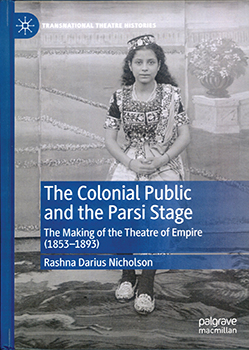
The Colonial Public and the Parsi Stage: The Making of the Theatre of Empire (1853-1893) by Rashna Darius Nicholson. Published in 2021 by Palgrave Macmillan, Gewerbestrasse 11, 6330 Cham, Switzerland, website: www.palgrave.com. Pp xvii + 328. Price: € 99.99 (Rs 8,828).
In 1969, when the last vestiges of Parsi theater could still be seen in Calcutta, Somnath Gupt, a professor of Hindi at Rajasthan  University in Jaipur published a book-length account of Parsi theater. His engagement with the subject was motivated by his interest in the language which had long dominated Parsi theater: Hindi or Urdu or Hindustani as it was known in the 19th century.
Gupt’s book was preceded by two books in Urdu: Urdu Drama aur Stage by Sayyed Masood Hasan Rizvi Adeeb (1957) and Abdul Aleem Nami’s multi-volume Urdu Theatre which was published in the 1960s. Both Adeeb and Nami mediated their engagement with Parsi theater through its language of performance. Gupt’s primary sources were the theater memoirs written by two Parsis, Dhanjibhai Patel and Jehangir Khambata (1914). Patel’s reminiscences were first serialized in the Gujarati newspaper Kaiser-i-Hind and then collected into two volumes; no copies of the first volume seem to have survived but the second volume (1931) is available in many libraries. However, Kaiser-i-Hind was then still in existence and Gupt could excavate the original articles from its archives.
Numerous other books on Parsi theater were published in Hindi and Urdu in the following decades; for example, Hindi rangamanch ke vikas mein Bambai ka yog (The role of Bombay in the development of Hindi theater) by Devesh Sharma (1987) and Parsi Theatre edited by Raveer Singh (1990). Perhaps the only Gujarati book on this subject is Purano Parsi Natak Takhto (The old Parsi theater) by S. D. Shroff (Firozgar) which was published in 1950. Shroff interviewed numerous retired Parsi theater artistes while writing this book. There have been very few attempts in English to document and analyze Parsi theater through all the stages of its century-long existence. Rashna Darius Nicholson (pictured) steps in to fill the breach with The Colonial Public and the Parsi Stage: The Making of the Theatre of Empire (1853-1893). Originally written as a doctoral dissertation, it has been published as a print-on-demand book by Palgrave Macmillan in their "Transnational Theatre Histories” series.
While Nicholson starts off by describing her book as "a history of the Parsi theater,” it is much more than that. It is also an account of how the members of the Parsi community, as individuals and in groups, negotiated the challenges which an ever-expanding colonial nimbus showered upon it. She proposes the emergence of a Parsi "public sphere” in the 1830s and 1840s as the stage on which Parsi theater began to be performed from 1853. She is particularly interested in exploring how these developments impacted the life of Parsi women who led largely regimented and secluded lives, not dissimilar to the harshest zenana. She adds, "This book, however, does not simply map the shifts that took place through the theater between physical and discursive bodies, between the construction and deconstruction of women as repositories of communal and national values; it also interrogates how these rhetorical maneuvers are rendered legible by the material yet hidden body of the archive.”
 As this quotation illustrates, the book is written in a high academic register and most readers interested in Parsi theater would struggle to keep pace with it. But if they do so, they will be richly rewarded. They will get to experience the hurly burly of a rumbustious theater culture complete with tyrannical directors, traitorous actors, flying machines, extravagant backdrops, and the occasional cross-dressing spectator. They could enter the hallowed portals of the Victoria Theatre where "respectable Parsi men and women” ran the risk of rubbing shoulders with "low class Muslims.” At the Delhi Durbar of 1877, they could choose to patronize either the Victoria Natak Mandali or the Elphinstone Theatrical Company. Upcountry, they could experience the adulation which Parsi actors and directors enjoyed in Indian princely states such as Jaipur and Baroda; and, in one episode more fantastic than Parsi theater itself, forage for diamonds in silver coconuts in fin de siècle Burma.
Like her predecessors, Nicholson mainly relies on the theater memoirs of Patel and Khambata for primary information. But she ventures deeper into the 19th century with an exhaustive, and what must have been exhausting, survey of contemporary newspapers to understand how theater unfolded in the public Press. Unfortunately, of the Gujarati newspapers, only Rast Goftar has survived the depredations of the 20th century and she makes excellent use of it, as she does of Kaiser-i-Hind and the Bombay Times. Nicholson, like most Parsi scholars of her generation, was, self-confessedly, bereft of Gujarati — the primary language of the Parsis for centuries until the 1960s — before she embarked on her research. However, unlike most of her peers, she was willing to ascend the learning curve to make use of the extensive Gujarati material which undergirds her work.
As Nicholson mines her sources to understand the actions and reactions of the Parsi community in relation to theater, she uncovers the roots of many of the anxieties that plagued the community post-independence and have been analyzed by the anthropologist Tanya Luhrmann in her book The Good Parsi (1996). In the late 1880s, after the formation of the Indian National Congress, these anxieties played out in both the editorial and letters columns of Rast Goftar where the Parsis struggled to discover "their proper position in the confusion of races and denominations inhabiting India.”
Nicholson could have engaged more with the pre-1853 choices that Parsis had when it came to entertainment and public performance. They not only went to the Grant Road Theatre in the 1840s to see European performers but also frequented other informal venues where a wide variety of entertainments were offered by Indian performers. A number of Parsi men (and perhaps women) were skilled in singing and playing instruments and regularly entertained their compatriots. There was widespread interest in Urdu poetry as evidenced by the number of Bombay imprints in Urdu (in Gujarati script) published by Parsis. She does not take notice of the event which catalyzed the Parsi theater into existence: the first tour of Vishundas Bhave and his Hindu Dramatic Corps to Bombay during 1852-53 and their ticketed performances, both in the Black Town and the Grant Road Theatre. The role of Bhau Daji, the secretary of the first Parsi theatrical committee, and who was instrumental in getting Bhave to perform at the Grant Road Theatre, has also been given short shrift.
At some unspecified time during the years of rapid growth, Parsi theater began the transition to no longer being just Parsi. Nicholson traces the beginning of this long phase to the 1870s when troupes began to extensively tour north India and south-east Asia. As Parsi theater began to attract new audiences in the hinterland, it tailored its performances to local tastes. In turn, local entertainers began to adapt Parsi theater to their own performance protocols and also joined Parsi theater troupes. The word "Parsi” when associated with "theater” began to assume new meanings, none of which had any relation to its erstwhile association with the community. In the mid-1890s, after four decades of existence, Parsi theater entered what some commentators have termed as its "golden era” and became "the theater of empire” as Nicholson aptly puts it.
This era, when Parsi theater dominated mainstream entertainment across North India from Peshawar to Calcutta via Bareilly, lasted until the early 1930s. But once movies with sound began to gain ground, the fortunes of Parsi theater nosedived. It survived in a few pockets for another three decades before it completely disappeared. The mantle of Parsi theater fell on film while theater in India took other directions. However, the "golden era” of Parsi theater has hardly been documented or studied by theater historians with Parsi-Hindi Rangamanch (1972) written in Hindi by Lakshminarayan Lal perhaps being an exception.
Nicholson also does not venture beyond the 19th century and has chosen to terminate her current study in 1893, a year in which, she notes, "moving pictures” were first invented. This event, however, did not have any impact on the trajectory of Parsi theater. 1893 was also the year when Bombay was convulsed by riots. This was the first time that the Parsis were neither agents provocateurs nor active participants in 19th century Bombay riots. This non-participation presaged a breakdown of the economic, political, and social power structures which the Parsi community had built for itself in colonial India and forecast their eventual marginalization from the Indian mainstream, similar to the one they had experienced in Parsi theater itself. One could conclude, like the author does, that, "Through a syncopation of irruptions, insertions, blurrings and exorcisms, the colonial Parsi drama as archive bore witness to a specific regularity of events, words, and ideals yet as an embodied, evanescent form not dissimilar to collective memory, it was also constituted by its own self-effacement, making history by forgetting it.”
It would be churlish to take issue with the trifling errors that have crept into the text but one hopes they will be weeded out in the next print. For example, the Zoroastrians are described as having "fled for the coast of Gujarat” from Iran "between 8 and 10 CE” where "between the eighth and 10th centuries” was intended. The Cama family is described as acquiring Mumbai Samachar in 1832 from Furdoojee Murzban though their association with the newspaper began a century later; and Munshi Talib is characterized as a Muslim playwright while his name Vinayak Prasad suggests otherwise. However, readers will be curious to know why the copyright of the images reproduced in the book from one of the theater memoirs has been attributed to the repository where the author referred to it.
The arena of Parsi theater continues to remain a vast field for research. The careers of individual artistes and troupes have yet to be studied in detail. Play scripts and songbooks related to Parsi theater were published in their hundreds — in Hindustani and other languages — but printed in Devanagari, Gujarati and Perso-Arabic scripts. These need to be documented and analyzed. The archives of princely states that were generous patrons of Parsi theater need to be examined. Photographs and souvenirs which are still in private possession need to be conserved. All the elements of theater — song, lighting, art, costume, makeup — need to be investigated. The public and governmental response to Parsi theater across India needs to be understood. Scholarly studies about Parsi theater published in its own languages — Hindi, Urdu and Gujarati — also need to be considered. It is hoped that a phalanx of committed and talented scholars will, like Nicholson, step forward to accept this challenge. MURALI RANGANATHAN
Ranganathan is a historian and translator. His most recent book is a translation of a Parsi Gujarati war memoir, The First World War Adventures of Nariman Karkaria.