How a marble bust of Dr Cawas Lalcaca, who was accidently shot dead in London,
found its way to Gordhandas Sunderdas Medical College
Shubhada Pandya
In the Parsi community’s pantheon of medical heroes of the British colonial era, two stand tall, namely Drs Kaikhoshhro Nasarvanji Bahadurji (1860-1898) and Cawas Kharshedji (or Cursetji) Lalcaca (1862-1909). Both had a connection with the Bombay Presidency and its capital city, and both were valorized in the manner of their respective deaths.
In 1931 the Staff Society of the Seth Gordhandas Sunderdas (G. S.) Medical College at Parel, Bombay was named after Bahadurji, and a "Bahadurji Memorial Scholarship for Proficiency in Surgery” was endowed and awarded annually to a student of
the College after a competitive examination. The Scholarship is still active.
However there is no tangible Bahadurji memorial.
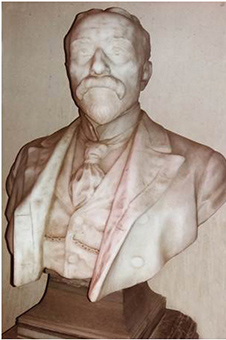
Lalcaca, on the other hand, is represented at the G. S. Medical College in the form of a marble bust (pictured). This is puzzling since there is no record of his involvement directly or indirectly with this institution. Neither was he a medico-political polemicist in the mold of Bahadurji. The mystery deepens, for in 1919 it was in the library of the Grant Medical College at Byculla.
Why it was sculpted and how it found its way to Parel is investigated in this article.
Lalcaca’s family belonged to the Gujarat region of Bombay Presidency. His father Khan Saheb Kharshedji Palanji Lalkaka joined the postal service in 1848 and by 1877 rose to inspector in the Gujarat Circle, Ahmedabad. In 1887 he was superintendent but reportedly declined promotion to deputy postmaster general at Bombay, preferring to remain in Ahmedabad. Cawas’ younger brother Kaikhosru Kharshedji Lalkaka joined Jehangir Vakil’s Saltworks in Vasai as manager and later opened a cycle shop in Bombay. Kaikhosru is germane to this article.
Lalcaca who was an alumnus of the Grant Medical College having joined in 1880, held the Anderson Scholarship for "General Proficiency,” and graduated with a first division in 1884. His route thereafter was unexceptional: like many of his peers he headed to Britain where he passed the examination and was admitted Licentiate of the Royal College of Physicians of London. In 1885 he acquired an MD (Doctor of Medicine, Brussels), the conventional wisdom being that this was easier than London University’s MD examination.
In 1886 Lalcaca arrived in China and his professional life was spent in Shanghai where his kin were prosperous merchants. His medical talents flourished. He was an honorary member of the Medical Missionary Association of Shanghai (but he retained his religion), and contributed clinical articles to its Journal.
He had other interests. As an active member of the quasi-military Shanghai Volunteer Corps, Lalcaca progressed steadily in rank from private to surgeon-lieutenant to surgeon-captain, and principal medical officer surgeon-major.
Lalcaca’s death
Unlike that of Bahadurji, the scenario of Lalcaca’s death — in the capital of the British Empire in the late evening of Thursday, July 1, 1909 — is not in doubt. It was violent, dramatic, unexpected and in full view of a large social gathering in the Cowasji Jehanghier Hall of the Imperial Institute, South Kensington. Lalcaca took a bullet in the chest from a mis-fired Colt Automatic pistol while instinctively rushing to aid the wounded British colonial official Sir William Curzon Wyllie, the assailant Madan Lal Dhingra’s intended prey. Dhingra has gone down in history variously as "a brainwashed youth” "a terrorist,” "a freedom fighter” "a revolutionary” (depending on who tells the story). He confessed at his trial that Lalcaca’s killing was unintentional. In other words, Lalcaca was "collateral damage.”
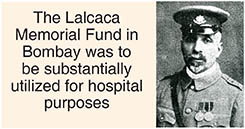
Lalcaca in his quasi-military Shanghai Volunteer Corps uniform
A memorial for Dr Cawas Lalcaca
The assassinated Wyllie got due deference from his government in a marble memorial in St Paul’s Cathedral.
In August 1909 a question was asked in the House of Commons "... whether it is intended by the Government to in any way recognize the heroism of the late Dr Lalcaca, who sacrificed his life in an effort to save that of Sir W. Curzon Wyllie?” The reply of the Under-Secretary of State for India betrayed an astonishing mean-spiritedness: "...The Secretary of State (Lord Morley) has considered whether the particular circumstances of the case are such that appreciation could appropriately be marked by a money grant; but, learning from the Government of India that Dr Lalcaca was unmarried, and that his surviving relatives are well-to-do, he feels that it is not necessary to take action in that direction.”
The Lalcaca Memorial Fund, Bombay
There were two prime movers in the Bombay initiative — a British journalist and a Parsi judge of the Bombay High Court. Both were controversial figures.
As expected, the Wyllie-Lalcaca killings were widely covered in Bombay’s English-language Press, the most pertinent being the now forgotten The Advocate of India, an eveninger owned and edited by the also-forgotten Francis Frederick Gordon (1866-1922), a member of the municipality from 1910-1916. Gordon also owned and edited a government-subsidized Marathi weekly, Jagad Vritta, which "promoted the dissemination of temperate views” to counter Indian disaffection. The Advocate of India was viewed as pro-establishment — "anti-Indian;” "an aggressive supporter of the bureaucracy” by some Indians and Britishers. Henry Polak, Mohandas Karamchand Gandhi’s associate in South Africa once referred to Gordon as "a most objectionable cad...”
In 1908 The Advocate of India had strongly deprecated the spreading culture of political killings in India, as it instanced the two European ladies who were "collateral damage” in the murder attempt on a British Magistrate by Khudiram Bose of Bengal. As is well known, B. G. Tilak’s defiant support of Bose in Kesari led to his six-year exile in Burma awarded by Justice Dinshaw Davar.
Davar was Gordon’s collaborator for a fitting memorial to the slain Lalcaca. A Lalcaca Memorial Fund was inaugurated with Gordon as honorary secretary. In addition to Gordon and Davar the committee of the Fund included Sir Mohamedbhoy Currimbhoy, Dr Nadirsha Sukhia, R. D. Sethna, Sir P. C. Sethna, Sir Cowasji Jehangir (1879-1962) and Dr Sir Bhalchandra Bhatwadekar (who had in 1899 respectfully protested Tilak’s irrational doubts about Haffkine’s plague vaccine).
By November 1909 a sum of Rs 17,375 had been contributed by well-wishers, the question at hand being the form of the Memorial. By March 1910, the Fund had swelled to Rs 20,706. Gordon prevailed on Morley to permit the government of Bombay to subscribe a token amount of Rs 1,500. A committee meeting chaired by Jehangir resolved to commission two busts of Lalcaca to be made in England at a cost of 300 guineas. One bust was to be placed in the Imperial Institute in London where Lalcaca had lost his life. The second bust was for Bombay.
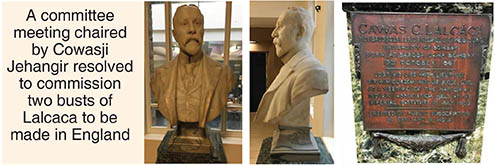
Two marble statues of Lalcaca cast from the same mold and bronze panel with inscription
Importantly, in 1911 Jehangir proposed that the balance amount of about Rs 16,000 be offered to the "Bombay Presidency King Edward VII Memorial Fund” (the monarch died in May 1910), on condition that "a ward or some part of the (proposed) King Edward Hospital building... be named after Dr Lalcaca and that his bust, which would be furnished by the Lalcaca Memorial Fund, be placed in it.” The committee unanimously accepted the proposal.
The individual who bestrode the two enterprises was Sir Stanley Reed. As editor of the Bombay’s premier English-language daily Reed’s support for the Lalcaca Memorial Fund took the form of acknowledging, receiving and forwarding subscriptions and reporting on Fund-related developments in The Times of India (TOI). As an honorary secretary of the Bombay Presidency King Edward Memorial Fund he was strategically placed to obtain acceptance of the Lalcaca Fund’s offer of about Rs 16,000 and the stipulation on naming a ward or dispensary and placing a Lalcaca bust in the proposed hospital bearing the late king emperor’s name.
A parallel Lalcaca Memorial Fund was inaugurated in London with former Conservative Member of Parliament Sir Muncherji Bhownagree as secretary. Bhownagree, whose name was famously parodied as "Bow and Agree” by Vanity Fair for his pro-Britishness, was donor of the "Avebai Bhownagree Corridor,” while Jehangir was donor of the "Jehanghier Hall” at the Institute. Thus there was a complete meeting of minds between the Bombay and London memorial committees.
The commission was awarded to Frederick Doyle-Jones (1873-1932), well known as a sculptor and portraitist. Two identical busts were fashioned from one plaster cast. In April 1912 the TOI’s London correspondent viewed the completed work in a room at the Royal Academy prior to its shipment to Bombay later that year. However, he was not impressed: it was "... a fanciful likeness,” not "oriental” enough in looks hence liable to be "... taken for an ordinary short-bearded Englishman” by the ignorant.
Its replica paid for jointly by the Bombay and London Funds was formally unveiled at the Imperial Institute by former Secretary of State for India Lord George Hamilton in April 1913. The select gathering was graced by old Bombay hands (Lords Harris and Lamington) and Indian members of the Secretary of State’s Council, and presided over by Bhownagree. Dr Lalcaca and his heroic death were eulogized amid general satisfaction that the Lalcaca Memorial Fund in Bombay was to be substantially utilized for hospital purposes.
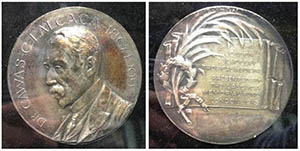
Front and obverse of the Dr Cawas Lalcaca Medal
On this occasion the reporter concerned dwelt on the high aesthetics of the sculpture: "... beautiful ...White marble of the specially fine kind found at Mount Pentelicus near Athens. It has a Cipollino plinth in green and stands on a pedestal of dark green Tinos, on which the bronze panel bore the following inscription:
Dr Cawas C Lalcaca
Born at Baroda Camp, Bombay, 13 October 1867 (sic),
Died at the Imperial Institute London,
1st July 1909
Shot while trying to save Sir William Curzon Wyllie from Assassination
Erected by public subscription in England and India”
The marble bust occupied its niche in the Bhownagree Corridor at the Imperial Institute for the next two decades. In 1933, in another Bhownagree initiative approved by concerned authorities, it was transferred from the Institute to the London School of Hygiene and Tropical Medicine (LSHTM) Museum at Gower Street. The Museum was closed in the 1960s. The bust currently resides in the Tropical School’s building at Keppel Street. The photographs show that it is in pristine condition, including the mistake in year of Lalcaca’s birth.
Bhownagree’s anxiety to transfer the bust from the Institute to LSHTM invites speculation. In a letter dated March 24, 1933 he recalled his conversation with Sir Patrick Manson, the "father of tropical medicine” who in 1899 founded LSHTM, on the need to involve India in this branch of medicine. Perhaps the bust of a much-praised Indian medical man at the London School to inspire Indian students was Bhownagree’s gesture towards that end. Perhaps the bronchitis which incapacitated him in March was an intimation of mortality. He died later that year. Nevertheless, the transfer was fortuitous, for the Bhownagree Corridor and Jehanghier Hall were demolished in the 1950s for expansion of the Imperial College of Science.
Dr Cawas Lalcaca Medal
Bhownagree had moved swiftly to consolidate the doctor’s posthumous connection with London. In 1913 itself the Fund endowed the "Dr Cawas Lalcaca (silver) Medal” at the LSHTM to be awarded annually to a student of the school after a competitive examination. (The error in the year of Lalcaca’s birth was perpetuated on the medal.) The illustrious cardiologist Rustom Jal Vakil who was trained in Britain was a Lalcaca medallist in 1937.
The replica bust probably arrived in Bombay around 1912-1913, but there is no record of this. One learns by chance of its presence between 1919 and 1926 amidst the statuary at the Grant Medical College. Neither is there a record of the date of its transfer to the King Edward Memorial Hospital and the location of the eponymous "Cawas Lalcaca Ward.” Unfortunately senior alumni of the G. S. Medical College do not recall such a ward.
The Cawas Lalcaca bust is now on display at the Medical College. It is a forgotten bye-product of the incongruous marriage between a grand imperial design (the King Edward VII Memorial Hospital) and assertive Indian nationalism (Seth Gordhandas Sunderdas Medical College) almost a century ago.
Lalcaca’s visage in white marble retains the fanciful resemblance to "a short-bearded Englishman.” The inscription on the pedestal for Lalcaca carries the dates "1862-1909” but hardly does justice to his memory and why the bust came to be where it is.