Coomie sat on a low iron bed called dholki for all four days of her monthly period. We children were forbidden to touch her; which made us all the more determined to do so. She would run away and we would pursue her. During those days, she would use a separate washroom in the backyard with a rusted door stopper which, otherwise, was our favorite spot to hide in. She had four children — the first delivered at age 18 and the youngest at 24. Until she reached menopause 30 years later, she religiously followed this monthly routine. Though most Navsari Parsis genuinely believed that sex was for procreation and not recreation, coitus with her caterer husband was a daily affair, barring those days when her exhausted uterus was allowed to shed its lining in peace.
The taboo around menstruation was endemic. Navsari swore that if a woman in isolation touched a jar of pickles it would instantaneously be spoilt. Particularly, the pani nu achaar (raw mango preserved in brine; best with lentils). Touch a cow and it will stop giving milk. Flowers would wilt. Even bathing was forbidden. Woe betide if a loved one passed away; a woman in menses was not permitted the final viewing. Hardly anyone rebelled; not even the progressive ones including the many Theosophists. While this taboo was prevalent in most ancient religions including Judaism, Christianity and Hinduism, there is no evidence of such practices in Sasanian Iran. Of course, the Khshnoomists have alluded to the impurities emanating during menstruation. There are also several scholarly Zoroastrian studies on Jeh, the primal whore, who was kissed on the head by Ahriman to entice men — the kiss that caused her to menstruate. It is highly likely that this practice of isolation was borrowed from their Indian rulers by the Zoroastrian refugees.
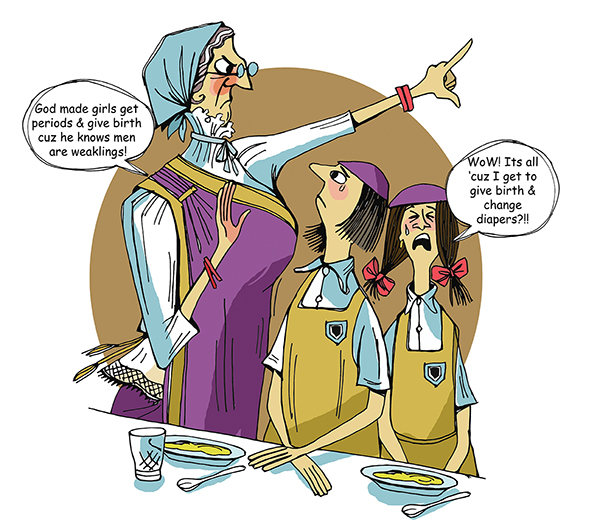
Illustration by Farzana Cooper
Navsari was equally strict about a woman who had delivered a child being placed in isolation for 40 days, with near identical restrictions. After the expiry of this period, the senior ladies would engage the services of an astrologer to prepare a basic horoscope called janam chitthi [chhokri Shani Mangal ni chhé, baap né maaté pugloo saroo nathi (the girl is born under Saturn and Mars, which bodes ill for her father)]. This would be replaced with an elaborate horoscope called the tapko on the eve of the navjote.
Navsari religiously forbade the pregnant from any activity during an eclipse. They had to mandatorily sleep during the entire duration of an eclipse as it was widely believed that not following this injunction would have an adverse effect on the fetus. A widely narrated story was about a woman from Navsari who later sold sandalwood sticks to devotees outside a Bombay atash behram. She had a striking resemblance to an owl, apparently the result of her mother having spotted the bird on the windowsill during an eclipse just as the midwife was urging her to push harder.
Not disclosing a pregnancy until it was self-evident was yet another unwritten rule. No formal announcement was made until the baby showers after the completion of the seventh month and the distribution of the ubiquitous agharni no laarvo (Adi Marzban called these sweetmeats "pregnancy balls”). Mothers-to-be were forbidden from knitting tiny sweaters in anticipation or even speculating upon proposed names to be given to the child. For all those aspiring for motherhood, it was believed that consuming the tip of the laarvo was a sure-shot method of getting pregnant soon. And unsuccessful couples of long-standing were advised to adopt a child, as it was believed that a natural born one would soon follow, smelling the milk being fed to the adopted child.
Just prior to delivery, the mother-to-be was packed off to her father’s home, to return to the matrimonial home 60 days post-delivery. The reason was partly economic, so that the girl’s father had to pick up the tab for all the expenses involved; a kind of deferred dowry.
If the new born was fair (as most were), a round black soot mark was placed on the chubby cheek and a bangle made of tiny black beads placed around those minuscule wrists, both amulets for protection against the evil eye. When a child fell ill, the most common conclusion was koi ni najar laagich (someone’s evil eye has adversely affected the child).
School girls were classified as topiwali and sariwali; the former had red or black velvet caps firmly placed on the head, and the latter wore saris. Upon attaining puberty, donning the sari for the first time was a watershed event in a woman’s life. Matchmakers began to assess their potential. Although there were no child marriages in the last century, girls were usually married before 18, mostly to their cousins. This solved the problem of dowry and the marriage expenses were shared. Framroze may have looked like Frankenstein and Bacha like a banshee but at least there were no surprises.
Sex education and premarital sex were absent. Girls feverishly fantasizing for many afternoons about their much awaited bridal night were terribly disappointed. Boys fared not much better. It was drilled into their heads that wasting semen was a cardinal offence in Zoroastrianism and 1,000 of the 72,000 nerves were destroyed in a single ejaculation. Those who disbelieved this, avoided a nervous breakdown. Navsari, after all, was a sacred town whose celestial vibrations kept the libido in check. A few libertarians did make merry though, and managed to cock a snook at the compulsively virtuous.
Berjis Desai, author of Oh! Those Parsis and The Bawaji, occasionally practices law.