Kudos to Berjis Desai for his brilliant piece "How Zoroastrian was Persia?” (Parsiana, July 7-20, 2023). What is truly heartwarming is that there are some Parsis with a good grasp of legends pre-dating Zarathushtra’s sojourn on earth as well as the fate of the Zoroastrian religion during the Achemenid, Parthian and Sasanian Persian empires.
It is shocking that there are some priests in our community who trumpet Gayomard not as a mythical figure but as a real man; they tout mythical characters such as Shah Faridoon ("a great exponent of white magic”) and other magical, imaginary figures (whose "legends bristle with pagan practices and rites”) as composers of nirangs to ward off setbacks in life. It is a clear indication that, with a few exceptions, our clergy propagate myths that credulous Parsis swallow as absolute truth. Unfortunately, many of our priests and our laity cannot separate fact from myth, failing to understand that these pre-Zarathushtra mythical characters and their legends were created as parables to educate humans in values to embody. They are not meant to be taken literally. The Zoroastrian religion is a very powerful one with profound wisdom. It is not a magical, farcical, fairy tale.
Desai accurately describes the state of the Zoroastrian religion during the three Persian dynasties. The Magi, the sacerdotal tribe among the Medes, were polytheists (belief in more than one god) who practiced the pre-Zarathushtra Indo-Iranian religion with Mithra at the head of their pantheon. When Cyrus the Great conquered Media, the Magi became part of the Persian Empire and they gradually wormed their way into the minds of the post-Darius Achemenian monarchs who, as Desai points out, had a modicum understanding of Zarathushtra’s doctrines. This gave the Magi a gateway to corrupt the Zoroastrian religion with their pagan beliefs and practices. Those pagan practices, being a far cry from Zarathushtra’s pristine tenets, are observed even today. Over time, the sovereigns and laity, in all three empires, began leaning towards other faiths and cults as Desai rightly notes.
Zarathushtra’s religion, as practiced today, is a faith infused with pagan, pre-Zarathushtra practices inherited from the Magi. It is a travesty every true Zarathushti should condemn.
MEHERYAR N. RIVETNA
Houston, Texas, USA
mrivetna@comcast.net
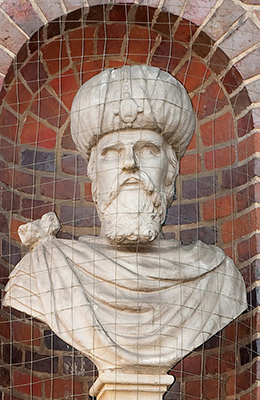
Seventeenth century bust of
Cyrus the Great in Hamburg
Photo: Wikipedia
What an eye-opener for bigoted Zoroastrians who envelop themselves in lofty ideals of state sponsored Zoroastrianism through the three Persian eras ("How Zoroastrian was Persia?” Parsiana, July 7-20, 2023).
Clearly Berjis Desai’s research is accurate to embolden him to pen such "heresy!”
The priestly class has cleverly perpetuated such myths of religious and pious Zoroastrian kings into the mindset of the Parsi laity leading to ideas of false superiority and ideals when, in reality, the kings were by and large marauding invaders with low morality, many foreign wives and little or no religious leanings and offered no coherent opposition to the Arab invasion. Hence, the racial purity and exclusiveness as propagated by the priestly class (and others) in India.
No wonder the majority of Parsis in India refuse to accept facts and are stubborn, orthodox dhongidox (someone else’s terminology for pretenders).
Berjis, please enlighten us thus always!
Berjis Desai’s piece "How Zoroastrian was Persia?” (Parsiana, July 7-20, 2023) is an excellent exposé of the community’s obsession with the purity of the religion through the Persian dynasties, forgetting the Prophet’s Gathas. This is still happening today.
DOLLY P. DASTOOR
Montreal, Canada
dollydastoor@sympatico.ca
Another fascinating piece from Berjis Desai. Keep them coming, please.
POURUCHISTI MEHERHOMJI
pourushah@gmail.com