Their business having thrived in Daman, The Dadachanji Group
renovated the 185-year-old Dar-e-Meher
Parinaz Gandhi Photos: Jasmine D. Driver
Inside the Dar-e-Meher, the red carpets and floral decorations were in place. The tray loads of divas, sukhad and logs of kathi wood had been systematically piled behind the kebla ahead of the inaugural jashan. All attention though was being lavished by the organizers on the full length, stained glass image of Zarathushtra. It had been newly introduced on the rear wall as part of the renovation efforts of The Dadachanji Group of Companies (DGC) to restore the 185-year-old Mehervanji Navroji Manekji Dar-e-Meher in Nani Daman.
The height of the floodlights outside was being shuffled around to determine the ideal level where the play of illumination and color could be optimized. Not satisfied with the effect, the architect of the project Khurshed Vazir suggested to the president of the Shree Daman Vapi Parsi Jarthosty Anjuman Ardish Vapiwala and his predecessor Tehmten Wadia who chairs the Agiary Committee that a white cloth in the background would help diffuse the light and enhance the appeal of the stained glass. Ultimately reassured that their efforts would please the founder and chairman of DGC Kairus Dadachanji who was constantly monitoring the restoration effort, the trio returned to the front patio.
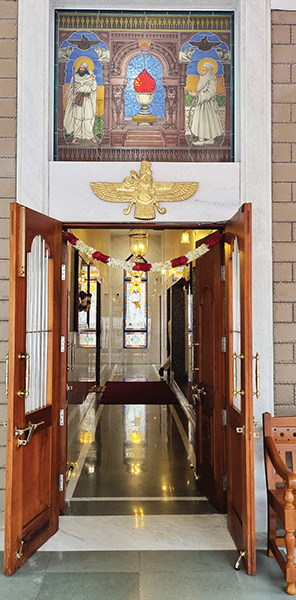
New stained glass installations at the Mehervanji Navroji Manekji Dar-e-Meher
Dignitaries alongside the new plaque at the Dar-e-Meher
Clockwise from top: Jashan in progress; new stained glass image of Zarathushtra; well near the entrance
While they were taking a breather ahead of the jashan and felicitation program on the evening of July 15, 2023, roj Shahrevar, mah Spandarmad, Parsiana was able to get some insights on the restoration efforts that commenced two years ago. No financial details to be divulged to the Press, the architect was cautioned, but he declared that he was barely in a position to do so since he had maintained no accounts. He knew that Kairus trusted him with "an open purse,” never questioning his expenditure.
The Anjuman executive committee had felt the need to renovate the Dar-e-Meher premises three years earlier but did not have the requisite funds, stated Wadia who was then president. At one of his meetings with Kairus, the latter showed his willingness to finance the repairs and renovation. Wadia assumed he would pick up the bill for plastering, painting, polishing and waterproofing, little expecting what was to follow.
"Kaam karvanu, tau barabar karvanu (if you are going to work, you must do it well),” was the maxim of both, Kairus who financed the project and Vazir who waived his professional fees viewing his efforts as his contribution to the community.
To those who have visited this Dar-e-Meher earlier, the most noticeable alteration in the façade would be the addition of the two, imposing marble ghodhas (Lamassu) on either side of the stairway at the entrance. These were specially crafted by artisans in Jaipur for which Vapiwala was required to make repeated trips to the Pink City for the selection of marble was as important as ensuring pleasant facial features! We were told that Kairus, known to charm all with his dimpled smile, was very particular that the expression on the image of the stained glass Zarathushtra as also the ghodhas should evoke happiness. Once the final approval was received, the sculptures were brought over to Daman and installed with the help of cranes.
Vazir elaborated on the efforts that went into the planning of the restored cum renovated Dar-e-Meher. Within the fire temple, the original cylindrical columns on the patio ending in the double bull head at the apex resembling Achemenian architecture were shaved and their shape changed to rectangular ones. The windows opening onto the patio that were originally resting on a brick and cement framework could now be seen standing on marble. The wall surface too had changed, with full body, vitrified tiles cut and chiselled to give the structure an age-old effect. The regular LED lights at the fire temple have been replaced with fibre lights in imported lanterns that cast a magical glow. The doorway from the patio to the hall has another stained glass installation above it. The asho farohar in brass was specially made in Kairus’s factory, we were informed.
The smoke emanating from the atash dadgah inside the kebla or sanctum sanctorum is now channeled out with the installation of the whirlybird exhaust system, a naturally powered ventilation that works 24x7 to minimize excessive temperatures in summer and humidity and dampness during the monsoons. "Earlier, every three months the dome required cleaning,” stated Wadia, showing us the metal spiral stairway in the anteroom facing the sanctum which had to be ascended to reach the gumbaj (dome above the fire).
Portraits of erstwhile donors and long-serving priests continue to adorn the hall of the Dar-e-Meher consecrated on March 6, 1838. Their first panthaky, Ervad Navroji Hormusji Unwala, reportedly used to walk to Nani Daman from Udvada around eight kilometers away to serve the Dar-e-Meher. For his labors he then earned four annas a day from the local Anjuman, according to the Global Directory of Zoroastrian Fire Temples authored by the late Marzban Giara. Three generations of the Unwala family served the Dar-e-Meher for 156 years, it was acknowledged.
While the larger well in the front courtyard and the smaller well in the rear have long been serving the needs of the fire temple, the ornate covers on the wells were installed recently. Yet another addition is the specially erected enclosure to perform kusti that replaces the earlier one which had a tin roof.
Religion and recognition
On July 14, the sacred dadgah fire that had been temporarily housed in the mobed quarters in the agiary complex was reenthroned in its original abode. Ervad Zuber Bhesania who has been serving as the priest here for the last two years mentioned that since it is a dadgah fire, only one boi (prayers to mark the change of gah) is offered every day (as compared to three or five for an adarian) unless an additional one is specifically requested by a devotee. On an average about two devotees visit the fire temple daily, he stated.
At the evening function the next day, the premises were teeming with devotees — from babes in arms to nonagenarians — while the khushali nu (celebratory) jashan was in progress with 12 priests led by Dastur Khurshed Dastoor of Udvada. Half the marble slab at the entrance to the kebla had been occupied by rectangular kathi offerings, stacked one atop the other. Only the devotees who arrived early managed to secure seats in the hall and sanctum. The rest had to be content to find space on the patio or shamiana specially erected for the event after paying their obeisance to the sacred fire. For the senior members of the Dadachanji family though a special row of chairs needed to be laid out. Besides Kairus and his wife Pervin, also praying in the sanctum were Kairus’s mother Homai, and Pervin’s parents Dolly and Homi Madon.
Representatives of the local media — Doordarshan Girnar (Gujarati), Bhaskar, Sandesh — patiently waited outside while the jashan was in progress. As soon as Dastoor and Kairus exited the Dar-e-Meher, they rushed to seek their inputs.
Continuously shown on the screen backing the rows of sofas on the dais was the message at the start of the felicitations: "Shree Daman Vapi Parsi Jarthosty Anjuman would like to thank Kairus Dadachanji and family for their kind contribution towards our Anjuman. Your benevolence is truly appreciated by all of us.” A plaque on the Dar-e-Meher patio too acknowledged, "The conservation and restoration of Shreeji Pak Dar-e-Meher has been made possible by the munificent contribution and executed by The Dadachanji Group of Companies” naming Kairus, Pervin and their son Rishad as the benefactors.
Gratitude was repeatedly expressed during the nearly hour long proceedings when three generations of the Dadachanji family who are known "to support each other, move ahead and help the community” were presented flowers and shawls. Kairus was given a further memento in the form of a framed sketch resembling his visage. The sketch given to Pervin depicted the couple, and the one for Rishad showed the father and son together. The Dadachanjis’ daughter Faarah and her husband Yohan Sachdev too were presented shawls.
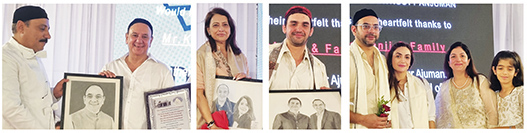
From l: Aspi Damania with Kairus Dadachanji; Pervin Dadachanji; Rishad Dadachanji;
Yohan and Faarah Sachdev, Ruzin and Mishka Vapiwala
Clockwise from top l: Tehmten Wadia, Khurshed Vazir, Ardish Vapiwala; a section of the audience;
Firoz Damania, Ervad Eric Dastur, Aspi Damania, Ervad Zarir and Rukshana Dastur; Maharukh Chichgar; Gev Karai
Devotees in the sanctum (front row, from l): Pervin and Homai Dadachanji, Homi and Dolly Madon
Plaque showing inception of fire temple in 1838
Others who had contributed to the restoration efforts and the priests who had joined in the jashan or served the Anjuman were also duly felicitated. Doing the honors were the office bearers of the Anjuman or their spouses. Besides Vapiwala, currently serving on the executive committee are vice president of the Anjuman and president of the Daman Municipal Corporation Aspi Damania, secretary Kaiwan Toddywalla, treasurer Rohinton Engineer, and executive committee members Firoz Damania, Mazda Motiwala and Mazda Toddywalla.
While chasni was being distributed, the audience got an opportunity to witness a nearly five-minute film, presented by Rumi Baria of Navsari’s Jehangir Recording Studio, documenting the history of the Dar-e-Meher since its inception until "a farishta (an angel)” in the form of Kairus magnanimously contributed towards the renovation and maintenance of the fire temple.
For the last few years Kairus would annually send six lakh rupees (USD 7,314) towards maintenance of the fire temple. In June this year he promised to increase the annual contribution to Rs 10 lakhs (USD 12,190). Shortly thereafter, Gev Karai who handles the family’s treasury portfolio called Vapiwala to inform him that the funds have been transferred, the Anjuman president acknowledged. Fifty percent of the ideas towards beautification of the agiary were initiated by Kairus, said Vapiwala who also commended the donor’s "punctuality and eye for perfection.”
Thirty-five years ago when the old agiary structure needed renovations, "bheekh maangi né kaam safal karyu (after begging for funds the work was accomplished),” stated Dastoor. Ervad Dadiba Unwala, the revered 90-year-old priest, was in charge then. Thanks to Kairus, the situation was different this time. In his speech in Gujarati, Dastoor commended Kairus for undertaking his responsibility as a mobed, though he may not practice mobedi, by helping an atash dadgah to flourish and serve the community. When the community is shrinking, if well-placed individuals take responsibility for one fire temple each, it would greatly help the religion, stressed Dastoor.
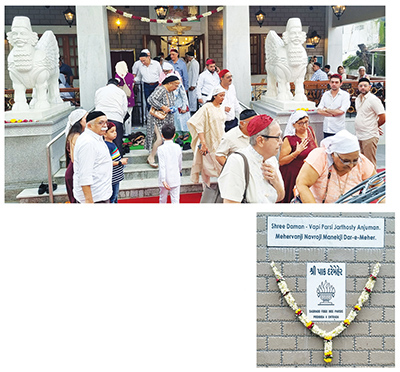
Top: pilgrims exit the Dar-e-Meher; above: plaques on the boundary wall
Guests enjoying patra nu bhonu
The Dadachanjis in Daman
"Shraddha gyan aapé chhè, namrata maan aapé chhè ané yogyata sthaan aapé chhè pun jémna ma aa trané no samanvay hoi témné sau sanmaan aapé chhè (faith earns knowledge, humility earns respect, and ability earns status; those who have a combination of all three are honored by all),” reminded master of ceremonies Maharukh Chichgar of Surat valuing the presence of "determined, dedicated and dashing personalities” at the evening function.
With his business having grown in Daman and soon "to start a vaccine manufacturing facility here,” Kairus felt the need to "give back. This will be an ongoing charity for us,” he mentioned in his short speech. In 2017 he had donated Rs 40 lakhs (USD 48,763) to rebuild the bungli on the Daman Doongerwadi property and had contributed towards building of the boundary wall too.
Starting with a small plant in 1990 to running a diversified business empire, Kairus’s association with Daman has strengthened over the years. Opting out of a salaried job that was bringing him Rs 700 (USD 8.5) per month, Kairus joined hands with Shapoor Mistry (currently chairman of the Shapoorji Pallonji Group) by investing Rs 25 lakhs (USD 30,477) to start Kaisha (conjoining Kai from Kairus and sha from Shapoor) Manufacturers Pvt Ltd to produce ampoules and tubular vials. Currently the Dadachanji Group of Companies has varied business interests in pharmaceuticals, biotechnology, primary and secondary packaging, medical devices, machine building, automation, robotics and sterile processing. Some of the leading companies under the Dadachanji Group include Kaisha Lifesciences, Kaisha Packaging, Kaisha Packwell, Kairish Innotech, Kairish Shared Services, Sovereign Pharma and Sovevax Biologics.
Underplaying the donations of the Dadachanjis, Kairus said, "We happened to be here at the right time.” Contributing towards the upkeep of the fire temple has brought him "contentment and peace within,” he said urging members of the community visiting the Iranshah in neighboring Udvada "to take 20 minutes of their time to come to Daman and pay respect to the agiary here.”
He particularly thanked Vapiwala for having "worked relentlessly to get a top quality product” and Vazir, his "dear, dear friend and architect who has been with me for many years, who would come by train to Daman every week.” Although Kairus was told that Vazir "bau strict chhè, badhaané firing aapéch (he is very strict and tends to fire all who are lax),” seeing the results of the restoration everyone is grateful to him, commented Kairus.
One should "visit an agiary regularly; not only when in trouble,” advocated Kairus in a separate chat with Parsiana. "Every four or five weeks I need to go to a fire temple. It is like a pull. After spending 20 minutes in prayer I feel recharged. At the end of the day, religion should bring you peace.” This tranquility, he has realized, percolates into his business, "the way you treat people and are there for the needy.” He feels most privileged to receive genuine "blessings from the poor,” and is convinced that "the power of sincere words is effective.” With the Dadachanji Group expanding from one plant to 10 plants in Daman, he resides in the Union Territory from Mondays to Fridays and visits Bombay on weekends, he noted.
Kairus’s navar training was at the Vachaghandhy Agiary under Ervad Asphandiar Dadachanji who along with his wife "treated me so well, at the end of the month, it had become home to me and I didn’t feel like leaving.” He recalled his initial reluctance to undertake the training when his father Shavak, erstwhile managing director of Merck Sharp and Dohme and a practicing priest in Bombay, had to cajole him to agree by promising him "a gift of Rs 1,000 at a time when pocket money was two or three rupees.” With this sum Kairus bought himself a cassette recorder. Though he never practiced as a priest, he was determined that Rishad too be ordained as a navar at the same Agiary.
Joining in the repast
In keeping with the religious tone of the event, the film, Life of Zarathushtra, produced by Meher Bhesania of Dubai, with the voice-over in Gujarati by Rumi Baria, was shown to the audience.
The current strength of the Daman Vapi Anjuman must be around 150 members, said Vapiwala. Besides the local populace who had attended in large numbers, guests had come from Davier, Sanjan, Valsad, Udvada, Navsari, Surat and Bombay to attend the jashan and partake of the drinks and lavish gahanbar generously hosted by the Dadachanjis. The patra nu bhonu catered by Sunnu Kasad of Navsari and the vegetarian thali from Hotel Soveriegn was enjoyed by 527 diners.