Whilst retaining the old wedding
customs, a few new ones have
been accepted by the Zoroastrian
community in the diaspora
Parinaz Gandhi
With the second and third generation of Zoroastrians being born and raised abroad, is there still a desire to maintain and follow the traditional lagan-navjote customs? Considerably, it would appear from the responses received from North America, UK, Australia, Hong Kong, Singapore and Pakistan to the questionnaire sent out by Parsiana to determine the mode of festivities among Parsis and Iranians in countries other than India. Priests and prayers continue to be given due importance. Among Parsis, substantial time and expenses are borne to dress in the traditional attire. And even if the lagan nu patru may not always be practical, the celebratory meal often includes a couple of Parsi and Persian dishes specially cooked by chefs who have been familiarized with the recipes.
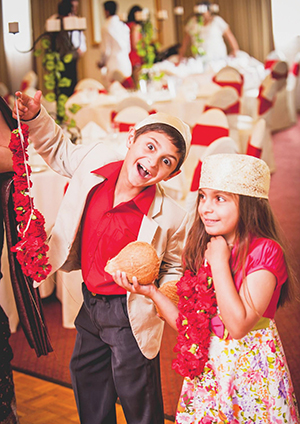
We had written to office bearers and/or long-standing active members of the community in sizable Zoroastrian pockets, approaching more than one person from different regions to gain a wider perspective. From North America, we received seven responses from: Homi Gandhi, president of the Federation of Zoroastrian Associations of North America (FEZANA), Ervads Arda-e-Viraf Minocherhomjee and Soli Dastur from the North American Mobeds Council, former FEZANA president Framroze Patel, erstwhile and current editor of FEZANA Journal, Roshan Rivetna and Dolly Dastoor, and Aban Rustomji who heads the FIRES (FEZANA Information, Research, Education System) committee of FEZANA.
"Weddings and navjotes are happy occasions and oftentimes an excuse for family reunions. They hold great significance not only for the children being initiated or married, but also for their parents and extended family elders who see their religious and ethnic traditions being passed down,” stated Gandhi.
Regarding the practices prevalent in the UK, our questions were answered by Dorab Mistry, former president of the Zoroastrian Trust Funds of Europe (ZTFE), administrative secretary of ZTFE and marriage registrar Roshan Avari and ZTFE resident mobed Ervad Yazad Bhadha. "It must be borne in mind that the traditional Zoroastrian marriage where both spouses are Parsi-Irani is now in a minority. About 60-70% of marriages involve one non-Zoroastrian spouse. However, there is great enthusiasm to observe Zoroastrian attire, cultural rituals and food,” said Mistry.
From Australia, Ervad Peshotan Katrak of Sydney and Firoz Pestonji, chair of the 11th World Zoroastrian Congress in Perth responded. "Most families try to keep the traditions alive depending on the most authentic items available,” stated Pestonji.
An overview of the practices in Hong Kong was provided by Neville Shroff, president of the Zoroastrian Charity Funds of Hongkong, Canton and Macao, who referred to "an increase in interfaith connections,” an observation confirmed by financial analyst Jimmy Master who stated, "I cannot recall when the last union was within the faith. It may have been decades ago. We have a preponderance of girls in the community, and all of them are marrying out… We have very, very few boys in the community and they too have married out.”
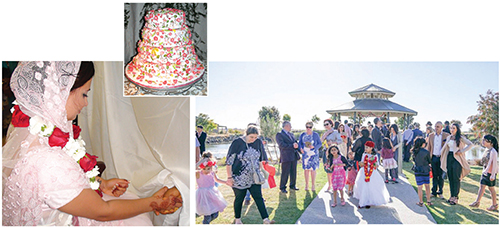
Top and above r: Young initiates and navjote celebration in Australia;
above l and inset: traditional aaraa-antar nuptial ritual and wedding cake in USA
The most prompt response came from Mobed Mehraban Firouzgary of Iran where Zoroastrianism was founded. He shared with us his presentations on "Performing the Sedreh Pushi Ceremony” and "Zarathushti Marriage Ceremony as performed in Iran.” The wedding ritual in Iran being different and full of symbolism to prepare the couple for a harmonious and purposeful life, Parsiana has summarized his note (see "Meaningful marriage,” pg 48).
From Pakistan, inputs were received from Khursheed Kotwal, trustee of the Karachi Parsi Anjuman Trust Fund (KPATF), and active members of the Karachi Zarthosti Banu Mandal, Sunnu Golwalla, Pouru Sidhwa and Toxy Cowasjee. As compared to a decade ago when there were over 4,000 Zoroastrians in Pakistan, they now number less than 1,000, wrote Kotwal, adding, "Most of the younger population has emigrated to Canada or Australia for better opportunities, and the Pakistani community mostly comprises of the older generation… The Karachiites are progressive… KPATF has approved that children with at least one Parsi parent can enter the faith… and visit the Anjuman owned and controlled agiary.”
In Singapore, "the majority of Zoroastrians are from India or have continued strong ties there and so most of the traditions are still followed here,” revealed Rustom Ghadiali, former president of the Parsi Zoroastrian Association of South East Asia, Singapore. "Due to our proximity to India, supplies from India are also easily accessible. However, practicalities are also considered. Individual families may have their own belief systems and the priests are quite flexible,” conveyed Ghadiali.
Very few Zoroastrians in Dubai have opted to perform navjote ceremonies for their children there. Most prefer to return to India or Pakistan to celebrate the ritual amidst family and community members. No one seemed to remember a Zoroastrian being married in Dubai.
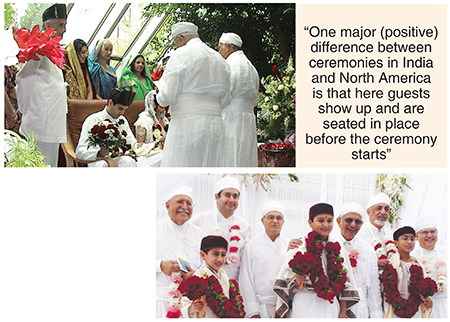
Above l: Ashirwad ceremony performed by two mobeds;
r: three new initiates with the mobeds who officiated in the US, Ervad Soli Dastur, 4th from r
Ahead of celebrations
The purificatory nahn (ritual bathing) ceremony before the performance of the navjote or wedding is complied with in most regions. The sipping of taro (consecrated bull’s urine) though is generally substituted by pomegranate or apple juice.
Among Parsis in all regions, sev and ravo with dahi continue to be the staple sweet dishes that mark an auspicious occasion but as specified by Mistry, "Ravo is much more in vogue than sev because it is easier to prepare.” Where it is not feasible to prepare this dish on the auspicious day itself, it may be prepared and consumed a day prior, specified Avari.
A few days before the navjote, in Karachi, a navjote jashan is done at home in the presence of the immediate family and a few friends. The jashan dinner may be at home or in a community hall, mentioned Kotwal.
The traditional attire of topis (caps), ijars (pajamas), sapats (slippers) for the initiates continues to be prevalent in all regions. At wedding time, saris and daglis for the married couple continue to be specially sourced for the occasion through relatives and friends. Most families choose "to make their special day as traditional as possible,” observed Bhadha and Avari. "Well-known 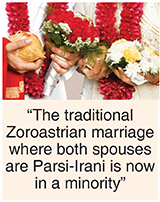 dagli makers in Bombay who take measurements by email and on Facetime are much in demand,” noted Mistry.
Sapats and topis can be purchased online at FEZANA’s Zoroastrian Shop (on the FEZANA website www.fezana.org). Pugrees and phetos may occasionally be borrowed from family or friends but new ones need to be ordered from Bombay. Saris can be purchased from Indian shops in all major cities in USA and Canada or bought from India. "After the ceremony, a few couples may change into the western attire,” noted Patel. "Most non-Zoroastrian spouses also wear our traditional garments,” wrote Minocherhomjee.
In Singapore too, Ghadiali has noticed that "the non-Zoroastrian spouse has usually been very respectful and dressed in traditional Parsi wear.” In Australia, while some wear the traditional outfits, other grooms may opt for the western attire or brides may wear lehengas or salwars.
Prayers and preparations
The onus of teaching prayers to the initiate lies mainly with the family. The efforts of parents and grandparents are frequently supplemented by the local priests, pre-recorded tapes, books, Sunday School classes, where available, and now made accessible online.
"Audio files created by me are available on
www.avesta.org,” reported Soli Dastur. According to Rivetna, the NAMC website,
www.namcmobeds.org/links/ also gives the text and recitation of the basic prayers and there are recently released books for children like My First Zoroastrian Prayer Book authored by her son Jamshed Rivetna that are gaining in popularity. In many cases the non-Zarathushti mother teaches the prayers. "I know of at least two Gujarati ladies taking the responsibility for preparing the children. This is a very encouraging trend,” remarked Patel.
Last year, one 11-year-old Iranian girl attending religion classes at the California Zoroastrian Center chose to be initiated on an open farm belonging to her paternal grandfather in rural British Columbia. When it was time to tie the kusti, it was the girl herself and not some family member who presented the sacred thread to the Iranian mobed who was officiating. Gandhi found "a great significance in that gesture… It struck me as the very fundamental aspect of the Zoroastrian faith — freedom to practice one’s own faith.”
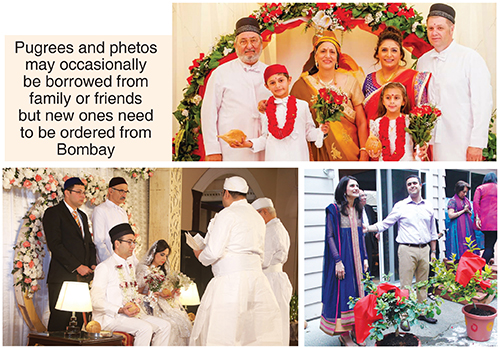
Top: initiates with their family in Australia; above l: wedding in Pakistan; r: at a madavsaro in the US
Decor for celebrations in the US
In London, many parents opt to send their children for the prayer class conducted by Bhadha. Recently ZTFE has also introduced classes by Skype "for those who have difficulty coming to the Zoroastrian Centre.” Skype permits video and voice chats at a very nominal rate.
"I provide a CD with navjote prayers for practice,” stated Katrak.
Wedding blessing
If both the partners are Parsis, the parents usually convince the couple to opt for a ceremonial wedding. Even in the case of mixed marriages, with the community having become "more inclusive,” some form of Zoroastrian blessing is included. The pre-nuptial Parsi customs like the madavsaro and the adarni are only observed in areas where there are seniors who are familiar with these rituals.
In Australia, the couple opts for "a ceremonial wedding in addition to a civil marriage. Two of our mobeds are registered ‘religious celebrants’ and can sign the wedding papers. For a full ashirwad ceremony we generally have two priests. For a wedding tandorasti alone, we may have one or two priests,” stated Katrak. Pestonji stated that most Australian cities where Zoroastrians have settled have six or more trained ervads so usually the wedding prayers are done by a pair although the navjote initiation may be done by a single priest.
Hong Kong has one full-time priest and a few others who assist when requested. If the girl marries out of the faith, the priest will recite the tandorasti on request but will not perform the ashirwad prayer as it is against his beliefs, said Master. He further explained that they have a choice of either going to the marriage registry or engaging a qualified celebrant who can perform the exchange of vows (according to legal prescription) anywhere in Hong Kong. If you are marrying in Hong Kong, you have to post the intention of marriage at the registry one month prior to the wedding. If opting for a destination wedding, it depends on the locale; the wedding planner being expected to organize the formalities.
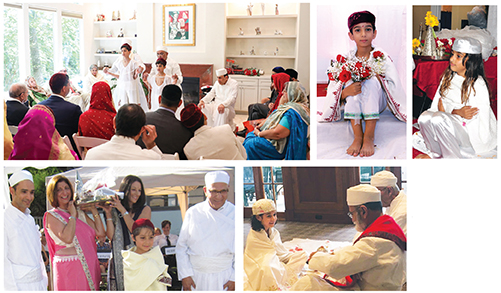
Clockwise from above l: navjote at one’s home in the US; new initiate in Pakistan;
awaiting investiture in the US; a navjote in Australia performed by Ervad Peshotan Katrak;
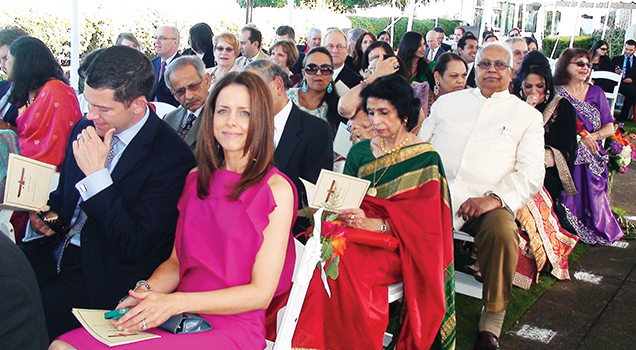
traditional ses carried to the venue in Canada; bottom: wedding congregation in the US
In the UK, the number of priests participating in a navjote is an odd number and has at least one more than the number of children to be initiated, stated Bhadha. Usually two priests officiate at a wedding of two Zoroastrians, one from the bride’s side and one from the groom’s, with one of them explaining the rituals and prayers in English to the gathering.
The venue selected should be authorized to host marriages in London. In addition to the religious ceremony, the registrar conducts the civil ceremony in England and Wales by either coming to the venue or the couple goes to the registrar’s office. In London, the Zartoshty Brothers Hall at the Zoroastrian Centre is very popular for navjotes. A civil marriage can be held at the Zoroastrian Centre provided it is immediately followed by the ashirwad ceremony, clarified Avari, adding, "The ZTFE has their own marriage registrars affiliated to the London Borough of Harrow, previously to the London Borough of Camden. Marriages can be registered at a hotel or other venue provided the hotel and the room in which the ceremony is being held is licensed to do so with a licensed local council registrar.” "Having a properly documented civil ceremony is always advisable for purposes of passports, residence, children’s passports, etc,” explained Mistry.
Generally, families in North America like to carry on the traditions with most following "the instructions in the book Parsi Weddings, Navjote and other Traditions by Roshan Bharucha (my sister-in-law),” said Dolly Dastoor adding, "But all the ingredients we use in India may not be available here, so we adapt and compromise. Performing all the ceremonies depends a lot on how familiar the family is with traditions and what they want to follow.” There is no waiting period for couples in Quebec. Further, "Our priests are registered with the ministry hence our couples do not have to go to a registrar’s office,” she explained.
"Please refer to them as mobed and not priest” as priests are generally associated with Christianity, recommended Soli Dastur who mentioned that usually one mobed officiates at a ceremony and the couple usually goes to the local municipal office to get the official marriage licence.
Whilst it would be preferable to have two mobeds, "one could theoretically perform the wedding ceremony if the cost of transportation and other expenses of mobeds are prohibitive or non-affordable,” stated Minocherhomjee. For a registered marriage, he clarified that "anyone, not only a mobed, could get a licence, perform a wedding ceremony anywhere at any venue. There are no residency requirements but time requirements for marriage. However a marriage to a US immigrant/citizen by a non-resident does not automatically entitle the non-resident to stay in the US.” In Texas, a license wait time is 72 hours. The marriage "needs to be solemnized by an authorized person and these days anybody and everybody can get a license over the internet,” commented Rustomji.
The three steps to get a marriage recognized in the US were delineated by Rivetna: obtain a marriage license from the local county office (similar to the registrar’s office in India); have the wedding performed by a duly ordained priest for a traditional ceremony or by a judge or licensed officiant for a civil ceremony (this can be in the county or registrar’s office, at home, in a hall or temple or any-where); get a marriage certificate from the local county/registrar’s office. A civil marriage is not required if a traditional ceremony is performed.
"One major (positive) difference between ceremonies in India and North America is that here guests show up and are seated in place before the ceremony starts. Noticed that in India, guests arrive after the ceremony is over; just in time for dinner!” pointed out Rivetna.
Festive feasting
The number of guests at a navjote or wedding would depend on the amount the hosts want to spend and the number of family and friends living in their proximity. The venue could be one’s home, dar-e-meher premises or hotels. Whilst the professional services of a photographer, disc jockey and a florist are generally engaged, a conscious effort is made to curb extravagance.
In the US the guest list is usually in the range of 100 to 400. The dar-e-meher premises are the favored venue for those living in cities like New York, Chicago, Houston, Dallas, Los Angeles and Toronto that have large community halls. Whilst some enthusiastic hosts have tried setting up a shamiana on the dar-e-meher grounds and organizing paat like sittings for the lagan nu bhonu catered by Parsis, due to the additional hassles of arranging for the tables and chairs, table linen, stage decorations, centerpieces, flowers, many prefer the convenience of large hotels like the Marriott or Hyatt where American food like steak/salmon/pasta/chicken are usually on offer.
"In Chicago we often opt for an Indian banquet hall where their cooks have now learned to make basic Parsi dishes like pulao dal, sali gosht, patra ni machhi, lagan nu custard and more. A Persian restaurant could offer berry pullav, geymeh, bademjan, fessenjan, lamb/beef/chicken kababs… In Chicago and neighboring areas, I help out with flowers – hars, torans, bouquets, stage decorations, centerpieces, etc but I must say our flower arrangements cannot be compared with the extravagant and exquisite fresh flower decorations we see in India,” added Rivetna.
The cost of a navjote or wedding with food, entertainment, etc for about 300 people could run into USD 30,000 or more. For a registered marriage (known as civil marriage in the US), the paperwork and licence would cost about USD 100 and the officiant might charge USD 150 to 250.
"A few western traditions have become a part of our wedding traditions… Couples nowadays get engaged after western style proposals. Bridal showers and bachelor/bachelorette parties are also common. Speeches and toasts to the bride and groom are common as is the tradition of the bridal bouquet toss,” summed up Gandhi.
"Recently weddings and navjotes have been held at homes with a limited number of guests,” Rustomji cited the instance of her daughter choosing to have her two sons navjoted at Rustomji’s residence after which South American cuisine was served. Home navjotes have a guest list of around 80 and entail an expenditure of around USD 20,000 in contrast to hotel weddings and navjotes that see around 300 guests and can cost USD 50,000 for a ceremonial wedding. For a registered marriage, USD 81 is the cost of a licence, Rustomji gave the break-up. Professional fees for florists and musicians are in the region of USD 2,000 in Houston. "And nowadays I see four-day ceremonies laced with mehendi and sangeet nights as well,” added Rustomji.
The services of a professional florist are used only for the garlands and bouquets. "We do not go overboard with floral decorations as in India. We generally make the torans ourselves. Many hotels would recommend DJs,” stated Dolly Dastoor. Whilst photographers and videographers are hired, "now many families take their own photos and videos.” The cost of a navjote or ceremonial wedding would be upwards of CAD 5,000, is her experience.
"On an average you would have to assume USD 75 to 100 per person” for a function in a hotel, mentioned Minocherhomjee. For those opting for Zoroastrian centers, the cost of renting the hall would be in the region of USD 500 to which would be added the cost of food, flowers and other variable expenses. Since the meal cost would vary between USD 75 to 150 per head for a fancy big wedding, Rivetna noted that pehramni or the cash gift would be about USD 100 to 150 to the couple and USD 100 to the parents.
The pehramni is determined by how well one knows the host family. In most cases "the bellwether amount of the gift would be USD 150 to 250 for a family of four. The hope is that the cost of the meal will be recovered,” conveyed Patel. He recalled performing the navjote of his children in 1977 at their Staten Island home "as we were struggling financially and there was no dar-e-meher.” In the case of events at hotels, the food on offer depends on whether they permit an outside caterer. At Zarathushti centers, mostly non vegetarian Punjabli style high quality food is served.
One’s own home, a hired hall, local municipal hall or hotels could serve as a venue for celebrations in Australia. The guest count could be as low as 15 to 20 or more than 200, stated Katrak. According to him, "about a third of the wedding/navjote events are held at the AZA (Australian Zoroastrian Association) House in Sydney; the rest in restaurants or other venues. Occasionally there is Parsi food catered by a local Parsi caterer; more often, Indian or western food.” According to Pestonji, the cost of an average navjote in a hotel would work out to AUD 5,000 and more. For a wedding, in addition to the hotel the official legal requirements would cost around AUD 2,000. For a registered marriage, the cost would be around AUD 500. Professional photographers charge AUD 5,000 to 8,000, music is available for AUD 2,000 and florists charge AUD 1,000 to 4,000. For cash gifts, most guests would add 10 to 25% to the base meal cost (known from hotel websites). Some invites specify not to bring boxed gifts.
"These days young people seem to prefer specialist wedding venues which have sprung up all over the suburbs of London. These venues have ample car parking, large dining rooms and a lavish dance floor,” stated Mistry. The number of invitees is usually around 200 although it could rise to 500 for weddings. Buffets that cost around GBP 40 per head are more popular than serviced seated dinners where the cost works out to GBP 60 to 80, not counting alcoholic drinks. There are a couple of Parsi caterers. For Persian food, select Persian restaurants are popular. Often the meal is North Indian at Parsi events with a mix of western dishes. In five star hotels, the cost works out to GBP 100 to 150 per head, all inclusive. Professional florists who may charge upwards of GBP 1,000 for an evening and video photographers are invariably hired.
Cash pehramni is common in the UK and it is acceptable to print the line "no boxed gifts please” in the wedding invite. On an average the pehramni would be in the region of GBP 31 to 51 per person and is determined by the cost of the venue and the meal. Bridal showers are common in the West "where the bride is taken away locally or outside UK to a fun destination for a day or more by her female relatives and friends,” reported Avari.
Most people prefer to have the ceremony and the dinner at the same venue in Karachi. However, a few do like to have the ceremony in their homes or in the agiary with a dinner reception at a hotel. The Byram Avari family owned Beach Luxury Hotel or Avari Towers are popular venues for navjote/wedding celebrations in Karachi. The other alternative is the Karachi Parsi Institute that is favored on account of its food and location. If the function is held at one’s residence, the guest list could be restricted to 100+. The average though is 300 and a large attendance would go up to around 700.
On an average, a navjote would cost upwards of PKR 1,000,000 and for a wedding, upwards of PKR 1,500,000. Most like to get the stage and hall decorated with flowers and lights by a professional. There is invariably a DJ in attendance as children and adults like to dance. Sometimes giveaways are presented to guests. Pareekas generally cover the cost of the food. Bridal showers are gaining in popularity. Usually the meals have a Parsi flavor although sometimes barbeque and Continental items are also included. The average cost of food per head is PKR 2,500. Photographers charge PKR 20,000, music is available for PKR 15,000 and flowers for PKR 2,00,000.
After the wedding, the priests and the Anjuman assist the couple in getting a marriage certificate. The marriage certificate signed by the couple and the witnesses is first entered in the Anjuman register and subsequently a copy is sent to the Cantonment Board or the Karachi Municipal Corporation (depending on the area where the marriage took place) for the government authorized marriage certificate. There are no civil marriages in Pakistan. Those opting for an interfaith marriage have to go abroad if they desire a civil marriage.
In Hong Kong, the Zoroastrian Building premises or clubs, hotels and other venues that serve a western or Asian meal are chosen as venues for the function. If held at the Zoroastrian Building, the community staff will prepare a traditional Parsi wedding meal or a combination of Parsi/Iranian/Asian/western cuisine. The guest list may range from 100 to 500 invitees, depending on the host family, stated Shroff.
Destination weddings with a guest list of 100 to 200 are gaining in popularity with the couple deciding whom to invite and the parents footing the bill, Master offered insights. The amount incurred on a celebration and the hiring of a florist, music provider and photographer depends on "how much you want to spend. You can do it on the cheap and you can also blow a huge hole in your bank account,” he added. For premium locations, bookings need to be done a year in advance if a particular date is required, cautioned Shroff.
More than jewelry gifting, common now are bridal showers. Some couples indicate they don’t want any gifts or specifically no boxed gifts. Gaining in popularity is a gift registry listing objects that the couple appreciates so that guests can go the designated shop and select items that fall within their budget.
The venue for a celebration in Singapore could be an individual’s home, a hotel or a destination resort. The food on offer is usually Parsi home cooked food if the event is at one’s home or Indian or continental food if on a grander scale. For a navjote the invitees usually number around 100 and the cost would work out to SGD 7,000 to 8,000. For a wedding with 200 to 250 guests, the cost would be in the region of SGD 15,000 to 18,000. The services of a professional florist, photographer, videographer, disc jockey are usually availed of when the event is celebrated at a hotel. A registered marriage with no ceremony or dinner works out to SGD 2,000, revealed Ghadiali. Gifts are typically in cash although the family may additionally gift jewelry to the initiate/couple.
Permissive yet conservative
Community elders may take upon themselves the responsibility of trying to find Parsi spouses for the youth by encouraging them to attend local association functions, participate in youth congresses and Return to Roots program, advertising in the media. FEZANA is now proposing to go high tech by offering a matrimonial app or website under its aegis. Nevertheless, interfaith marital unions continue to be on the rise. Gay couples are gaining acceptance. There are not many instances known of couples living together before marriage in the US, Hong Kong, Singapore and Pakistan.
In the UK, "living together or co-habitation is now the norm. Young people want to get to know each other very well before they make a lifelong commitment,” stated Mistry. "The community has moved on. We are respectful and tolerant,” confirmed Mistry referring to the existence of gay couples although gay marriage celebrations are not common. "We do not discriminate or judge people on their personal preferences and believe that personal lives should remain personal,” attested Avari and Bhadha.
Whilst gay marriages among Zoroastrians are not known of in Australia, many couples live together before marriage to the discomfort of the older generation that is learning "not to judge others.” Interfaith marriages account for almost 50% of the total, stated Pestonji.
As it is difficult to find "suitable partners within the community,” interfaith marriages are on the rise in Pakistan and families accept them and even celebrate the wedding as long as the partner comes from a decent, educated, liberal family. A live-in relationship, though, "is still frowned upon.”
There are nearly 30% of interfaith marriages in Singapore but no known instances of couples living together without getting married. Likewise the conservative community in Hong Kong does not have couples living together before marriage nor instances of gay marriage.
Patel presumes that live-in relationships and gay marriages must be prevalent but being liberal he believes in the maxim "Who am I to judge?” According to Dolly Dastoor, live-in partners "eventually do get married. Same sex couples living together in our community in Quebec are generally accepted,” she mentioned. In Houston, there are no instances of couples living together instead of getting married. The one gay couple in their midst has gained acceptance. Rivetna too confirmed "the few instances of civil marriages of gay couples. They are well accepted.”
Whilst Minocherhomjee has not performed an ashirwad ceremony for a gay couple, he believes "acceptance is generally good for such couples.” He further remarked, "I do not know what most Parsi couples do in North America as we do not live in a colony!”
According to Minocherhomjee’s estimate, more than 50% of marriages are interfaith. "North American men/women are typically not shy! They have to just find the right Zarathushti partner.”
Meaningful marriage
Whilst the essence of the Zoroastrian prayers may be similar, the marriage rituals among Zoroastrians in Iran are different from the practices prevalent among Parsis. The symbolism of different objects included in the ceremony, the significant message imparted by the priest to the newlyweds and the stress on increasing one’s charitable deeds after marriage are explained in detail in "Zarthushti Marriage Ceremony as performed in Iran” by Mobed Mehraban Firouzgary, the venerated priest of Iran. Parsiana reprints edited excerpts from this presentation:
The wedding ritual among Zoroastrians in Iran starts with the mother of the bride being requested by the groom’s mother to go on the stage and drape her future son-in-law with a green shawl over his right shoulder and place the green prayer cap on his head; a confirmation of her family’s approval. This shawl and cap are preserved and used when going on pilgrimage or for very special occasions. As per the Iranian culture, a husband is the Nmanoo Paiti or the lord of the house and the wife, the Nmanoo Patni, the queen and hence the mother-in-law is believed to be symbolically coronating a king.
At the wedding ceremony, a priest sits in front of the couple to be wed, with their respective parents on either side. The young man standing with a tray behind the couple is normally a close relative of the family and a bachelor. The tray contains symbolic items, scissor, needle and thread, an egg, the prayer book, the coiled kusti, a pomegranate and green wrapped sugar cone. Probably, a bachelor is selected, so that he too may be blessed with a partner.
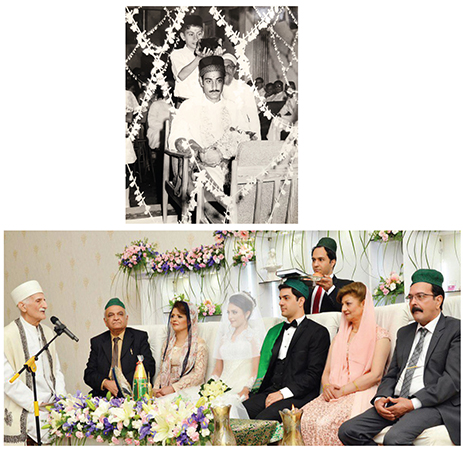
Top: Iranian wedding ritual followed in India; above, from l: Mobed Mehraban Firouzgary officiating at a wedding in Iran
Group navjote and traditional ses in Iran; r: maknaa and shawaal, traditional attire for an Iranian bride
The officiating priest asks the bride three times whether she takes the man seated next to her to be her partner in body and soul and as per the rules of the good religion of Mazdayasni. The bride, normally, says yes after the third repetition of the same question, thereby giving her ample time and opportunity to ponder upon and give a decisive commitment of fidelity until death do them apart. Then facing the groom, the priest asks him a similar question to which he gives his consent on the first asking.
After invoking the blessings of Ahura Mazda and congratulating the newly weds, the priest passes on certain religious advice: "Constantly remember and pray to Ahura Mazda. Remain steadfast to the Good Religion of Mazdayasni and to its Prophet Asho Zarathushtra. At all times follow the path of Asha and make sure to maintain the principles of good thoughts, good words and good deeds. Do not take even one step without the sudreh and kusti and make sure to adorn your children with the sudreh and kusti no sooner they grow to an age of self realization, definitely before the age of 15.
Make sure to observe and carry out all the required religious ceremonies for your dead relatives. Make sure to arrange for the best possible facilities and requirements of myazd (solid foods that are kept on prayer tables) and prayers, etc especially during the gahanbars and the Fravardian period to ensure their blessings.
Be ever grateful to your parents and equally to your teacher.
Choose one particular day of the month and every month, on that roz, try to allow more time in prayers and give more than usual in charities. Choose a wise counselor and guide (the bride and groom specify the name of their chosen counselor) to consult for important decisions or in times of difficulty.
Follow in the path of the Amesha Spentas who represent the main aspects of Ahura Mazda: The path of Vohu Manu calls for the practice of good thoughts and peace making. Acquire knowledge and practice wisdom. Be just and kind. The path of Ardibehesht calls for truth and virtue. Be clean in body and in conscience. The light emitting fire that represents love and loyalty, should be revered and never polluted. The path of Shahrevar calls for acquiring self esteem and strength of character. Do your best to acquire wealth and fame. Avoid a life of mere leisure and idleness. The path of Spandarmad calls for modesty and kindness. Be beneficial and reproductive as the Mother Earth. The path of Khordad calls for acquiring prosperity and perfection. Do not grumble or be ungrateful with what you have. Be optimistic and spread happiness. The path of Amardad calls for efforts to extend longevity and to acquire good health. In your actions try to outdo each other in kindness and good deeds. These will ensure you a happy life.
On completion of the prayers, the priest brings to their attention the philosophy and significance behind some of the items that are customarily placed on a ceremonial tray:
Scissors are formed by the joining together of two blades and will cut effectively only if the two blades move in unison. Starting from today you two are, symbolically, joined together in spirit. To successfully cut through the problems in your life all your actions and planning should be in unison. The needle and thread are normally tools for darning. Due to misunderstandings or other related problems when a slight ‘cut’ may appear in your relations, immediately use the symbolic needle and thread to darn the tear by looking at the problem with modesty and forgiveness, making use of your mutual love and affection.
The egg symbolizes an independent existence. When the parents give this egg after the wedding ceremony it indicates their faith in their children to lead their own lives whilst maintaining bonds of mutual love and respect. The prayer book and kusti is to remind you of your pledge to the Good Religion of Mazdayasni and adherence to the practice of good thoughts, words and deeds. The green wrapped sugar cone represents long lasting youth and sweet happiness. Pomegranate signifies riches and childbearing.
After the marriage ceremony when the priest steps down from the dais, unmarried girls belonging to the family bring sweets and sherbat to the six persons seated on the stage. Such assignments could also promote their chances of attracting suitors from the audience! The newly wed couple exchange several customary rites – sipping sherbat from one another’s glasses and tasting sweets from each other’s hands and much more as the joyful guests exult "Hobiro Shaad baash (Oh you, go and stay happy).” Against the background of loud music, the couple then comes down from the dais to sign a written declaration of their marriage, attested by seven other close relatives as witnesses, on a form printed with all the advice given and reiteration of their commitment to each other for a life of fidelity and self sacrifice. Soon thereafter they are taken to the adjoining fire temple where they offer their thanks and renew their pledges in front of the holy fire.
After the wedding festivities, the crowd leads the couple to their new abode. Here the relatives and friends of the bride ceremonially push off the bride or anyone from her family / friends from entering the new abode, declaring the bride is precious and is not to be given away free. They demand compensation to be placed in a big pouch that is tied around the waist. The bargaining keeps repeating until the bride is formally allowed into the house where the merriment and teasing continues and the couple is finally pushed into their bedroom.
Maknaa and shawaal, traditional bride’s clothes handed down from mother to daughter, are now replaced by the western wedding gown usually hired for the occasion. The bride wears white as it is considered a good omen and the color of a Zarthoshti. Similarly the groom’s light colored suit and shirt has been replaced by a very dark or black suit.
Although interfaith marriages are comparatively fewer in Iran, inability to find suitable spouses leads some to marry outside the faith or to remain unmarried, noted Firouzgary. If marrying a Muslim, the Zoroastrian male or female has to convert to Islam and bring up their children as Muslims. Any deviation can get them beheaded. A Muslim can always get an easy divorce by accusing the spouse of "not remaining a devoted Muslim.”