Synthetic stablility
A Tryst With Geosynthetics — Annual Lecture by Shahrokh Pallonji Bagli. Published in 2021 by Strata Geosystems (India) Pvt Ltd, Sabnam House, Plot No. A-15/16, Central Cross Road B, Behind MIDC, Andheri (East), Bombay 400093. Pp: 176. Price: Not mentioned.
On April 12, 1831, the bridge collapsed. While a detachment of 74 men were returning to their barracks in Salford, United Kingdom, by way of the bridge, the soldiers, who were marching four abreast, felt it begin to vibrate in time with their footsteps, leading to its collapse. Another episode concerns a suspension bridge over the Maine River in Angers, France, designed by Joseph Chaley and Bordillon and built between 1836 and 1839. On April 16, 1850, while a battalion of soldiers was marching across the Angers Bridge, also called the Basse-Chaîne Bridge, it collapsed, killing over 200 men. Obviously, the designers of both these bridges had no idea about the use of geosynthetics. Both these bridges had a certain low frequency of vibration, and when that frequency was duplicated by the rhythm of the marching soldiers, the bridges mysteriously collapsed.
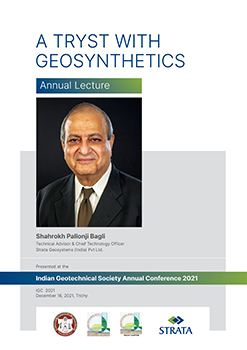 The soft cover book, A Tryst With Geosynthetics, is not really a book in the strict sense. It is a private publication brought out by the Indian Geotechnical Society, Trichy, of a lecture delivered by Shahrokh Pallonji Bagli. It has not been peer reviewed. So, I will be dealing with merely the lecture. I do not pretend to know much about the science of geosynthetics, but I am reviewing this publication from a layman’s point of view. The subject is highly technical and may not be of much interest to Parsiana readers. Nor is the book available at any book store. Nevertheless, geosynthetics is an interesting subject.
Bagli, the chief technology officer at Strata Geosystems (India) Pvt Ltd, is one of the foremost authorities in geosynthetics. He had also worked for the Shapoorji Pallonji group of companies for a period of eight years. Passing his Indian School Certificate examination from St Mary’s School, Bombay in 1965, he joined the Indian Institute of Technology (IIT) Bombay and graduated in 1971 with a BTech (Hons) in civil engineering. This he followed with a MTech degree in geotechnical engineering in 1973.
Geosynthetics are synthetic products used to stabilize terrain. They are generally polymeric products used to solve civil engineering problems. They include eight main product categories: geotextiles, geogrids, geonets, geomembranes, geosynthetic clay liners, geofoam, geocells and geocomposites. The polymeric nature of the products makes them suitable for use in the ground where high levels of durability are required. They can also be used in exposed applications. Geosynthetics are available in a wide range of forms and materials. These products have a wide range of applications and are currently used in many civil, geotechnical, transportation, geoenvironmental, hydraulic and private development applications including roads, airfields, railroads, embankments, retaining structures, reservoirs, canals, dams, erosion control, sediment control, landfill liners, landfill covers, mining, aquaculture and agriculture.
One of the most evident and easily observed uses of geosynthetics is in road surfacing. Discarded rubber tires have been recycled and used in a mixture with tar and sand to resurface roads. This provides greater grip permitting higher speeds as well as creating less sound even in heavy and fast traffic. This is not a novel practice. Materials mixed with soil have been used for thousands of years in many different parts of the world. They were used in roadway construction during the days of the Roman Empire to stabilize roadways and their edges. These early attempts were made using natural fibers, fabrics or vegetation mixed with soil to improve road quality, particularly when roads were built on unstable soil. They were also used to build steep slopes, as in the case of several pyramids in Egypt as well as walls. A fundamental problem with using natural materials (wood, cotton, etc) in a buried environment is that biodegradation occurs from microorganisms in the soil. With the advent of polymers in the middle of the 20th century, a much more stable material became available. When properly formulated, a lifetime of centuries can be predicted even in harsh environmental conditions. For example, geogrids are used to prevent sliding on long and steep slopes during installation and use of a landfill capping system.
Bagli’s publication throws light on how to make various surfaces more stable using synthetics and also to permit greater or better use of whatever the strata is utilized for. Another example of such use is in laying out of rail systems for high-speed trains as well as main highways for road transport.
The objective of any slope protection is to counter against driving forces by increasing the resisting forces. Inherent slope instability and/or erosion can be due to one or a combination of factors such as rain, percolation and seepage, surface runoff, wind, etc. Slope failures can be aggravated by soil erosion. Two basic mechanisms that are involved with soil erosion along slopes are detachment followed by transportation of the material. Conventional methods for erosion control include stone pitching, vegetative turfing, mulching, hydro seeding, jute/coir netting, revetment mats, gabions, etc.
Early papers on geosynthetics (as we know them today) in the 1960s documented their use as filters in the United States and as reinforcement in Europe. A 1977 conference in Paris brought together many of the early manufacturers and practitioners. The International Geosynthetics Society (IGS) founded in 1982 has subsequently organized a worldwide conference every four years and its numerous chapters hold additional conferences. Presently, separate geosynthetic institutes, trade groups and standards setting groups are active. Approximately 20 universities teach standalone courses on geosynthetics and almost all include the subject in geotechnical, geoenvironmental and hydraulic engineering courses. Geosynthetics are available worldwide and the activity is robust and steadily growing.
Bagli has covered the subject of geosynthetics extensively in this publication. In the beginning he was casually curious about the study of synthetics but he became obsessed with it over the last decade as is evident in his lecture. I recommend this publication to all architects, engineers and others who are in the construction industry and engaged in major civil engineering works.
Dr ARDESHIR B. DAMANIA
Dr Ardeshir B. Damania is Associate Research Geneticist at the University of California, Davis, USA.