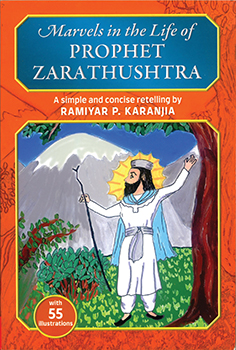
Marvels in the Life of Prophet Zarathushtra: A simple and concise retelling by Ramiyar P. Karanjia. Published in 2020 by Shree Book Centre, 8, Kakad Industrial Estate, S. Keer Marg, Off L. J. Road, Matunga (W), Bombay 400016; website: www.shreebookcentre.com; email: sales@shreebookcentre.com. Pp: 300. Price: Rs 399.
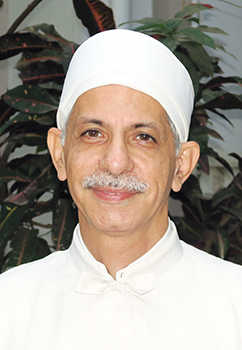
The learned and erudite Ervad (Dr) Ramiyar Karanjia (pictured) is well known for his scholarship. This book reveals him as a lucid writer too. Like Alice in Wonderland, this book, though ostensibly addressing children, will fascinate adults as well.
Most Parsis know Good Friday to be the day on which Jesus was crucified; few instantly connect Zarthost no diso to be the day on which the prophet attained transition from this world. Karanjia’s book provides the much needed connect with our prophet.
 Apart from recounting the life and times of Zarathushtra in simple conversational style, the book introduces some occult interpretations. Contrary to popular belief that a Turanian soldier called Tur-bara-Tur assassinated the prophet while he was praying in a fire temple, the author expounds another theory that neither Satan nor any mortal was capable of harming an exalted divine being like Zarathushtra and, therefore, Tur-bara-Tur was nothing but an accumulated evil force which the prophet dissipated by releasing the life force from his physical body.
Similarly, after narrating the much told tale of how the prophet cured the stricken black stallion of King Gushtasp by intoning Avestan mantras, Karanjia explains that the story of Aspe-siha is said to have a deeper meaning. "Aspe-siha” means black horse. Mystically, a horse represents the mind. A black horse indicates a mind which has been corrupted and shrouded by lies. The King’s mind had been poisoned and corrupted by wicked courtiers, and the prophet cleansed it with the power of prayers.
The author endorses the view that the cabinet of the creator, Ahura Mazda, his six Ameshaspands and 23 Yazads worked hard to prepare a suitable physical vehicle to hold the all-powerful spiritual energy of Zarathushtra who was himself a divine being (Yazad) consenting to incarnate as man for the welfare of humanity. This is similar to occult Christianity which asserts that the body of Jesus had to be prepared for 30 years to receive the Christ Force (Christos) within.
Similarly, Karanjia’s explanation about how the creator could himself be an Ameshaspand like the other six is equally fascinating: "Zarathushtra, looking a bit confused, asked, ‘Is Ahura Mazda an Ameshaspand or not?’ ‘The answer to your question is, yes and no,’ chuckled Sarosh Yazad. ‘I do not understand,’ retorted Zarathushtra, a bit perplexed. ‘Let me explain it to you,’ said Sarosh Yazad patiently. ‘Ahura Mazda, as God, is the creator, father and preceptor of the other six Ameshaspands. In this way, He is above and beyond the Ameshaspands. However, in the administration of the material world, He has taken the responsibility of looking after the creation of human beings himself. So, in that sense, He is considered an Ameshaspand though not named as one.’”
 There are sufficient hints in the book that Zoroastrianism believes in reincarnation. While traditional scholars assert that ours is a religion of the Book [like Christianity (Bible); Islam (Koran)] and therefore there is a day of judgment when all souls will be collectively resurrected, the Khshnoomists and others strongly assert that it is impossible to explain any cosmology without the twin principles of karma and reincarnation. The author seems to support the latter view.
The coming of another savior, Adarbad Mahraspand (who composed most of the Khordeh Avesta), was foretold. Khordad Ameshaspand said, "Many years into the future, long after you are gone from this material world, when the religion will fall on bad times, a learned priest, Adarbad Mahraspand by name, shall come. He will regain the faith of the people in the Mazdayasni Zoroastrian religion by pouring over himself molten brass without any harm coming to his body. By this, men will get back their faith in the Zoroastrian religion. They shall draw back from wicked paths, and shall follow the right way.”
Of course, there are a few controversial statements in the book. "In hell,” were also found the souls of people who wilfully chose not to have children and family in "earthly life.” If the author is right, many Parsis who have chosen to remain single and/or not have children, are doomed to fire and brimstone.
Karanjia portrays the prophet as monogamous; though even orthodox scholars like Dr Mary Boyce have concluded that he had three wives from whom he begot six children, with the juniormost wife, Havovi, remaining childless, as cited in Dr Firoze Kotwal’s volume. However, the author states that the prophet had six children, all from Havovi!
Does Zoroastrianism preach vegetarianism, as Parsi Theosophists and Khshnoomists claim? The author quotes the following dialog between Zoroaster and Bahman Ameshaspand: "I look after the good, beneficent animals, especially cattle. I also look after domesticated and tame animals, and the birds and the fish. I, in my position as the guardian of the good animals, command you, O Zarathushtra, to save these animals from harm and persecution. Look after them in a nice manner and ask the people of the world to do the same.”
"I will surely do that,” said Zarathushtra. "I have been protecting and taking care of these dumb and innocent creatures right since I was a child.”
Zarathushtra himself composed the five Gathas, which contain the most potent Avestan mantras including the earthly memory obliterating geh sarna (funeral) prayers included in the Ahunavad Gatha.
"The Gathas,” asserts the author, "constitute 17 beautiful metaphysical poems divided into five groups, on the basis of their meter.” This is reinforced by another Avestan scholar, Supreme Court Justice Rohinton Nariman, who submits that the Gathas have to be "sung” like hymns or psalms.
Karanjia’s book contains some nuggets of spiritual interest about the Nasks, as explained in the following extract: "These are the 21 Nasks (volumes) of the Avesta,” said Zarathushtra, pointing towards the stacks. "Everything that is to be known in the world is contained in it. There is not a single thing in the world that is not in the Avesta. It contains all the knowledge of the world.”
"What are these Nasks called?” inquired the king.
"Each Nask has its own name, but each Nask is also associated with one of the 21 words of the Ahunavar. So each word of Ahunavar prayers is the name of the Nasks,” clarified Zarathushtra.
Thus, the Ahunavar (Yatha Ahu Vairyo) mantra is so powerful, says Karanjia, that even Satan himself (Ahriman) experienced "tremendous heat and felt as if he was being melted” when the prophet unleashed the full power of the Ahunavar upon the fallen angel.
Much earlier than the other great prophets, Zarathushtra emphasizes the principles of charity, humility and non-violence ("except when confronting evil”).
Miracles enthuse believers: whether it is Mobed Nairyosang Dhaval stunning the Hindu King by making the holy fire (Adar Burzin Meher) descend from the heavens in broad daylight onto the fire vase (the Iranshah) or Adarbad Mahraspand pouring molten metal on his bare chest and emerging unscathed. Like Jesus, Zarathushtra walks on water, temporarily turns his body into a bridge over a river, and mesmerizes the court of King Vishtasp by making a blazing fire sit on his palm. "It is a spiritually burning fire, which does not give out heat. It neither needs fuel nor gives out smoke,” said Zarathushtra.
Karanjia’s prophet expounds: "When I had a conference with Ardibehesht Ameshaspand, he had promised me that he would send it to me when the time is right. Now I feel it is the opportune time for this fourth and the last of the spiritual fires to come to this world. These spiritual fires are sent to specially assist a person for some grand work, and now that the most important part of my work is about to start, it has come to assist me.”
The author alludes to astral travel and the hierarchy of souls when the prophet presents consecrated wine to King Gushtasp whose astral body then starts "floating towards the spiritual realms.” Upon entering heaven, he saw the place where the righteous souls would dwell. He was told that, as per his life up to that time, he too would be assured a place there. He also saw the different divine beings housed in mansions based on their ranks and hierarchy.
Similarly, the prophet bestows on Jamaspa the gift of foretelling the future. The Zoroastrian Nostradamus, who penned the book of revelations called the Jamaspi, became the immediate spiritual successor to the prophet after the latter’s transition from this world.
The many illustrations by Katie Bagli will excite the young. Karanjia is an excellent story teller. He must use his skills to tell our community many more stories about our dazzling heritage to rekindle interest for the faith in the indifferent. The book is a highly recommended read for every Parsi, young or old.
BERJIS DESAI
Desai is a lawyer in private practice and a part-time writer.