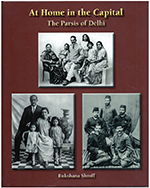
At Home in the Capital: The Parsis of Delhi by Rukshana Shroff. Published in 2025 by the author in association with Parzor at E 22A, East of Kailash, New Delhi 110065. Pp: 387. Price: Rs 2,000.
Although Parsis settled in Delhi on a permanent basis only after the British had defeated the Mughals in the mid-19th and early 20th centuries, some had engaged with the Mughals and visited Agra and Delhi, even receiving titles and grants of land from them. However, it was Meherji Rana’s meeting with Emperor Akbar at Fatehpur Sikri that brought the community pan-Indian notice. He was bestowed the title of High Priest and presented with a jagir (land grant), a document which is housed in the First Dastoor Meherjirana Library at Navsari.
Rukshana Shroff’s At Home in the Capital is a significant addition to the literature on the Parsis. The compilation encapsulates those Parsis who lived in Delhi and even those who had later shifted elsewhere (the floating population). The blurb of the book reveals that the Delhi Parsis never numbered more than 800 at any point of time. (They now number around 500.)
The book is structured chronologically into four sections: Delhi from 1803-1911, Delhi as the Imperial Capital, 1911-1947; Delhi as the capital of independent India, 1947-1990; and Delhi after the creation of the National Capital Region 1990 onwards. The opening chapter of each section gives a brief synopsis of the historical and socio-political events of the time. The reader encounters an amazing variety of personalities as the author takes us on an entertaining rollercoaster ride.
Even as the book focuses on the lives and achievements of the Parsis of Delhi, it also provides an overview of the changes that have taken place in the city since the 19th century. This gives context to the narration that follows and the author deserves to be congratulated for showing how the settlement pattern was influenced by the social, political and economic changes that took place in Delhi.
Nowrosji Kapadia (seated, center) flanked by Dr Sorabji Shroff and
Hormusji Setna, Pesi Bhumgara (standing behind Nowrosji) with
Ruttonshaw Sorabji to his l.
Photo courtesy: Farrokh Kapadia
Above, from l: Dinshaw Challa (center, in dark dagla) at foundation
stone laying of Dharamshala block in 1950;
Rustom Sidhwa, Parsi member of the first cabinet in independent
India on March 21, 1952 at foundation stone ceremony of Bhiwandiwalla Hall
Photo courtesy: Soli Variava; inset: plaque
Top: Dadi Muncherji and family with others outside Singer Sewing Company
Photo courtesy: Soli Variava;
Above: unveiling of Madame Bhikaiji Cama’s portrait by Dr Shankar Dayal Sharma,
with Rajiv Gandhi and Homi Taleyarkhan (4th and 5th from l)
There are brief references to Parsis in the official records and histories of Delhi. Parsi traders were present in the city at least by 1857 with liquor being supplied to the British army by Parsi merchants. Col Sir Gordon Risley Hearn, who was one of the most accomplished railway engineers in India, describing the siege of Delhi observed, "The rigors of campaigning during the siege of Delhi were alleviated by the arrival of Parsi merchants with 2,000 bottles of beer.” Other historians note that in 1858 Parsi shops were stocked with champagne and French wine with the poet Ghalib bemoaning the fact that he could not afford to buy the expensive French liquor on offer.
A Gazetteer of Delhi of 1912 reveals that the Parsi population had increased from 27 to 74 between1881 and 1911, doubling in the last decade, 1901-1911. Official records of the Delhi Parsi Anjuman (DPA) refer to Nowrosji Kapadia as the earliest Parsi resident. Hailing from Bharuch, Kapadia decided not to join the family’s cloth business and worked as an agent for Ralli Brothers, a European trading company. He moved to Delhi in 1880 and was the first president of the DPA (1925-44). His great-grandson, Novy, taught English at Delhi University for many years and was a famous sports journalist. (In fact four generations of Kapadias taught at Delhi University.)
When Delhi was declared the capital in 1911, a number of Parsis decided to go there to better their prospects, including ophthalmologist Dr Sorabji Shroff (1878-1964) who set up practice in 1913. Moved by the plight of indigent patients he established a charity hospital, which evolved into Dr Shroff’s Charity Eye Hospital, becoming fully operational in 1927 in Daryaganj. His son Dr Minoo was a worthy successor and now the Hospital is in the safe hands of his sons, Drs Noshir and Cyrus and their sons Drs Daraius and Rushad. Other doctors included Drs K. S. Sethna and Rustom Kapadia, son of Nowrosji.
Jamshedji F. Madan (1857-1923), a businessman from Calcutta, owned shops and cinema houses which provided employment for many Parsis. Later, when Connaught Place developed, the Parsis owned and managed cinema halls such as Novelty and Minerva. Plaza was owned by Sohrab Modi’s company Minerva Movietone and became an important meeting place for Parsis.
Between 1911 and 1930s when New Delhi, and particularly Connaught Place was being developed, the initial center of the new capital was the area around Kashmere Gate which included the Civil Lines. During this period several Parsis began to live in this area and Chandni Chowk or near the railway station. Later with the emergence of Connaught Place as the new commercial and residential center many Parsis moved there.
As the railways expanded, the community supplied many guards and drivers because the British found it increasingly difficult to source English railway staff. Ruttonshaw Sorabji was the first Parsi to be appointed the Delhi station master. And if the Parsis of Delhi enjoyed crisp OK wafers and fresh fish at the Anjuman’s Navroz dinners they had the engine drivers, guards and dining room managers to thank. Sorabji resigned from the railways and went into partnership with Lala Bhagirathmal importing woollen and electrical goods from Europe. Little did I know when I was a resident of Delhi that the famous Bhagirath Palace in Chandni Chowk started off with one half belonging to a former railway employee.
Homai and Maneckshaw Vyarawalla
Photo courtesy: HV Archive/The Alkazi Collection of Photography
Above from l: Lt Gen Adi Sethna, Pandit Ravi Shankar, Indira Gandhi,
Maj Gen Narindar Singh, Buta Singh, Khorshed Sethna Photo courtesy: Sethna family;
Piloo Jungalwalla inaugurating the Dr Nowshir Jungalwalla Room with Adi Sethna,
Dadi Mistry, Sohrabji Godrej and Jamshed Guzder (2nd to 5th from l)
When the need for residential accommodation for Parsi visitors to the new capital increased, Apollo Hotel, the Sorabji guest house, the Mody guest house and the Mehta guest house supplied the deficiency. The Apollo Hotel, which was bought by Rustomji Patel from the British, changed hands a few times before it was ultimately bought and managed by Phirozeshah and Banoobai Variava. It was famous for its billiards table; their son Soli learnt billiards at the age of five, standing on a stool. When the Variavas moved out of Apollo Hotel the table was shifted to Bhiwandiwalla Hall in the DPA complex. The Mehta guest house was started by Merwanji and Sherinbai Mehta, and one of their guests, Burjor Italia ended up marrying their daughter Khorshed. Khorshed Italia the "Grand Old Lady of Connaught Place” lived there from 1936 till her death in 2010. Shernaz Italia, her daughter, recalls how there was no water or electricity when her grandparents moved there in 1936.
Sir Nowshirwanji Engineer became advocate general of the Federal Court in 1945 and in that capacity was chief prosecutor of Subhas Chandra Bose’s three associates from the Indian National Army. Perhaps this is why he was overlooked for the post of attorney general when India became a republic in 1950. India has had two Parsi Chief Justices of the Supreme Court: Sam Bharucha and Sarosh Kapadia. Other jurists include sitting Justice Jamshed Pardiwala and before him Justice Dinshah Madon and Justice Rohinton Nariman who retired in 2021, legal luminaries Fali Nariman (Rohinton’s father), Soli Sorabjee, Tehmtan Andhyarujina, Jimmy Dadachanji and Rustom Gae who was law secretary.
Author Rukshana Shroff
Senior civil servants included Shavax Lal and Jamshed Kapadia (father of journalist Coomi Kapoor and Roxna Swamy, wife of Indian politician Dr Subramanian Swamy), Yezdi Gundevia and Burjor Paymaster. After independence came Kershasp Satarawala, and Bomi Jal Heerjee in the Indian Administrative Service and Soonu Kochar (née Kapadia) the first Parsi woman in the Indian Foreign Service. The police department was represented by, among others, Khusro Rustamji, doyen of Indian policemen (who remains the only police officer to be awarded India’s second highest civilian award, the Padma Vibhushan), Minoo Dittia, followed by the two Kekis, Keki Dadabhoy and Keki Daruwalla. Daruwalla was perhaps more famous as a poet and was a member of the National Commission for Minorities (NCM). In the public sector the brightest star was Russi Billimoria who was chairman of the Steel Authority of India Limited (SAIL), chairman of Indian Airlines and the Public Enterprises Selection Bureau (PESB). His wife Frenny, a social worker, is deeply interested in the pictorial and plastic arts apart from authoring two books on cookery.
The armed forces had Field Marshal Sam Manekshaw heading the list. Lt Gen (Dr) K. S. Master was the first director general of the Armed Forces Medical Service. The lieutenant generals include Jehangir Sataravala, Adi Sethna and Faridoon Bilimoria. Among the major generals, Cyrus Pithawalla received the Ashok Chakra, India’s highest award for gallantry during peacetime in 1981. There have been two Parsi chiefs of air staff: Air Marshals Aspy Engineer and Fali Major. Air Marshal Edul Dhatigara was vice chief of air staff. Other Air Marshals include Minoo Engineer, Minoo Dotiwalla and Adi Ghandhi. Manekshaw’s brother Air Vice Marshal Jemi Manekshaw pioneered aviation medicine in India. His wife Bhicoo Manekshaw was a culinary expert and the first Indian to complete the advance certificate course of the Cordon Bleu School of Cookery, London.
The Indian Navy was represented among others by Admiral Jal Cursetji, the first and only Parsi chief of naval staff. He was also vice president of the DPA (1960-61). Vice Admiral Rustom Contractor rose to become director general of the Indian Coast Guard and Vice Admiral Rustom Ghandhi has the distinction of commanding both the Western and Eastern Fleets of the Indian Navy.
There were Parsis in the constituent assembly of India: Sir Homi Mody, Minoo Masani and RustomSidhwa. The last named became minister of state for Home and in that capacity laid the foundation stone for Bhiwandiwalla Hall. Cooverji Bhabha was part of the interim government in 1946 and after independence joined the cabinet as independent India’s first commerce minister. Later Piloo Mody, Feroze Gandhi, Naushir Bharucha and Homi Daji all became members of Parliament. Homi Taleyarkhan was a minister in the Maharashtra cabinet and also served as governor of Sikkim.
Among scientists the most famous was eminent geologist Darashah Wadia Fellow of the Royal Society, who was appointed scientific officer in the Geological Survey of India and in 1945 was mineral adviser to the central government. He interacted closely with Dr Homi Bhabha as a member of the Rare Minerals Survey Unit of the Atomic Energy Commission of which Bhabha was chairman. Wadia’s work on the Himalayas was path-breaking and definitive and his Geology of India is a classic read by students to this day.
DPA arising
The DPA formally came into existence in 1925 with Nowrosji Kapadia as president, Hormusji Setna as vice president and Ardeshir Devitre as secretary. It became a society in 1941 and in 1959 was registered as the Delhi Parsi Anjuman Trust. By 1925 the Delhi aramgah was nearly full and a new plot was allotted at the present location on Prithviraj Road in 1929 thanks to the efforts of Dr K. S. Sethna. In recognition of the contributions of Nowrosji to the community it was called Navroze Bagh.
In 1944 Nowrosji passed on the baton to Dr S. P. Shroff. In the early 1940s the Apollo Hotel in Connaught Place became the venue for DPA meetings and Plaza Cinema and the Plaza Building became places where community functions were celebrated.
Land for the agiary and dharamshala on Mathura Road (now Bahadur Shah Zafar Marg) was obtained in 1949 thanks to the efforts of veteran lawyer and politician Maneckji Dadabhoy who used his clout with the government to obtain the lease. (It was leased in perpetuity in 1959.) The dharamshala was built with generous donations from Manchersha Billimoria, Sir Cowasji Jehangir and Dinshaw Challa. It was named Mengusi Parsi Dharamshala in memory of Manchersha Billimoria’s wife Gulbai Manchersha Mengusi.
But one mystery remains. The money for the eponymous hall where we attended innumerable functions at the dharamshala complex was donated by one Ardeshir Bhiwandiwalla; sadly, the author does not tell us who he was and what he did. He was obviously a man of some means, possibly a successful businessman, but she gives us no details. It was inaugurated on March 21, 1954 and, as noted earlier, the famous billiards table from Apollo Hotel found a new home there. The Hall was renovated in 2010 thanks to a grant from the Pirojsha Godrej Foundation and became the Pirojsha Godrej Cultural Centre though few call it that.
The Anjuman has been ably led by stalwarts over the years. Shiavax Nargolwala, an Indian Civil Service officer, led the DPA from 1960 to 1986 and was responsible for starting the Dar-e-Meher in December 1961 assisted by Ervad Daraius Bagli the first head priest who became something of an institution himself. His wife, the graceful and impeccably turned-out Dhun, was in charge of the dharamshala for many years. Their son, Ervad Cawas, later the head priest, is an avid photographer and a worthy successor to his father.
Nargolwala not only augmented the existing infrastructural facilities but also negotiated with the authorities for additional land for the aramgah. For many years the DPA bore Nargolwala’s unmistakable imprimatur. I still vividly recall him wearing his favorite light pink sharkskin suit, its color perfectly matching his own rubicund complexion. Another memory is the panache with which he showed Prime Minister Indira Gandhi around the premises when she visited the DPA in 1984, addressing her by her first name. My sister, Tushna Kotwal, who was a youth trustee when he was president, remembers him as dapper and extremely capable.
Nargolwala also played an important role in the establishing of the Federation of the Parsi Zoroastrian Anjumans of India (FPZAI) and served as vice president. His tragic death in a car accident in 1986 shocked the entire community. As Ava Khullar, the current president said at his condolence meeting, "He left behind a community united on all issues, forward looking, and an Anjuman sound and without any taint of corruption.” Nargolwala’s son Adil, who is now vice president, is a marathon runner of repute, mentioned twice in the Limca Book of Records. Keki Gandhi, the general secretary of the FPZAI, also rendered yeoman’s service to the community for many years.
Prior to Nargolwala, Khusro Rustamji had been the president (1952-1958). It was thanks to his cosmopolitan and pragmatic outlook that non-Parsis could attend the funerals of their Parsi friends. Lt Gen Adi Sethna, who succeeded acting president Zal Nowsherwanjee, retired as vice chief of army staff and had a distinguished career even after that. A recipient of the Padma Bhushan he was also a member of the NCM and vice president of the FPZAI. He worked tirelessly to bring visibility to the community during his nearly two-decade-long tenure (1987-2006) at the helm of the DPA. Dadi Mistry, the longest serving trustee of the Anjuman, succeeded him. Mistry was also a member of the NCM.
The first principal of Lady Shri Ram College for Women in New Delhi (LSR), a college where the author and her sisters (and my own sister) studied, was a Parsi: Dr Homai Dastoor. The gentle and genial Pilloo Jungalwalla, whom we knew primarily as a Zoroastrian scholar, was the first full-time principal of Janaki Devi Memorial College. The author’s sister, Dr Shernaz Cama, like the author, also taught at LSR and is the moving spirit behind Parzor, ably assisted by another sister Dr Niloufer Shroff.
Notable in the creative field were Homai Vyarawalla, India’s first woman press photographer and puppeteer Dadi Pudumjee. The corporate sector was represented by Jamshed Desai of Kelvinator and Rustum Daroga of Selvel.
Rukshana has tried her best to be as inclusive as possible, and barring a few important misses, has succeeded. Aware that she may have excluded some without meaning to, she observes, "I apologize to all those whose accounts may have been left out inadvertently.”
I am aware of at least two major exclusions. Both had distinguished careers and when there is a second edition, Rukshana would do well to include their names. The first is Dara Khurody, director of purchase in the food department, who resided in Delhi in the 1930s and 1940s. He set up Aarey Milk Colony in Bombay in 1949 and was a pioneer along with Verghese Kurien of the country’s dairy industry. The credit for the Bombay Milk Scheme goes to Khurody. He shared the 1963 Ramon Magsaysay Award with Kurien and Tribhuvandas Patel in 1963 for his pioneering work. His son, Nawshir, now the oldest surviving member of the Tata Administrative Service, retired as managing director of Voltas.
The second omission is of is Manijeh Kherawala of the Indian Revenue Service, the first and so far only Parsi chairperson of the Central Board of Direct Taxes (2006) who once graced the cover of Parsiana. (She was only the second lady officer to become chairman.) Sadly, cancer claimed her a few years after retirement.
Roda Mistry, former Rajya Sabha member, though mentioned, has been given short shrift. She was a minister in Andhra Pradesh chief minister Chenna Reddy’s cabinet and a Roda Mistry Nagar in Hyderabad has been named in her memory.
The book ends with a section titled "Reminiscences” with articles contributed by Parsis who have lived or continue to reside in Delhi. As Rukshana tells us, "These bring together personal histories, reminiscences, and anecdotes that provide invaluable insights into the community as it grew and evolved over the past 100 years.”
The author helps us to understand the present by providing important context about the past. These micro histories in the form of biographical profiles are important in piecing together and understanding the whole: we see how past events have shaped the Delhi experience and how Parsi institutions in the capital have been shaped by eminent personalities of the community. A labor of love, and the result of arduous research, I have no doubt that this well-produced coffee table book will remain the definitive account of the Delhi Parsis for a long time to come. BAKHTIAR DADABHOY
Dadabhoy is a Secunderabad based author.